Example: stock market
Geophysik
Refraction profile: i Direct wave Reflection Refraction Depth h ∆ Figure 1: Geometry of reflection/refraction experiment. There are three arrivals recorded at greater distances: the direct wave, the reflection from the discontinuity at depth h and the refracted wave. v1 v2 v1 <v2
Tags:
Information
Domain:
Source:
Link to this page:
Documents from same domain

Introduction to seismology - uni-muenchen.de
www.geophysik.uni-muenchen.deIntroduction to seismology Exercise 2 1) Show that ( ) 1 ( , ) f r t r r t Φ = ± α, where α is the wave velocity, is a solution to the 1-D wave equation in spherically symmetric media: 1 [ ] 1 2 0 2 2 2 r r r t ∂ ∂ − ∂ Φ= r α φ 2) Computational seismology: You want to simulate wave propagation on a discrete regular

Seismology and the Structure of the EarthSeismology and ...
www.geophysik.uni-muenchen.deSeismology and the Earth’s Deep Interior Introduction Seismology and the Structure of the EarthSeismology and the Structure of the Earth Short History of Seismology

SCIENTIFIC RESEARCH METHODOLOGIES AND TECHNIQUES …
www.geophysik.uni-muenchen.deEntrepreneur • Professor ... a conceptual framework that explains existing observations and predicts new ones a logical, time tested explanation for events that occur in nature. Theories not only describe why or how the phenomenon occurred but also guide the way for further research.

SCIENTIFIC RESEARCH METHODOLOGIES AND …
www.geophysik.uni-muenchen.deResearch question must be capable of being confirmed or refuted. The study must be feasible. Research question / Problem - Examples ... There are methods and techniques for data collection and analysis. ... Field vs. Laboratory work.

The Elastic Wave EquationThe Elastic Wave Equation
www.geophysik.uni-muenchen.deSeismology and the Earth’s Deep Interior The elastic wave equation Elastodynamic Potentials Elastodynamic Potentials Any vector may be separated into scalar and vector potentials u where P is the potential for Φ waves and Ψthe potential for shear waves u P-waves have no rotation Shear waves have no change in volume ∂2θ=α2∆θ t ∂2ϕ ...

2-D elements - LMU
www.geophysik.uni-muenchen.deFinite element method – basis functions. 20. 1-D and 2-D elements: summary. The basis functions for finite element problems can be obtained by: ¾Transforming the system in to a local (to the element) system
Related documents
CHAPTER10 Light – Reflection and Refraction
ncert.nic.inLight – Reflection and Refraction 161 Let us recall these laws – (i) The angle of incidence is equal to the angle of reflection, and (ii) The incident ray, the normal to the mirror at the point of incidence and the reflected ray, all lie in the same plane. These laws of reflection are applicable to all types of reflecting surfaces

Chap 6 RefleCtion and RefRaCtion page 157 ChAptER 6
vaga.studyafter reflection from a mirror, actually meet or appear to meet at a point, then this second point is called the image of that object point. 6.3.1 Real and Virtual Images If light rays from an object, after reflection or refraction, actually meet at a point, then the image is …

CHAPTER10 Light – Reflection and Refraction
www.ncert.nic.inLight – Reflection and Refraction CHAPTER10 Fig. 10.1 80 EXEMPLAR PROBLEMS – SCIENCE Fig. 10.2 5. A light ray enters from medium A to medium B as shown in Figure 10.2. The refractive index of medium B relative to A will be (a) greater than unity (b) less than unity
CBSE Class 10 Science Chapter 10 Light Reflection and ...
cdn1.byjus.comLight – Reflection and Refraction Notes Visible light or light is an electromagnetic radiation found on the electromagnetic spectrum which enables us to see light. Objects reflect some colours of the spectrum when light falls on them. Learn in detail about light and discover other interesting concepts by exploring Class 10 notes for chapter 10

Reflection and Refraction - California State University ...
physics.fullerton.eduReflection and Refraction Physics 212 Lab . If the light is refracted as in . Figure 2, then 2 is defined as the angle of refraction. ( 1 is still the angle of incidence.) The amount that the ray of light will refract is related to the index of refraction of the medium. The index of refraction, n (no units), is defined as the ratio of the speed of light in a vacuum and the speed of light in the
Reflection and Refraction Solutions - Physics 11
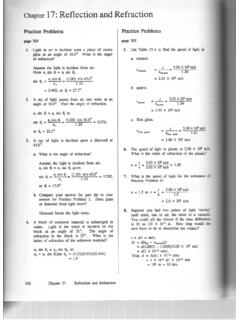
physics11witherrol.yolasite.comReflection and Refraction A ray of light travels from air into a liquid. The ray is incident upon the liquid at an angle of 30.00. The angle of refraction is 22.00. a. What is the index of refraction of the liquid? sin sin sin 30.00 = 1.34 sin 22.0 189
Reflection and Refraction Lab - Mrs. Roche's Physics I I
mrsrochephysics.weebly.comof refraction and reflection. Some of these are: why do fish look larger in the water, what causes a spoon to appear bent in a glass of water, why does light travel indefinitely in an optical cable, and, of course ,how are rainbows, and mirages formed, etc. Spring 2009 ‐ Home Lab – Week 5 ‐ Refraction of Light ...