Transcription of GERMAN TANK MAINTENANCE
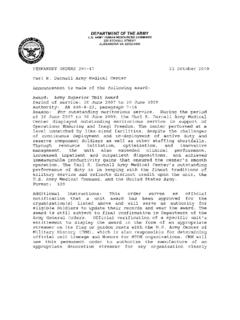
1 DEPARTMENT OF THE ARMY PAMPHLET NO. 20-202 mSTORICAL STUDY GERMAN TANK MAINTENANCE IN WORLDWARII DEPARTMENT OF THE ARMY JUNE 1954 'No. 2(}-201 2(}-230 2G-231 20-282 20-233 20-234 20-236 20-240 20-242 20-260 20-269 20-290 20-291 20-292 Department of the M-my ~pbleta Publfabed n the GERMAN REPORT SERIES J>.lllfeatln Tllll . ~aU Military Improvisations During the Russian Campaign _____ . Aug 51 Russian .Combat Methods in World War II, _____ . Nov 50 Combat in Russian Forests and --Jul 51 Airborne Operatioria: A GERMAN :-Oct 61 GERMAN Defense Tactics Against Russian Break-Throughs----Oct 61 Operationa of Enc:ii-cled Fortes: GERMAN Experiences in Ruasia. _ Jan 62 Night -------------------,..- -----------------. Jun 68 Rear Area Security in :auesia _____ :. ____ Jul 61 GERMAN Armored Traffic Contsrol During the Ruealan Cam- palgn.))
2 ~--------------------------------------- -------Jun 52 The GERMAN Campaigns hi the Balkana (Spring 1941) ____ . ___ Nov~ Small Unit Actions During GERMAN Campaign In ' Jul 53 Terrain Factors in the Ruaaian Campaign _____ :. _____ : ___ Jul 61 Effects of CUmAte on Combat in European Ruseia_____ Feb 62 Warfare Jn the Far North-------------------------------'- Oct 61 DEPARTMENT OF THE ARMY GERMAN TANK MAINTENANCE IN WORLD WAR II DEPARTMENT OF THE ARMY NO. 20-202 JUNE 1954 DEPARTMENT OF THE ARMY WASHINGTON 25, D. C., ~5 June 1954, DA Pamphlet 20-202 is published for the information and use of all concerned. [AG 3M (26 Apr. M)] BY OBDER OJ' THI!l SEOBETABY OJ' THI!l AB:u:Y: OJ'J'ICIAL: M. B. RIDGWAY, General, United. 8tatea Jtrmv, ot Staff. JOHN A. KLEIN, Major General, United.
3 States Jtnny, The . General. DI6 TBIB'O'l'ION ; II Active Army: Gen Statr, DA (5) SS, DA (5) Tee Svc DA, (26) Admin & Tee Svc Bd (10) AFF (10) OS Maj Comd (50) Armies (10) Corps (10) NG: State AG (1). : None. In!, Div (2) Armored Div (8) In! Brig (3) Armored Gp (8) Armored Bn ( 4) Gen & Br Svc Scb (25) PMST ROTC units (1) Mil Dist (1) Unless otherwise noted, distribution appUes to ConUS and overseas. For explanation of abbreviations used, see SR 820-50-1. Facsimile Edition Center of Military History United States Army Washington, , 1982 FOREWORD The material for this pamphlet was prepared for the Historical Division, EUCOM, by a. group of former GERMAN generals, general sta1f officers, and tank MAINTENANCE specialists. The principal author, General Burkhart H.
4 Mueller-Hillebrand, served as aide to the Chief of the Army General Sta1f before assuming command of an armored regiment on the Russian front. Successively appointed chief of staff of a panzer corps and a panzer army, he saw action in the Ukraine, Poland, and East The reader is reminded that all publications in the GERMAN RE-PORT SERIES were written from the GERMAN point o view, and that the procedures of the GERMAN Army normally differed widely from those of the United States Army. " GERMAN Tank MAINTENANCE in World War II" will be of interest to persons who want to compare the United States and GERMAN systems of tank MAINTENANCE . Ill ' I CONTENTS CHAPTER 1. INTRODUCTION Page I. The Centralized Tank MAINTENANCE System -------1 II. The Collapse of the Centralized System.
5 _. - -------2 III. Decentralization __ ---------- ----------- ---8 IV. New tanks versus Spare -- CHAPTER 2. ORGANIZATION AND EQUIPMENT I. GenenU------------ ------------- ------ ------------5 II. The Tank MAINTENANCE Detachment_____ 5 Ill. The Tank MAINTENANCE CompanY----------- -----------6 IV. Nonorganlc Tank MAINTENANCE Units_____ 14 V. Automotive - -------- ------------14 CHAPTER 3. OPERATING PROCEDURES I. --------------------------------- -----------17 II. The Tank MAINTENANCE Detachment_____ 17 III. The Tank MAINTENANCE CompanY---------- ------ ----17 IV. The Casual Company ----- -- _____ -------------20 V. Spare Parte Supply_____ 21 VI. Depot MAINTENANCE Installations_____ 26 VII. ~nin8------------- - ----- - ----- -------------29 CHAPTER 4.
6 OPERATIONS I. In BivouaC------- - - -- ----------- - - -------32 II. On the March. _____ _____ ._-----____ 32 III. Before and During an - ------ - - - --------33 IV. During Advance and Pursuit-------------------- ------34 V. After an ------- - -------------------------35 VI. In Statio Situations_____ 37 VII. On the -- - - -- --------- -37 VIII. During a Retrograde Movement ------ - -----------39 CHAPTER 5. CONCLUSIONS I. General--------------------------------- -------------41 II. Basic Principles __ _. _____ _____ __ _____ -------41 III. Summary -------------------------- -------------- 44 MAPS AND CHARTS General Reference MaP------------------------------------- -------vi Chart 1-Qrganlzation of a GERMAN Tank MAINTENANCE Detachment_____ 7 Chart 2--0rganlzation of a GERMAN Tank MAINTENANCE Company_____ 8-9.
7 , ~ GENERAL REFERENCE MAP .,o , r.,..;o 120 .,. IIILt~ - u. s. s. II. ~ v .. ,, .. , -"\ ~< ' u II K E y . /"'' CHAPTER 1 INTRODUCTION I. The Centralized Tank MAINTENANCE System Even before the outbreak of World War II, GERMAN experts in armored warfare realized that a well-functioning tank MAINTENANCE system would be essential. Initially, a centralized system was planned in which only minor repairs would be carried out in the field, and tanks that had sustained more serious damage would be returned to the factory of origin in the zone of interior. During the short Polish campaign in September 1989, this system worked well and very few difficulties were encountered. As soon as Poland had been conquered, the armored divisions returned to their respective peacetime garrisons in Germany, where all vehicles were quickly r epaired and restored to maximum efficiency at depot main-tenance installations and tank production plants.
8 The French campaign of 1940 presented only a few main-tenance problems. Minor organizational deficiencies that had first cropped up during the Polish campaign were corrected and the strength of the organic MAINTENANCE personnel was inc~sed. A large tank spare parts depot, from which the armored forces drew their sup-plies, was established in northern France. At the end of the cam-paign, which lasted only 6 weeks, most of the armored divisions returned once more to their garrisons in Germany. Those divisions remaining in France were able to utilize the services and facilities of the many former French Army repair shops. Moreover, the distance to the tank factories in Germany was relatively short. AB a result, all armored divisions were combat-ready shortly after the conclusion of the French campaign.
9 During the campaigns in the Balkans in the spring of 1941 the Ger-mans committed numerous panzer divisions. These campaigns were also short and involved few tank losses, most of them caused by bad road conditions and accelerated march movements during which it was not always possible to perform preventive MAINTENANCE . After the conclusion of the operations against Yugoslavia and Greece, the armored divisions were rehabilitated in the zone of interior and trans-ferred to assembly areas for the campaign against Russin. 1 2 GERMAN REPORT SOliS When GERMAN armored units first landed in North Africa in Feb-ruary 1941, it was realized that a rigidly centralized MAINTENANCE sys-tem was not feasible in the new theater. Since relatively few damaged tanks could be returned to the zone of interior, greater emphasis had to be placed on field MAINTENANCE .
10 As the GERMAN Army became more heavily engaged in .Russia, the supply situ11;tion within the North African theater grew precarious and tank MAINTENANCE personnel had to rely mainly on improvisation and cannibalization. For the Russian campaign the Germans intended to apply a. slightly modified, but essentially centralized system of tank MAINTENANCE . Most of the tank repairs were still to be performed in the zone of in-terior. On the other hand, each of the three army groups in tb& Russian theater was to have a spare-parts depot. Improved main-tenance vehicles, recovery vehicles, and better shop equipment wer& issued to the MAINTENANCE units in the field. No further planning was considered necessary because both the military and the political leaders assumed that military operations would reach their climax du~ing the autumn of 1941 and that most of the armored forces would return to Germany before the winter.