Transcription of Ghost Dances by Christopher Bruce ... - Rambert Dance …
1 Ghost Dances by Christopher Bruce Study Notes Rambert Ghost Dances Study Notes p2 These notes were compiled and written in 2000 and have not been rewritten for the new specifications for exams in AS and A level Dance from 2017 onwards, although it is hoped that these notes will be a starting point for further work. Some of the material was adapted or reproduced form earlier resource packs. We would like to thank Christopher Bruce CBE (choreographer) and Michele Braban (choreologoist) for their help in compiling this resource. Practical workshops with Rambert are available in schools or at Rambert s studios.
2 To book, call 020 8630 0615 or email This material is available for use by students and teachers of UK educational establishments, free of charge. This includes downloading and copying of material. All other rights reserved. For full details see Rambert Ghost Dances Study Notes p3 Contents About Ghost Dances page 3 Characters Television and video recordings Music recordings Background to the work page 6 Bruce and human rights Ghost Dances in the context of Christopher Bruce s work Creation 1973 military coup in Chile Victor Jara Inti-Illimani and the New Chilean Song Movement North American Ghost Dances Features of the production page 11 Music Design Set Costumes Lighting The Dance page 17 Overall structure Choreographic language An evolving Dance Key movement phrases Individual sections Bibliography page 25
3 These Study Notes are intended as a companion to the Ghost Dances Teachers Notes, which include information on the work, critical responses and suggestions for practical work, and are also available. Rambert Ghost Dances Study Notes p4 About Ghost Dances Choreography by Christopher Bruce Music South American Folk Music arranged by Nicholas Mojsiejenko from recordings by Inti-Illimani Ojos Azules, Huajra, Dolencias, Papel de Plata, Mis Llamitas, Sicuriadas Set design by Christopher Bruce Costume designs by Belinda Scarlett Lighting by Nick Chelton Running time approximately 30 minutes Cast: 11 dancers (5 women and 6 men) Ghost Dances was created for Ballet Rambert (as Rambert Dance Company was then known) and first performed on 3rd July 1981 at the Bristol Theatre Royal (Old Vic).
4 It remained in the Company s repertoire for four consecutive seasons and was revived by Rambert on 24th June 1999 at the Theatre Royal, Norwich. It was nominated for the 1982 Society of West End Theatre Awards as the Outstanding Achievement of the Year in Ballet. It has also been performed by Nederlands Dans Theater, Australian Dance Theatre, Cullberg Ballet, Zurich Ballet, Ballet Gulbenkian, Houston Ballet and Ballet du Grand Th tre de Gen ve. Ghost Dances is a one-act Dance work in which three skeletal Ghost Dancers await a group of Dead who will re-enact moments from their lives before passing on. I made this ballet for the innocent people of South America, who from the time of the Spanish Conquests have been continuously devastated by political oppression.
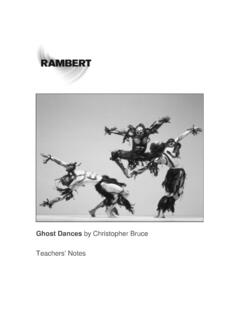
5 I would like to give my thanks to Joan Jara for all her help and to Inti-Illimani for the inspiration of their performances. Christopher Bruce (Programme note July 1981) Characters The Ghost Dancers The Ghost Dancers (sometimes referred to as White Ghosts) are three skeleton-like men with skull masks and long, matted hair. They are present on stage throughout the production from the moment the curtain rises to the point at which it falls, apparently awaiting their next consignment of the Dead. Interviewed for BBC Radio 4 s arts programme Kaleidoscope on 12th October 1981, Christopher Bruce described them as having hung around for millions of years, and lying on rocks, animals.
6 They d become birds and lizards as well as men. These are symbolic creatures who may be said to be spirits, guardians of the rocky, barren noman s land at the mouth of the cave where the work is set, oppressors, murderers, forces of dictatorship, or death itself. Rambert Ghost Dances Study Notes p5 The Dead The Dead are five women and three men who throughout the work experience contrasting forms of death. The Dead enter as a group upstage left soon after the music begins, all remain on stage during the work, and exit together downstage right at the end. The precise relationship between characters is open to individual interpretation by the viewer but as they arrive and depart together, and are all present on stage from the point of their entry to that of their departure, there is a clear sense that they form a community.
7 The clothes worn by the Dead suggest a variety of social backgrounds. Bruce described this group as on their way to Heaven or Hell , wandering from life to death. It is like their last remembrances, their last statements, before they go very proudly at the end, to death (Kaleidoscope 12th October 1981) The choreographer George Balanchine once noted that there are no mother-in-laws in ballet ; that complex genealogical relationships cannot be conveyed through Dance . In Ghost Dances , the audience is free to interpret any relationships between the men and women as they like; A woman may be the mother, wife, lover, daughter or friend of a man.
8 Nevertheless most people have regarded the couple of the first duet as more mature than those in the playful second duet. Both the costumes and the nature of the choreography suggest characters without making any individuals overly specific. Interpretation by individual dancers will also affect how a role is perceived. Television and video recordings Ghost Dances was created to be performed on stage and its fullest impact is experienced when viewing a live performance. Nevertheless those studying the production will find it convenient to refer to the recorded versions of the work. Discussion in these notes therefore focuses on Rambert s stage performances and the videos by Ballet Rambert and Houston Ballet.
9 (Only the Houston Ballet recording was commercially available in Britain, this has since been discontinued.) Ghost Dances has been televised in two versions. The earlier, danced by Ballet Rambert , was for Dance on 4 and first shown in a double bill with London Contemporary Dance Theatre in Robert North s Troy Game on 15th June 1983. The second, performed by Houston Ballet, was first shown in Britain (together with Bruce s Journey) on BBC2 Summer Dance on 1st August 1993. The dancers in the Rambert recording have a vibrant roughness while those in the Houston recording are lighter, neater and more controlled, partly indicative of the performers heritage as a classical ballet company.
10 The Rambert recording, with the original cast, was filmed hurriedly on the stage of the old Sadler s Wells during the afternoon of 24th March 1982 in the middle of Ballet Rambert s London season, without the supervision of Christopher Bruce . The opening sequence was treated with the multiple superimposition of frames showing the passage of movement in frozen images. Wind and bird noises and echoes were added to the sound track for the Ghost Dancer s Dances and the interludes between numbers which, in live performance, had been performed unaccompanied. (Wind sounds have subsequently been added to the introductory Ghost Dancers Dance on stage.)