Transcription of Swansong by Christopher Bruce - Rambert
1 Swansong by Christopher Bruce Teachers Notes Rambert Swansong Teachers Notes p2 This pack was compiled by Rambert and has not been rewritten for the new specifications for exams in AS and A level Dance from 2017 onwards, although it is hoped that these notes will be a starting point for further work. Some of the material was adapted or reproduced form earlier resource packs. We would also like to thank the following individuals for their invaluable help in compiling these notes: Christopher Bruce Choreographer and Former Artistic Director, Rambert Dance Company Michele Braban Choreologist and Rehearsal Director, Rambert Dance Company Philip Chambon Composer Stuart Sweeney and Dan Jones Amnesty International UK Practical workshops with Rambert are available in schools or at Rambert s studios.
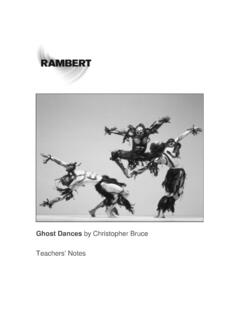
2 To book, call 020 8630 0615 or email This material is available for use by students and teachers of UK educational establishments, free of charge. This includes downloading and copying of material. All other rights reserved. For full details see Cover photo: Robin Gladwin, Renaud Wiser and Eryck Brahmania in Swansong Photo: Anthony Crickmay Rambert Swansong Teachers Notes p3 Contents Page 4 Introduction 5 Section1: General information Structure of Swansong 6 Dance styles used 8 Characterisation and interpretation 10 Summary of characteristic elements in Christopher Bruce s choreography 12 Music for Swansong 16 Design for Swansong 18 Section 2: Appreciating Swansong 19 Worksheet 1: Music and Design 19 Critical responses to Swansong in performance 22 Worksheet 2: Writing an appreciation of dance 24 Worksheet 3.
3 Appreciating Swansong 26 Section 3: Practical work 27 Workshop 1: The Chair 28 Workshop 2: Exploring the Trio 30 Workshop 3: Questions and Answers 33 Workshop 4: Freedom 36 Section 4: Swansong Across the Curriculum Ideas for further development of the main themes Rambert Swansong Teachers Notes p4 Introduction These Teachers' Notes are intended as a companion to the Swansong Study Notes, which contain detailed background information on Swansong and are also available from Rambert . Swansong was a set work on the 2000 syllabus for both GCSE and A Level Dance have not been rewritten for the new specifications for exams in AS and A level Dance from 2017 onwards, although it is hoped that these notes will be a starting point for further work.
4 Some of the material will be more appropriate for teachers of GCSE Dance, some may be useful for teachers of A and A/S Level Dance, but it is hoped that these notes will be a starting point for further work. Also included are suggestions for using Swansong across the curriculum, with ideas which could be pursued in English and Drama, as well as in Dance lessons. Rambert Swansong Teachers Notes p5 Section 1. General information Swansong was choreographed by Christopher Bruce in 1987 for London Festival Ballet (now called English National Ballet). The recorded music score was composed by Philip Chambon, commissioned by London Festival Ballet.
5 The design was by Christopher Bruce and the lighting was designed by David Mohr. Swansong lasts 32 minutes and has a cast of three dancers. Structure of Swansong For a detailed analysis of the dance and background information please refer to the Swansong Study Notes. Swansong is divided into seven sections, described throughout these notes as follows: Section 1 (Questions and answers) Section 2 (Tea for Two) Section 3 (First solo) Section 4 (Slow trio) Section 5 (Second solo) Section 6 (Cane dance) Section 7 (Third solo) Rambert Swansong Teachers Notes p6 Dance styles used Christopher Bruce 's choreography for Swansong incorporates a variety of dance styles, including contemporary, ballet, jazz, tap and ballroom.
6 The inclusion of 'folk' styles is a typical feature of Bruce 's choreography and can be seen particularly in Ghost Dances (1981) and Sergeant Early's Dream (1984). In Swansong balletic movements, such as arabesques, attitudes and jet s combine with the low centre of gravity, spiralling torso and use of off-balance from contemporary dance to create a lyrical feel for the victim's solos. The images of flight, or birds, could be seen to relate historically to ballets like Swan Lake or The Dying Swan (the solo choreographed by Fokine). In Swansong the victim's movements use an extended body line, typical in ballet, but the contemporary element, with strong use of the back is also very evident.
7 Some movements from jazz technique, such as the slide to the floor, can also be seen in the victim's movement material and jazz is combined with tap dance and movements inspired by vaudeville, in the interrogators' dance sequences. Acrobatic movements, like cartwheels and handstands are also used, together with a variety of lifts in the trio sections. Jazz Dance Jazz dance has its roots in African rhythms brought to the USA with the slave trade at the beginning of the 19th century. African dance reacts strongly to the beat of the drums and features a low stance with gyrating hips and a rippling spine.
8 As black slaves developed jazz music, jazz dance, with its twisting and hip-wiggling, began to emerge. This style of movement fed into many social dances, such as tango and rumba. Jazz dance gradually became a recognized technique as dancers like Katherine Dunham and Pearl Primus researched traditional African and Caribbean dances and adapted them for the stage. The technique is physically demanding, like ballet and contemporary and features isolation of different body parts, reflecting the multiple rhythms of the music. Tap Dance American tap dance developed alongside jazz dance and blended African dance styles with European clog dancing and Irish step dancing, developing from the immigrant population of the era.
9 Some of the movements in Swansong are familiar from the films of famous dancers like Fred Astaire and Ginger Rogers, who danced in the European style with an upright, smooth line, and Gene Kelly, whose dancing was more closely related to jazz, from the numerous black influences. However, Christopher Bruce 's inspiration for the tap sequences went back further than these old films to music hall or vaudeville. Music hall / Vaudeville Music hall was a popular form of entertainment during the nineteenth century. Until the 1880s the principal element was song, but in the last two decades of the century variety Rambert Swansong Teachers Notes p7 shows featuring comedy routines became popular and took place in larger halls, usually specifically constructed theatres, to reach a wider audience.
10 In the 1890s, under the influence of America, syncopated song and dance began to be included in the variety shows, followed in the early part of the twentieth century by ragtime. The comedy acts of the variety shows often used loosely constructed satire, which in turn may have derived from eighteenth century French theatre, which satirised contemporary events. Music hall continued to be popular until the Second World War and provided a training ground for many well known stage, screen and radio performers who perfected short acts to suit their individual style. The term 'vaudeville' is the American equivalent of music hall and is generally understood to suggest dramatic sketches interspersed with song and dance acts, a reflection of late music hall.