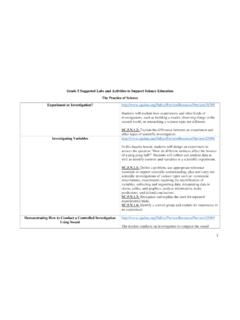
Transcription of Grade 3 Science Toolkit - fldoe.org
1 Grade 3 Science Instructional Focus / Toolkit The Grade 3 Science Instructional Focus Toolkit has been created to assist teachers in identifying activities that are well aligned to the benchmarks. This Toolkit is not intended to replace your district's curriculum or to be solely used to address the benchmarks. Care was given to identify multiple activities that could be executed via hands-on inquiry, virtually and in some cases infused with the literacy block. Resources have been pulled from CPALMS as well as PBS Learning Media.
2 If you don't already have one, you will want to create an account for use with PBS Learning Media. The account is free and gives you access to a multitude of resources. For all activities, a materials list resides on the first page once you click the link. There may be materials listed that are not accessible to you. Do not let this discourage you. There are talking points and alternative activities built within the resources. Again, the Toolkit serves as a suggestion of activities that can be used to support your instruction.
3 To register for a free PBS Learning Media account go to: Benchmark Verbiage Instructional Resources Guidance and Vocabulary Describe the Structure and The Life Cycle of Plants (Virtual Manipulative). structures in functions of major plants and parts of plants are their roles in limited to stem, Think Garden: Plant Structure (Video). food leaf/needle, root, production, flower, seed and 8650f9429c01/think-garden-plant-structur e/. support, water fruit. This video from KET's Think Garden collection examines plant structure by taking a and nutrient closer look at the root and shoot systems.
4 Learn about roots, stems, leaves, flowers, transport and seeds and fruit through engaging illustrations and animations. reproduction. Parts of a Plant In this lesson, third Grade students learn the basic functions of a plant and recognize their importance (flower, stem, seed, leaf and roots). The lesson will provide students the opportunity to review parts of a plant with a five flap activity. *materials list available by clicking link Text Complexity Resource to support content in literacy block Parts of a Plant 1. Investigate Plant's response to A-maze-ing Plants and describe stimuli are limited to how plants a conceptual This Engineering Design Challenge is intended to help students apply the concepts of respond to understanding of flowering plants, plant structures and plant responses to stimuli as they build mazes stimuli plant's response to to demonstrate a plants response to light.
5 It is not intended as an initial introduction (gravity, heat heat, light or gravity. to this benchmark. and light) such *materials list available by clicking link as the way Note that the terms plant stems gravitropism and Plants-in-Motion (Video). grow toward phototropism need light and their not be mastered at This interactive activity adapted from Indiana University features time-lapse videos roots grow this level although that reveal the movement and growth of plants in their pursuit of light. Although downward in they may be plants have no choice about where they are rooted, they do respond to response to introduced.
6 Environmental cues in ways that enable them to survive. gravity. Text Complexity Resource to support content in literacy block Plants Responding to Different Factors Classify Students will classify What am I? Classifying Living Things animals into animals into major major groups groups according to In this lesson, students will learn how to classify animals. First, they will learn (mammals, their physical vertebrate versus invertebrate. Next, they will learn the animal classifications: birds, reptiles, characteristics and mammal, bird, fish, reptile, amphibian and arthropod.)
7 They will practice sorting these amphibians, behaviors. animals by different attributes and then do a short research project on one animal fish, classification, which they will share with the class. arthropods, Classification of *materials list available by clicking link vertebrates vertebrates should and focus on general PBS Learning Media Animal Classification Game (Virtual Manipulative). invertebrates, physical those having characteristics and/or classification-game/. live births and behaviors of This interactive activity adapted from Sheppard Software challenges you to identify those which mammals, birds, various animals as they flash across the screen.
8 Correct recognition depends on your lay eggs) reptiles, amphibians understanding of how animals are classified according to certain physical according to and fish. characteristics and behaviors. For example, even though a butterfly and a 2. their physical Students only need hummingbird both fly, their respective body plans and other inherited traits mean characteristics to be exposed to that one is classified as an insect and the other as a bird. Similarities and differences and behaviors. common names of among living things are the result of evolution.
9 Organisms. Coverage of scientific names is not Grade level appropriate. When instructing on classification of organisms as vertebrates or invertebrates, it is helpful to include a picture of the organism. Classify Students will classify Classifying Plants flowering and flowering and/or nonflowering nonflowering plants In this lesson students watch an introductory video, read an essay and identify plants into into major groups appropriate vocabulary words" meaning within context, and complete an activity on major groups according to their plant classification.
10 During the activity, students will cut out pictures of plants from such as those physical magazines, classify them and identify similarities and differences between them. that produce characteristics. *materials list available by clicking link seeds, or those like ferns and mosses that produce spores, according to their physical characteristics. Describe how Students will describe Do not disturb! A lesson on hibernating and migration animals and or explain how plants respond animals/plants 3. to changing respond to changing Have you ever wondered why animals hibernate or why they migrate?