Transcription of Grammar 101 - Planning at Illinois
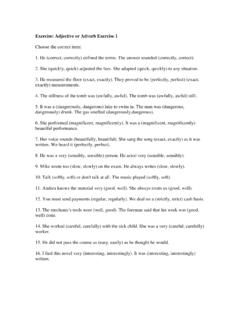
1 S Grammar 101: Adjectives, Adverbs, Articles, Prepositions, oh my! For Planners Adjectives S Adjectives modify nouns: S I ate a meal. Meal is a noun. We don t know what kind of meal; all we know is that someone ate a meal. S I ate an enormous lunch. Lunch is the noun, and enormous is an adjective that modifies it. It tells us WHAT KIND OF meal the person ate. Adjectives S Adjectives usually answer one of a few different questions: S What kind? S Which? S How many? S Examples: S The tall girl is riding a new bike S Fifteen students passed the midterm exam; twelve students passed the final exam Adjectives S Most of the time, adjectives come before nouns. However, when they come after the nouns they modify, they usually follow a verb like: be, feel, taste, smell, sound, look, appear, seem S Examples: S The dog is black [black = adjective, is = form of verb to be ] S Brian seems sad [sad = adjective, seem = verb] S The speaker sounds hoarse [hoarse = adjective, sound = verb] Adverbs S Adverbs modify verbs, adjectives, and other adverbs (sometimes they are easily recognizable because many of them are formed by adding ly to an adjective) S Adverbs answer the question HOW S Examples: S She sang beautifully S The cellist played carelessly S That woman is extremely nice S It was a terribly hot afternoon Adverbs: Common errors S Bad vs.
2 Badly: S I feel bad = describing the way you feel S I feel badly = you are unable to feel, hands are numb (similar to saying I play football badly ) S The dog smells badly = The dog cannot smell very well S The dog smells bad = The dog needs a bath Adverbs: Common errors S Good vs. Well: Good is an adjective, so you do NOT live good you live well S My mother looks good = she appears healthy S I feel really good today = I do not touch things successfully, I am happy or healthy Adverbs: Common errors Sure vs. Surely: Sure is an adjective, surely is an adverb. He is sure about his answer = sure describes HE The Senator spoke out surely = surely describes HOW S. spoke Near vs. Nearly: Near can be a verb, adverb, adjective or preposition, nearly is used as an adverb to mean in a close manner, or almost but not quite I ll be seeing you in the near future The cat crept near Don t worry, we re nearly there Articles S Articles MODIFY nouns (just like adjectives) S English has two articles: S THE = definite article: used to refer to specific or particular nouns S A/AN = indefinite article: used to modify non-specific or non-particular nouns Definite and Indefinite Articles S The is used to refer to a specific or particular member of a group.
3 S Let s read the book = Let s read a specific book S I just saw the most popular movie of the year = There are many movies, but only one particular movie is the most popular S A/an is used to refer to a non-specific or non-particular member of the group. S Let s read a book = Let s read any book S I would like to go see a movie = Not talking about a specific movie, talking about any movie, don t have have a specific one in mind S However, there are ALWAYS EXCEPTIONS! Definite Articles: Exercise S ____ dog that bit me ran away S I was happy to see ____ policeman who saved my cat! S I saw ____ elephant at the zoo S He spilled ____ milk all over the floor S I love to sail over ____ water Indefinite Articles: Usage Rules S Choice of indefinite article is based on the phonetic (sound) quality of the first letter in the word following it, not the orthographic (written) representation of the letter. S If the first letter makes a vowel-type sound, you use an ; if the first letter would make a consonant-type sound, you use a.
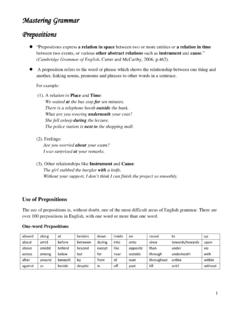
4 S However, there are ALWAYS EXCEPTIONS! Indefinite Articles: Examples S An goes before words that begin with vowels: S An apricot S An egg S An orbit S An uprising S An office S A goes before words that begin with consonants: S A cat S A dog S A purple onion S A buffalo S A big apple Indefinite Articles: Exceptions S Use an before any unsounded h. Because the h hasn t any phonetic representation and has no audible sound, the sound that follows the article is a vowel; thus, an is used. S An honorable peace S An honest error S An hour Indefinite Articles: Exceptions S When u makes the same sound as the y in you, or o makes the same sound as w in won, then a is used. The initial word sound y ( unicorn ) is actually a phonetic glide that has consonantal properties; thus, it is treated as a consonant a is used. S A union S A united front S A used napkin S A ship S A one-legged man S A useful tool Indefinite Articles: Exercise S ____ broken egg S ____ unusual problem S ____ European country S I am ____ teacher S Brian is ____ Irishman S Seiko is ____ practicing Buddhist Prepositions: Definition S Prepositions are used for Time, Place, and Introducing Objects S I will see you on Monday S I m going to Paris for two weeks S There is a wasp in the room S Hang that picture above the couch S She glanced at her reflection S I m looking for my keys Prepositions: Time S One point in time: S On is used with days: S I will see you on Friday for our PWE lunch session S The week begins on Sunday S At is used with noon, night, midnight, and with the time of day: S My plane leaves at noon S The movie starts at 6:00 S In is used with other parts of the day, months, years, seasons.
5 S He likes to read in the afternoon S The days are long in August S The book was published in 1999 Prepositions: Time (cont d) S Extended time: To express extended time, English uses the prepositions since, for, by, from-to, from-until, during, (with)in: S She has been gone since yesterday S I m going to Paris for two weeks S The movie showed from August to October S The decorations were up from spring until fall S We must finish the project within the semester Prepositions: Place S To express notions of location: S To talk about the point itself: IN S To express something contained: INSIDE S To talk about the surface: ON S To talk about a general vicinity: AT S There was a wasp in the room S Put the present inside the box S She was waiting at the corner S I left your keys on the table Prepositions: Place (cont d) S Higher than a point: over above S He threw the ball over the roof S Hang that picture above the couch S Lower than a point: under underneath beneath below S The rabbit burrowed under the ground S The valley is below sea level S Close to a point: near by next to between among opposite S She lives near the school S I found my pen lying among the books Prepositions: Introducing Objects S At: glance, laugh, look, rejoice, smile, stare S Of: approve, consist, smell S Of (or about): dream, think S For: call, hope, look, wait, watch, wish Prepositions.
6 Introducing Objects (cont d) S She glanced ____ her reflection S I m looking ____ the computer monitor S Stop staring ____ me S I don t approve ____ his speech S My contribution to the article consists ____ many pages S I dream ____ finishing college in four years S I am thinking ____ this problem S Did someone call ____ a taxi S He hopes ____ a raise in salary S I you wish ___ an A in this class, you must work hard Final Grammar Review: S Adjectives modify nouns; answer questions of what kind, which, how many S Adverbs modify verbs, adjectives, and other adverbs (sometimes they are easily recognizable because many of them are formed by adding ly to an adjective); answer question of how S Articles modify nouns, there are two different types: definite (the) and indefinite (a/an) S Prepositions are used for time, place, and introducing objects: on, at, in, inside, since, for, by, from-to, from-until, during, (with)in, over, above, under, underneath, beneath, below, near, by, next to, between, among, opposite, of Sources: S ALL MATERIAL used in this presentation was from the Purdue Online Writing Lab (OWL) website, which has an AMAZING collection of writing resources, very logically and clearly organized: S Info on Adjectives: ; S Info on Adverbs: S Info on Articles: ; S Info on Prepositions: ; ; ; S All exercises can be found here: Looking Ahead: More PWE Lunch Sessions!
7 S Writing effectively with statistics S Using pronouns correctly S How to compose transitions between paragraphs S Strategies for sentence variety: adding complexity to your writing S How to use outlining effectively to organize a paper S Essay writing: different styles for different assignments ( argumentative, expository, descriptive, narrative) S Using the active voice