Transcription of grammar section Present tenses
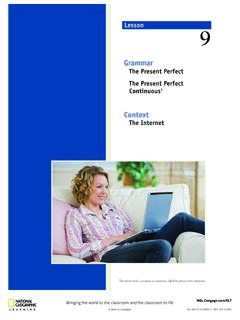
1 Cambridge University Press978-1-107-48106-0 grammar and Vocabulary for First and First for SchoolsBarbara Thomas Louise Hashemi and Laura MatthewsExcerptMore information in this web service Cambridge University listening 1 You are going to hear Millie talking on her phone to her friend Lisa. It s Saturday morning. Before you listen, answer these Where is Lisa? 2 Where is Millie? 3 Why do you think Millie is phoning Lisa? 2 02 Listen and check if you were right. 3 02 Listen again and answer these questions. Write complete What s Millie doing this morning? She s looking round the What does she do nearly every Saturday? 3 What s she looking for?
2 4 What s Lisa wearing? 5 What s she doing this morning? 6 What does she do whenever she goes to town? 7 What s Millie looking at right now? 8 What does Lisa want Millie to do now? 4 Look at your answers to Exercise 3 and answer these questions. 1 Look at answers 2 and 6. What tense are they? 2 Look at answers 1, 3, 4, 5 and 7. What tense are they? 3 Which sentences are about regular actions? 4 Which sentences are about actions at or around the time of speaking? 5 Look at answer 8. Does it fit the pattern? AMillieLisa12 Present simple; Present continuous ; state verbs; the verb to be1 Present tensesgrammar sectionCambridge University Press978-1-107-48106-0 grammar and Vocabulary for First and First for SchoolsBarbara Thomas Louise Hashemi and Laura MatthewsExcerptMore information in this web service Cambridge University 1 Present simple+verb / verb + -s She works in London.
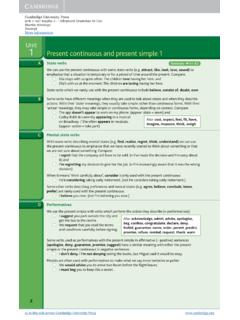
3 Do/does not + verbHe doesn t work in .. + verb?Where do you work?We use the Present simple: to say when things happen if they take place regularly:They eat lunch at two o clock. to talk about permanent situations:I work in London. to state general truths: Those bags sell really fast. The moon goes round the earth. to talk about habits and how often they happen:You buy new clothes every Saturday. to describe the plots of books and films:The story begins and ends in Spain. The year is 1937. 2 Present continuous +am/is/are + verb + -ingHe s working in London this week. am/is/are not + verb + -ingI m not working in London this .. + verb + -ing?
4 Are you working in London this week?We use the Present continuous : to talk about the Present moment:I m wearing a pair of old jeans. I m looking at a blue bag right now. to suggest that an action is temporary, often with words like now, at the moment, at Present or just:They re eating lunch at the moment. I m working in London this week. (= I don t usually work in London) for an action around the time of speaking, which has begun but is not finished:I m cleaning my room. I m looking round the shops. (Millie isn t looking round at this moment she has stopped to talk to Lisa but she plans to continue looking round later.) for changing or developing situations:Navy blue bags are getting really Earth s temperature is rising.
5 With a word like always or continually if we want to criticise or complain:Yo u re always buying new clothes! (= you buy too many) He s always complaining about things. with always when something unexpected happens several times:I m always meeting my neighbour John near the station. I guess he works somewhere near tenses 1 Cambridge University Press978-1-107-48106-0 grammar and Vocabulary for First and First for SchoolsBarbara Thomas Louise Hashemi and Laura MatthewsExcerptMore information in this web service Cambridge University 3 State verbsThese verbs are nearly always used in a simple rather than a continuous tense. They are mostly about thoughts, feelings, belonging and the senses.
6 That leather bag you want to get (not you are wanting to) You don t deserve to hear it. (not you aren t deserving to)The following are some important state verbs: thoughts: believe, know, mean, realise, recognise, remember, suppose, understand, feel (= believe), think (= believe):I think you re feel this decision is right. feelings: adore, dislike, despise, hate, like, love, want, wish, prefer:They despise me because of the way I m living. belonging: belong, have (= possess), own, possess:It belongs to my manager has the biggest company car. senses: smell, taste, hear, see:This sauce tastes great. I hear what you re saying to me, but I don t agree.
7 Do you see anything you want to buy here? We use can with these verbs to show we are talking about this moment:I can see you re can hear someone in the next room. other state verbs: need, contain, deserve, fit, seem, look (= seem), look like, matter, weigh:This medicine contains weighs 70 kilos.! Think is not a state verb when it refers to what someone is doing, not what they believe:I m thinking about my holiday.! Have can be continuous when it does not mean possess :Steve is having a difficult time at college this I phone you back later? We re having lunch right now.! Ta s t e and smell can be continuous when they refer to what someone is doing:I m tasting the sauce.
8 ! Listen to, watch and look at are not state verbs and can be continuous :We re listening to music and Diane is watching a DVD upstairs.! See can be continuous when it means meet with :Lara s at the medical centre. She s seeing a doctor about her sore throat.! Weigh can be continuous when it refers to what someone is doing:The shop assistant is weighing the cheese. 4 The verb to beThe verb to be is nearly always used in a simple rather than a continuous tense. When it is continuous it emphasises that a situation is temporary. It often describes a person s behaviour:Yo u re being so impatient! (Millie doesn t believe that Lisa is normally an impatient person.)
9 My brother is being very nice to me this week. I wonder what he wants!Francis is filling in a form online, so we re all being quiet as we don t want him to make any Present tensesCambridge University Press978-1-107-48106-0 grammar and Vocabulary for First and First for SchoolsBarbara Thomas Louise Hashemi and Laura MatthewsExcerptMore information in this web service Cambridge University exercises 1 Choose the correct sentence from each a My brother lives with us until he can find a flat of his own. b My brother is living with us until he can find a flat of his own. 2 a Megan goes to Hong Kong every January. b Megan s going to Hong Kong every a I don t have enough money for a long holiday this year.
10 B I m not having enough money for a long holiday this a Everyone needs a break from work sometimes. b Everyone is needing a break from work a What period of history do you study this term? b What period of history are you studying this term?6 a The team manager looks bad-tempered in public, but he s always being very kind to young players. b The team manager looks bad-tempered in public, but he s always very kind to young players. 2 Complete these sentences with the Present simple or Present continuous form of the My father knows (know) all about mending cars, but nothing about bicycles.