Transcription of Guideline on the Specification Limits for Residues …
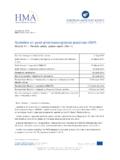
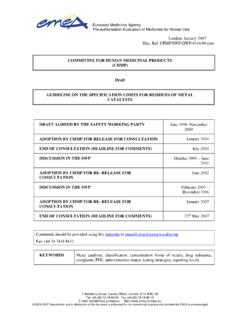
1 European Medicines Agency London, 21 February 2008. Doc. Ref. EMEA/CHMP/SWP/4446/2000. COMMITTEE FOR MEDICINAL PRODUCTS FOR HUMAN USE. (CHMP). Guideline ON THE Specification Limits FOR Residues OF METAL. CATALYSTS OR METAL REAGENTS. DRAFT AGREED BY THE SAFETY WORKING PARTY June 1998 -November 2000. ADOPTION BY CHMP FOR RELEASE FOR CONSULTATION January 2001. END OF CONSULTATION (DEADLINE FOR COMMENTS) July 2001. DISCUSSION IN THE SWP October 2001 June 2002. ADOPTION BY CHMP FOR RE- RELEASE FOR June 2002. CONSULTATION.
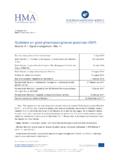
2 DISCUSSION IN THE SWP February 2003 . December 2006. ADOPTION BY CHMP FOR RE- RELEASE FOR January 2007. CONSULTATION. END OF CONSULTATION (DEADLINE FOR COMMENTS) 23rd May 2007. DRAFT AGREED BY THE SAFETY WORKING PARTY December 2007. ADOPTION BY CHMP 21 February 2008. DATE FOR COMING INTO EFFECT 01 September 2008. KEYWORDS metal catalysts, classification, concentration Limits of metals, drug substance, excipients, PDE, administration routes, testing strategies, reporting levels 7 Westferry Circus, Canary Wharf, London, E14 4HB, UK.
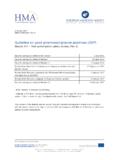
3 Tel. (44-20) 74 18 84 00 Fax (44-20) 74 18 86 13. E-mail: European Medicines Agency, 2008. Reproduction is authorised provided the source is acknowledged. Guideline ON THE Specification Limits FOR Residues OF METAL. CATALYSTS OR METAL REAGENTS. TABLE OF CONTENTS. EXECUTIVE 3. 1. INTRODUCTION (BACKGROUND) .. 3. 2. DEFINITION AND 4. 3. LEGAL BASIS .. 4. 4. MAIN Guideline TEXT .. 5. CLASSIFICATION .. 5. EXPOSURE Limits .. 5. SETTING CONCENTRATION Limits METAL Residues .. 6. 6. Pharmaceutical products applied via the oral, parenteral or inhalation route of administration.
4 6. Pharmaceutical products applied via other routes of 7. Pharmaceutical products used for short-term and for life-saving 7. ANALYTICAL PROCEDURES .. 7. BATCH RESULTS, TESTING FREQUENCY AND DELETING OF A TEST FROM THE. Specification .. 8. REPORTING LEVELS OF METALLIC Residues .. 8. 5. GLOSSARY .. 9. 6. REFERENCES (SCIENTIFIC AND / OR LEGAL) .. 11. APPENDIX 1: RATIONALE FOR PDE 12. APPENDIX 2: MONOGRAPHS ON ELEMENTS .. 14. PLATINUM (PT) .. 14. PALLADIUM (PD) .. 16. IRIDIUM (IR).. 18. RHODIUM (RH) .. 18. RUTHENIUM (RU).
5 19. OSMIUM (OS) .. 20. MOLYBDENUM (MO) .. 20. NICKEL (NI).. 22. CHROMIUM (CR) .. 23. VANADIUM (V) .. 26. COPPER (CU) .. 27. MANGANESE (MN) .. 28. ZINC (ZN) .. 30. IRON (FE) .. 31. APPENDIX 3: EXAMPLE CALCULATIONS FOR CONCENTRATION Limits .. 33. Page 2/34. EXECUTIVE SUMMARY. The objective of this Guideline is to recommend maximum acceptable concentration Limits for the Residues of metal catalysts or metal reagents that may be present in pharmaceutical substances or in drug products. A pharmaceutical substance is defined here as a substance that is either an active pharmaceutical ingredient or an excipient.
6 The metals addressed in this Guideline are normally used as process catalysts or reagents during the synthesis of pharmaceutical substances. Their use may lead to Residues in the final pharmaceutical substance, and consequently in the final drug product. Such metal Residues do not provide any therapeutic benefit to the patient and should therefore be evaluated and restricted on the foundation of safety- and quality-based criteria. The Guideline may be updated to include other metal Residues in due course. This Guideline classifies metal Residues into three categories based on their individual level of safety concern and sets concentration Limits .
7 The Limits are based on the maximal daily dose, duration of treatment, and administration route of the drug product as well as the permitted daily exposure (PDE). of the metal residue. The Guideline also includes recommendations on testing strategies, analytical procedures and reporting levels in pharmaceutical substances or drug products. 1. INTRODUCTION. Metal Residues in pharmaceutical substances or drug products may originate from several sources like metal catalysts and metal reagents used during the synthesis of the active pharmaceutical substance and the excipients, manufacturing equipment and piping, bulk packaging, the environment, cleaning solvents etc.
8 Since metal Residues do not provide any therapeutic benefit to the patient, and product risk should commensurate with the level of product benefit, the Specification of a pharmaceutical substance or the drug product may need to include a limit and validated method for metal Residues to guarantee acceptable product quality. The considerations for such a requirement should be made in a manner that is consistent with safety- and quality-based criteria as well as GMP, GDP and any other relevant provisions. The objective of this Guideline is to recommend maximum acceptable concentration Limits of metal Residues arising from the use of metal catalysts or metal reagents in the synthesis of drug substances and excipients.
9 Since the use of these metals is restricted to defined chemical reactions, limitation of their Residues in pharmaceutical substances themselves will normally be sufficient. Thus, limitation of these metal Residues in the final drug product will normally not be necessary. The concentration Limits in this Guideline are based on safety criteria and assure an adequate quality of the pharmaceutical substance and the drug product. It is therefore not considered appropriate to expect that the pharmaceutical industry tightens the concentration Limits in the regulatory dossier on basis of GMP, process capabilities, or any other quality criteria.
10 Since the origin of metal Residues is irrelevant regarding their potential toxic effects, the concentration Limits in this Guideline are in principle also applicable to Residues from other sources than catalysts and reagents. However, for these other sources adoption of a concentration limit and a validated method in the Specification is only necessary in the very exceptional cases where these Residues are known to be insufficiently limited by GMP, GDP or any other relevant provision. Pharmaceutical companies are not supposed to perform extensive tests on metal residue findings of unknown sources to comply with this Guideline .