Transcription of Guidelines for Intermittent Subcutaneous Injections
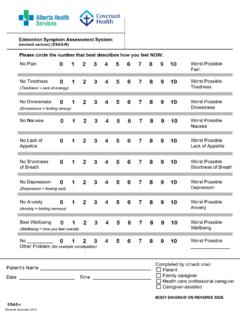
1 Seniors Health edmonton Zone Regional Palliative Care Program K:\Administration - RPCP\RPC Program Binder\SECTION 3 CLINICAL\3C assessment Tools\ Guidelines for revised edmonton symptom assessment system (ESAS-r).doc Revised: September 2010 Page 1 of 7 Guidelines Title: Guidelines for using the revised edmonton symptom assessment system (ESAS-r) Date Approved: September 16, 2010 Approved By: Practice, Development, and Quality Committee Purpose The ESAS is a tool that was developed to assist in the assessment of nine symptoms that are common in palliative care patients: pain, tiredness, drowsiness, nausea, lack of appetite, depression, anxiety, shortness of breath, and wellbeing (1). There is also a blank scale for patient-specific symptoms.
2 The ESAS has been revised to improve ease of understanding and completion for patients (2). The revised version of the tool is known as the ESAS-r. Changes include specifying a timeframe of now , adding definitions for potentially confusing symptoms, modifying the order of symptoms, adding an example for other symptom , and altering the format for improved readability. The ESAS-r is intended to capture the patient s perspective on symptoms. However, in some situations it may be necessary to obtain a caregiver s perspective. The ESAS-r provides a profile of symptom severity at a point in time. Repeated assessments may help to track changes in symptom severity over time. The ESAS-r is only one part of a holistic clinical assessment .
3 It is not a complete symptom assessment in itself. General Information How to do the ESAS-r It is recommended that the patient complete the ESAS-r with guidance from a health care professional, especially on the first occasion. The patient should be instructed to rate the severity of each symptom on a 0 to 10 scale, where 0 represents absence of the symptom and 10 represents the worst possible severity. The number should be circled on the scale. The patient should be instructed to rate each symptom according to how he or she feels now. The health care professional may choose to ask additional questions about the severity of symptoms at other time points symptom severity at best and at worst over the past 24 hours.
4 Definitions have been added to items that have been found to be more problematic for patients to understand or rate (3); it is recommended to review these with the patient: Tiredness - lack of energy py Drowsiness - feeling sleeDepression - feeling sad Anxiety - feeling nervous Wellbeing - how you feel overall Guidelines Revised edmonton symptom assessment system (ESAS-r) K:\Administration - RPCP\RPC Program Binder\SECTION 3 CLINICAL\3A Guidelines \ Revised edmonton symptom assessment system (ESAS-r).doc Revised: September 2010 Page 2 of 7 are consultants will utilize this tool upon initial assessment and at each follow-up visit. Whhlf. -r is ily member, friend, or health maining s objectively as possible.
5 The following are examples of objective dicato s resting lertness be eating, increased heart rate ellbeing how the patient appears overall regiver may indicate U for Unable to assess on the ESAS-r and ESAS-r Graph. With the previous version of the ESAS, patients often reversed the scale for appetite they considered 0 as no appetite and 10 as best appetite . The scale has now been re-labeled as lack of appetite . Coaching patients on the correct direction of the scale is still recommended. The body diagram on the reverse side of the ESAS-r can be used to indicate sites of pain. The circled numbers can be transcribed onto the ESAS-r graph. Wh ten o do the ESAS-r In palliative home care, it is a good practice to complete and graph the ESAS-r during each telephone or personal contact.
6 If symptoms are in good control, and there are no predominant psychosocial issues, then the ESAS-r can be completed weekly for patients in the home. In hospice and tertiary palliative care units, the ESAS-r should be completed daily. In other settings, palliative c o s ould do the ESAS-r It is preferable for the patient to provide ratings of symptom severity by himself/herseIf the patient cannot independently provide ratings of symptom severity but can still provide input ( when the patient is mildly cognitively impaired), then the ESAS completed with the assistance of a caregiver (a famprofessional closely involved in the patient s care). If the patient cannot participate in the symptom assessment at all, or refuses to do so, the ESAS-r is completed by the caregiver alone.
7 The caregiver assesses the resymptoms ainrs: Pain grimacing, guarding against painful maneuverTiredness increased amount of time spentDrowsiness decreased level of aNausea retching or vomiting Appetite quantity of food intake Shortness of breath increased respiratory rate or effort that appears to causing distress to the patient Depression tearfulness, flat affect, withdrawal from social interactions, irritability, decreased concentration and/or memory, disturbed sleep patternAnxiety agitation, flushing, restlessness, sw( Intermittent ), shortness of breath W If it is not possible to rate a symptom , the caGuidelines Revised edmonton symptom assessment system (ESAS-r) K:\Administration - RPCP\RPC Program Binder\SECTION 3 CLINICAL\3A Guidelines \ Revised edmonton symptom assessment system (ESAS-r).
8 Doc Revised: September 2010 Page 3 of 7 The method of completion of the ESAS-r must be indicated in the space provided at the bottom of the ESAS-r and the ESAS-r Graph as follows: Bottom of ESAS-r Numerical Scale Completed by (check one): Patient Family caregiver Health care professional caregiver Caregiver-assisted Bottom of ESAS-r Graph Insert letter from key in date column (date indicated at the top of form) Completed by Key: P = Patient F = Family caregiver H = Health care professional caregiver A = Caregiver-assisted Where to document the ESAS-r The ESAS-r is always done on the ESAS-r numerical scale and the results later transferred to the ESAS-r Graph. Graphing symptom severity directly onto the ESAS-r Graph without the use of the numerical scale is not a valid use of the ESAS-r, nor a reliable method of symptom assessment (attention to the graphed historical trend may affect the current scores and thus undermine one of the main purposes of the ESAS, to assess the current symptom profile as accurately as possible).
9 Other information about the ESAS-r The ESAS-r Graph contains space to add the patient s Folstein Mini-Mental State Examination score. The normal box refers to the cutoff for a normal score for the ). patient, based on age and education level (see Instructions for MMSE A space for the Palliative Performance Scale (PPS) is also provided. The ESAS-r is available in other languages, although most translations have not been validated (4). eferences R 1. Bruera E, Kuehn N, Miller MJ, Selmser P, Macmillan K. The edmonton symptom assessment system (ESAS): a simple method for the assessment of palliative care patients. J Palliat Care 1991; 7:6-9. 2. Watanabe S, Nekolaichuk C, Beaumont C, Mawani A. The edmonton symptom assessment system : what do patients think?
10 Support Care Cancer 2009; 17:675-683. 3. Watanabe SM, Nekolaichuk C, Beaumont C, Johnson L, Myers J, Strasser F. A multi-centre study comparing two numerical versions of the edmonton symptom assessment system in palliative care patients. J Pain symptom Manage (accepted). 4. Cancer Care Ontario: symptom assessment and Management Tools. Guidelines Revised edmonton symptom assessment system (ESAS-r) K:\Administration - RPCP\RPC Program Binder\SECTION 3 CLINICAL\3A Guidelines \ Revised edmonton symptom assessment system (ESAS-r).doc Revised: September 2010 Page 4 of 7 Additioalliative Care. Oxford: Radcliffe Medical Press, 993:61-77.. Validation of the edmonton symptom assessment cale. Cancer 2000; 88:2164-2171.