Transcription of Hamilton Rating Scale for Depression
1 Suicide Risk Screening Measures Peter M. Gutierrez, for the Military Suicide Research Consortium 26 June 2012 Statement of the Problem The Office of the Army Surgeon General requested recommendations for the most appropriate suicide risk screening measures to deploy throughout the Service, and in particular whether the Columbia Suicide Severity Rating Scale (C-SSRS) is the best option. Summary of the relevant literature A previous MSRC white paper (Gutierrez, 2011) reviewed the C-SSRS, summarizing its strengths and weaknesses and highlighted the additional research that must be conducted prior to recommending wide- Scale use of this measure.
2 The C-SSRS, and other similarly purposed clinical interviews, are appropriate and useful as part of a comprehensive assessment, but do not meet the needs of clinicians conducting a brief screening in a range of clinical settings. For screening purposes a measure which does not require extensive staff time to administer, score, and interpret is preferred. Often large numbers of individuals are screened in a short amount of time, frequently in group settings. In selecting screening measures to include in the current review, the following criteria were applied: validated for use with adults; can be administered by wide range of professionals and in multiple clinical settings ( , not limited to psychiatric applications); minimally has cut-off scores associated with a measure of self-directed violence; and ideally has predictive validity data ( , future self-directed violence).
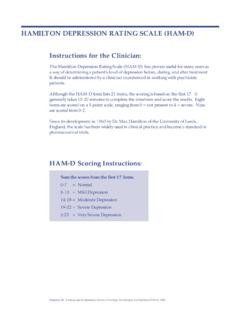
3 Despite the large number of scales that have been developed over the past 40 years for use in suicide research and clinical care, remarkably few meet the above criteria. The Hamilton Rating Scale for Depression (HRSD; Hamilton , 1960) contains a single suicide item which could be used for screening purposes. It consists of four ratings of self-directed violence related behaviors: 0 ( absent ), 1 ( feels life is not worth living or any thoughts of possible death to self ), 2 ( wishes he were dead ), 3 ( suicidal ideas or gestures ), or 4 ( attempts at suicide ). There is evidence in the published literature supporting the reliability and concurrent validity of this item (Alexopolous, Bruce, Hull, Sirey, & Kakuma, 1999; Hamilton , 1960; Williams, 1988; Trajkovic et al.)
4 , 2011). There is also unpublished data from a 2000 study (Brown et al.) supporting the predictive validity of this item. Specifically, patients scoring 2 or higher were found to be times more likely to die by suicide than those scoring below 2. The Beck Depression Inventory-II (BDI-II; Beck, Steer, & Brown, 1996) also contains a single item (number 9) specific to suicide, which can be used for screening purposes: 1 ( I don t have any thoughts of killing myself ), 2 ( I have thoughts of killing myself, but I would not carry them out ), 3 ( I would like to kill myself ) and 4 ( I would kill myself if I had the chance ). Data in support of the concurrent validity of this item are acceptable (Beck & Steer, 1987; Beck et al.
5 , 1996). Unpublished analyses from the Brown et al. (2000) study also support the predictive validity of this item. Specifically, patients scoring 2 or higher were times more likely to die by suicide than those scoring less than 2. The Suicide Probability Scale (SPS; Cull & Gill, 1988) is a 36-item self-report measure of current suicide ideation, hopelessness, negative self-evaluation and hostility. It was specifically designed to assess risk for suicide in a fairly comprehensive manner. Responses range from 1-4 on each item, generating a suicide probability score, total weighted score, and a normalized T-score. Additionally, the suicide probability score can be adjusted based on the clinical population in which it is being used.
6 There is good evidence in the published literature supporting the reliability of this measure, and adequate support for concurrent validity and sensitivity to change. The Adult Suicidal Ideation Questionnaire (ASIQ; Reynolds, 1991b) is a 25-item self-report measure of suicide ideation and behavior in adults. Respondents are asked to rate a range of items about thoughts and behaviors occurring in the previous month on a 7-point Scale of frequency. The total score is compared to an empirically derived cut-off score referenced to normative samples in order to determine if additional clinical follow-up is required. There is strong evidence in the published literature of reliability and concurrent validity for this measure (Reynolds, 1987, 1991a, 1991b).
7 Evidence supporting predictive validity (3-month follow-up suicide attempts) in psychiatric inpatients who had made a previous attempt has also been published (Osman et al., 1999). The Beck Scale for Suicide Ideation (BSI; Beck & Steer, 1991) is a 21-item self-report measure designed to assess the current intensity of the patients specific attitudes, behaviors, and plans to engage in self-directed violence over the past week. All items are rated on a 3-point Scale of intensity and generates a total score between 0 and 38. The first five items are intended to be used to screen for presence of risk, which if detected then triggers administration of the next 14 items which gather additional details.
8 The final two items do not factor into score calculations, but instead assess lifetime number of suicide attempts and the level of intent associated with the most recent. There is good evidence of this measure's reliability and concurrent validity (Beck & Steer, 1991; Beck, Steer, & Ranieri, 1988; Steer, Kumar, & Beck, 1993; Steer, Rissmiller, Ranieri, & Beck, 1993). The Suicidal Behaviors Questionnaire-Revised (SBQ-R; Osman, Bagge, Gutierrez, Konick, Kopper, & Barrios, 2001) is a self-report measure of four constructs within the suicidal behavior domain lifetime ideation and attempt, recent frequency of ideation, suicide threats, and self-assessed likelihood of future suicidal behavior.
9 It has been found to be valid and reliable across a range of clinical and non-clinical adolescent and adult samples. A cut-off score of 8 accurately discriminates between adult psychiatric inpatients with recent ideation or attempts and psychiatric controls. Gaps in the literature A limitation of all the reviewed measures is that none of the existing psychometric studies conducted to date have utilized military samples. There well may be differences in measure performance between civilian and military populations, and caution should be exercised in interpreting scores until adequate military norms are developed. Recommendation(s) As is apparent from the above review, there is a lack of published data on predictive validity for these measures.
10 Ideally, selected screening measures would derive scores that have been empirically determined to predict future suicide attempts and suicide across a range of populations ( , primary care, outpatient behavioral health). A study is currently underway in the MSRC (see Joiner, 2011 and update 2012) designed to gather exactly this type of data by testing the predictive validity of two suicide-specific clinical interviews and two self-report measures. However, that study is intended to answer the question of what is the gold standard suicide assessment, not what is the most useful screening measure. Of the measures reviewed, only the BDI-II, HRSD, and ASIQ have data on predictive validity, and only data for the ASIQ have been published.