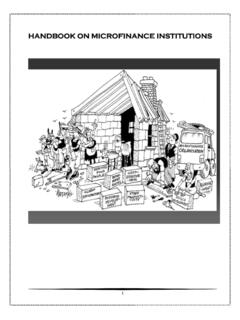
Transcription of HANDBOOK ON MICROFINANCE INSTITUTIONS
1 HANDBOOK ON MICROFINANCE INSTITUTIONS . 1. INDEX. CHAPTERS PARTICULARS. 1 BIRTH OF MICROFINANCE . HISTORY. WHAT IS MICROFINANCE ? HOW DOES MICROFINANCE HELP THE POOR? 2 GLOBAL IDEA OF MICROFINANCE . 3 MICROFINANCE SECTOR IN INDIA. MAJOR AND RELATIVELY RECENT DEVELOPMENTS IN THE. MICROFINANCE SECTOR. BANKING CORRESPONDENT MODEL AND BANKING FACILITATOR. MICRO FINANCE INSTITUTIONS (DEVELOPMENT AND REGULATIONS). BILL 2011. 4 LEGAL FRAMEWORK. SOCIETIES REGISTRATION ACT, 1860. INDIAN TRUSTS ACT, 1882. NOT-FOR-PROFIT COMPANIES REGISTERED UNDER SECTION 25 OF. COMPANIES ACT, 1956(Ref. Section 8 under Companies Act 2013). NON BANKING FINANCIAL INSTITUTIONS .
2 NIDHI COMPANIES(Ref. Section 406 under Companies Act 2013). 5 PRODUCTS OF MICROFINANCE . OBJECTIVE. MICROSAVINGS. INSURANCE. REMITTANCE. NON-FINANCIAL PRODUCTS. INVESTMENT CRITERION. JOINT LIABILITY GROUP PRODUCT. 6 FINANCIAL INCLUSION AND RBI MANDATE. 2. 7 FINANCIAL REPORTING OF MICROFINANCE . TYPES OF SOURCES. ACCOUNTING PRACTICES FOLLOWED. FINANCIAL REPORTING. USERS OF FINANCIAL REPORTS. METHODS OF ACCOUNTING. APPLICABILITY OF ACOUNTING STANDARDS. PROFIT AND LOSS ACCOUNT (INCOME. AND EXPENDITURE ACCOUNT) FORMAT. FORMAT OF BALANCE SHEET. 8 TAXATION OF MICROFINANCE . SOCIETIES AND TRUSTS. NBFCS AND OTHER LOCAL BANKS. CO-OPERATIVE SOCIETIES INCLUDING MULTI STATE CO-OPERATIVE.
3 SOCIETIES. CO-OPERATIVE BANKS. SECTION 25 COMPANIES (Ref. Section 8 under Companies Act 2013). 9 FRAUDS IN MICROFINANCE . WAYS OF UNDERTAKING FRAUDS. EXAMPLES OF FRAUD. COMMON CONDITIONS MAKING MICRO FINANCE INSTITUTIONS . ATTRACTIVE TOWARDS FRAUDS. SUMMARY FOR REASONS OF FRAUDS. 10 CODE OF CONDUCT FOR MICROFINANCE INSTITUTIONS . APPLICATION OF THE CODE. INSTITUTIONAL CONDUCT GUIDELINES FOR MICROFINANCE . INSTITUTIONS . CLIENT PROTECTION GUIDELINES FOR MICROFINANCE . INSTITUTIONS . 3. 11 BUSINESS CORRESPONDENCE MODEL OF MICROFINANCE . WHAT IS BUSINESS CORRESPONDENCE MODEL? VIABLITY OF BC MODEL. BC CAN BECOME AN EFFECTIVE TOOL FOR FINANCIAL INCLUSION.
4 THE BC MODEL HAS BENEFITS FOR BOTH THE BANKS AND THE. MFIS. THE BENEFITS OF THE BC MODEL FOR MFIS ARE MANIFOLD. GUIDELINES BY THE RESERVE BANK OF INDIA. ENTITIES ELIGIBLE TO BECOME BC FROM BANK. 12 PROCEDURE FOR CASH CREDIT LIMITS FROM MICROFINANCIAL. INSTITUTIONS AND TERM LOANS FROM OTHER NBFCs PROCEDURAL FOR CASH CREDIT LIMITS FROM MICROFINANCIAL. INSTITUTIONS . 12,2 BASIC FORMALITIES FOR SECURING CASH CREDIT FROM BANKS. BASIC FORMALITIES INVOLVED IN SECURING A CASH CREDIT FROM. BANKS. TERM LOAN FROM OTHER NBFCS. 13 CONSTRAINTS OF MICROFINANCE . RISK RISE IN CREDIT AND FUNDING: RISK OF MFIS IN ASIAN COMPANIES. TYPE OF RISK OF MFIS IN PRACTICES.
5 14 SMALL ENTERPRISE DEVELOPMENT AND MICROENTERPRENUERS. MICROENTERPRISE. MICROFINANCE . HOW DO MFIS MEET THE NEEDS OF SMALL ENTERPRISES? UNDERSTANDING THE FINANCIAL NEEDS OF SMALL ENTERPRISES. THREE REASONS WHY MFIS ARE INTERESTED IN SERVING SMALL. BUSINESSES. MFIS' CHALLENGES IN SERVING SMALL BUSINESS. 4. INADEQUATE MFI PRODUCTS. LACK OF A SPECIALIZED DEPARTMENT AND STAFF. WEAK PORTFOLIO MANAGEMENT AND DATA ANALYSIS. 15 SUPPORTING WOMEN IN THE INFORMAL SECTOR. WOMEN AS MICRO ENTREPRENEURS IN THE INFORMAL SECTOR. PROVIDING WOMEN ENTREPRENEURS WITH SUSTAINABLE ACCESS. TO MICROFINANCE . 16 MICRO FINANCE INSTITUION DUE DILIGENCE-GUIDE ON REVIEW OF.
6 MICROCREDIT PORTFOLIO. THE DUE DILIGENCE PROCESS. TIER I DUE DILIGENCE. TIER II DUE DILIGENCE. TIER 3 DUE DILIGENCE. 17 ANALYSIS OF MICROFINANCE BILL 2011 AND 2012. BRIEF ABOUT SECTIONS. FEATURES OF MFI BILL-2012 VIS A VIS THE DRAFT BILL 2011. 18 TOP 10 MICROFINACIAL INSTITUTIONS IN THE WORLD. 19 FUTURE PROSPECTS OF MICROFINANCE . 20 PROFFESIONAL OPOURUNITIES IN MICROFINANCE . 21 ANNEXURE. 1- Self Regulatory Organization (SRO) for NBFC-MFI. 2- Master Circular Corporate Governance 3- Guidelines on Fair Practices Code for NBFCs 4- The Micro Finance INSTITUTIONS (Development and Regulation). Bill 2012. 5. CHAPTER: 1 BIRTH OF MICROFINANCE .
7 HISTORY. Money is required for every single step of Business Life-Cycle, Micro Finance is about the finance to satisfy the need for small entrepreneurs to fulfill or to set up a business at a small scale and give a source of livelihood to people from poor villages, and increase the standard to live life in an optimistic manner. Franciscan monks founded the community-oriented pawnshops in the 15th century, The history of microfinancing can be traced back as far as the middle of the 1800s, when the theorist Lysander Spooner was writing about the benefits of small credits to entrepreneurs and farmers as a way of getting the people out of poverty The founders of the European credit union movement in the 19th century(Spooner, Friedrich Wilhelm Raiffeisen) founded the first cooperative lending banks to support farmers in rural Germany.
8 The birth of modern micro-finance is said to have occurred in the mid 1970s in rural Bangladesh when the founders of the microcredit movement in the 1970s as Dr. Muhammad Yunus (professor of economics at the University of Chittagong) and Al Whittaker, have tested 6. practices and built INSTITUTIONS designed to bring the kinds of opportunities and risk- management tools that financial services can provide to the doorsteps of poor people. While the success of the Grameen Bank, which serves over 7 million poor Bangladeshi women has inspired the world. In nations with lower population densities, meeting the operating costs of a retail branch by serving nearby customers has proven considerably more challenging.
9 To find a practical solution, Dr. Muhammad Yunus began visiting local villages. In one nearby village, Jorba, he found a group of 42 women who made bamboo stools. Because they lacked the funds to purchase the raw materials themselves, they were tied into a cycle of debt with local traders, who would lend them the money for the materials on the agreement that they would sell the stools at a price barely higher than the raw materials. Yunus was shocked to find that the entire borrowing needs of the 42 women amounted to the equivalent of US$27. He lent them the money from his own pocket at zero interest, enabling the women to sell their stools for a reasonable price and break out of the cycle of debt.
10 Another pioneer in this sector is Akhtar Hameed Khan Inspired by the success of The Grameen Bank, the 1970s and 80s saw rapid growth in the number of new micro-finance INSTITUTIONS appearing around the world, many of them started by NGOs and funded by grants and subsidies from public and private sources. They demonstrated that the poor could be relied on to repay their loans, even without collateral, and hence that micro-finance was a potentially viable business. During the 1990s, the industry began to realize that it could not continue to grow at such rates while still relying on grant funding. As a result, many began to restructure themselves to attract commercial investors, adopting more formal business practices and working to improve their efficiency and sustainability.