Transcription of Hardness Conversion Charts
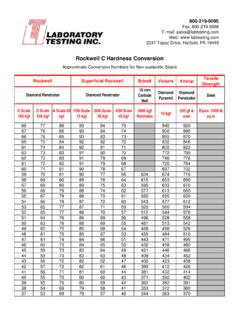
1 BUEHLER HardnessConversionChartsIntroductionThe requirement to convert from one Hardness test scale to another is quite common and as such is covered by variousInternational Standards (ASTM E140, ISO 18265). These standards point out that, due to the differences in the various typesof Hardness test methods, it is not possible to show a constant Conversion relationship across all materials. As such, the standards provide approximate conversions only with defined Hardness ranges and test loads for specific materials. Thusthere are a number of Conversion tables according to material type and it is essential to use the correct one. The followingconversion Charts have been constructed according to the Hardness test scale Conversion algorithms provided within ASTME140. Please treat all converted values as approximations table below lists the scales present in the following tables and any restrictions on the load ranges valid for the and Load forceVickersHVVickers diamond, nickel alloys (1, 5, 10 or 30-kgf), copper (100-gf), aluminum (15-kgf)
2 KnoopHKKnoop diamond, 500-gf and overRockwell AHRAD iamond, 60-kgfRockwell BHRBS teel ball 1 16 , 100-kgfRockwell CHRCD iamond, 150-kgfRockwell DHRDD iamond, 100-kgfRockwell EHRES teel ball 1 8 , 100-kgfRockwell FHRFS teel ball 1 16 , 60-kgfRockwell GHRGS teel ball 1 16 , 150-kgfRockwell HHRHS teel ball 1 8 , 60-kgfRockwell KHRKS teel ball 1 8 , 150-kgfSuperficial Rockwell 15 NHR15 NDiamond, 15-kgfSuperficial Rockwell 30 NHR30 NDiamond, 30-kgfSuperficial Rockwell 45 NHR45 NDiamond, 45-kgfSuperficial Rockwell 15 THR15 TSteel ball 1 16 , 15-kgfSuperficial Rockwell 30 THR30 TSteel ball 1 16 , 30-kgfSuperficial Rockwell 45 THR45 TSteel ball 1 16 , 45-kgfSuperficial Rockwell 15 WHR15 WSteel ball 1 8 , 15-kgfBrinellHBWT ungsten carbide 10mm ball, 3000-kgfBrinellHBSS teel 10mm ball, steel and nickel (3000-kgf), brass and aluminum (500-kgf)A commonly asked question is "How come my results and those from another facility are different?
3 "The first step is to use statistical analysis to see if the difference is significant. Next, determine any differences in the test method. The two mostcommon problems relate to either a different load being applied or a converted value being compared with an actual measurement. For this reason, it is recommended that the measured value is included in parenthesis following the Conversion when reporting a converted Hardness addition to steel balls, tungsten carbide balls have been introduced for Rockwell and Rockwell Superficial scales. However,all of the equations applied to create values for the tables in this document are based on empirical test accomplished withsteel indenters. A Rockwell Hardness test done with a tungsten carbide ball may yield slightly different Conversion ChartsTable of ContentsHardness Conversion Chart for Non-Austenitic Steels (Rockwell C Range).
4 1 Hardness Conversion Chart for Non-Austenitic Steels (Rockwell B Range) ..3 Hardness Conversion Chart for Austenitic Stainless Steel Sheet (Rockwell C Range) ..4 Hardness Conversion Chart for Austenitic Stainless Steel Sheet (Rockwell B Range) ..5 Hardness Conversion Chart for Nickel and High-Nickel Alloys ..6 Hardness Conversion Chart for Cartridge Brass ..7 Hardness Conversion Chart for Copper ..8 Hardness Conversion Chart for Wrought Aluminum Products ..9 Common Applications and Nomenclature for Hardness Tests ..10 Hardness Conversion Charts1 Hardness Conversion Chart for Non-Austenitic Steels (Rockwell C Range) Conversion Chart for Non-Austenitic Steels (Rockwell C Range) non-austenitic steels included carbon, alloy and tool steels in the as-forged, annealed, normalized, and quenched and tempered conditions.
5 3 Hardness Conversion Chart for Non-Austenitic Steels (Rockwell B Range) non-austenitic steels included carbon, alloy and tool steels in the as-forged, annealed, normalized, and quenched and tempered conditions. 4 Hardness Conversion Chart for Austenitic Stainless Steel Sheet (Rockwell C Range) austenitic stainless steel sheet included in the original testing was as follows: Types 201, 202, 301, 302, 304, 304L, 305, 316, 316L, 321 and 4 Hardness Conversion Chart for Austenitic Stainless Steel Sheet (Rockwell B Range)5 Hardness Conversion Chart for Austenitic Stainless Steel Sheet (Rockwell B Range) austenitic stainless steel sheet included in the original testing was as follows: Types 201, 202, 301, 302, 304, 304L, 305, 316, 316L, 321 and 4 Hardness Conversion Chart for Austenitic Stainless Steel Sheet (Rockwell B Range)6 Hardness Conversion Chart for Nickel and High-Nickel AlloysHV HKHRAHRBHRCHRDHREHRFHRGHRK HR15N HR30 NHR45N HR15T HR30T HR45T 4 Hardness Conversion Chart for Austenitic Stainless Steel Sheet (Rockwell B Range)7 Hardness Conversion Chart for Cartridge 4 Hardness Conversion Chart for Austenitic Stainless Steel Sheet (Rockwell B Range)8 Hardness Conversion Chart for copper included in the original testing was UNS C10200 to C14200 inclusive.
6 The conversions are listed for strip in ( mm) or greater in 4 Hardness Conversion Chart for Austenitic Stainless Steel Sheet (Rockwell B Range)9 Hardness Conversion Chart for Wrought Aluminum Indentation TestSymbolIndenterForce (kg)depth (mm)*ApplicationRockwell AHRA diamond60(100 - HRA value) / 500 Very hard materials, cemented carbidesRockwell BHRB1 16 ball100(130 - HRB value) / 500 Low strength steel, copper alloys, aluminum alloys, malleable ironRockwell CHRC diamond150(100 - HRC value) / 500 High strength steel, titanium, pearlitic malleable ironRockwell DHRD diamond 100(100 - HRD value) / 500 High strength steel, thin steelRockwell EHRE1 8 ball100(130 - HRE value) / 500 Cast iron, aluminum and magnesium alloysRockwell FHRF1 16 ball60(130 - HRF value) / 500 Annealed copper alloys, thin soft metalsRockwell GHRG1 16 ball 150(130 - HRG value) / 500 Phosphor bronze, beryllium copper, malleable irons** Rockwell HHRH1 8 ball 60(130 - HRH value) / 500 Aluminum, zinc, leadRockwell KHRK1 8 ball 150(130 - HRK value) / 500 Rockwell LHRL ball60(130 - HRL value) / 500 Rockwell MHRM ball100(130 - HRM value) / 500 Rockwell PHRP ball150(130 - HRP value) / 500 Rockwell RHRR ball60(130 - HRR value) / 500 Rockwell SHRS ball100(130 - HRS value) / 500 Rockwell VHRV ball150(130 - HRV value) / 500 Superficial HR15 Ndiamond15(100 - HR15N value) / 1000 Rockwell NSuperficial HR30 Ndiamond30(100 - HR30N value)
7 / 1000 Rockwell NSuperficial HR45 Ndiamond45(100 - HR45N value) / 1000 Rockwell NSuperficial HR15T1 16 ball15(100 - HR15T value) / 1000 Rockwell TSuperficial HR30T1 16 ball30(100 - HR30T value) / 1000 Rockwell TSuperficial HR45T1 16 ball45(100 - HR45T value) / 1000 Rockwell T10 Common Applications and Nomenclature for Hardness TestsBearing metals and other very soft or thin materials, including plastics. Use smallest ball and heaviest load that do not give anvil carbides, thin steel and case hardenedsteel, hard cast irons, titanium, and other materials harder than100 HRBC opper alloys, phosphorbronze, soft steels, aluminum alloys, malleable iron, thin softsheet metals Test Indentation TestSymbolIndenterForce (kg)depth (mm)*ApplicationSuperficial HR15W1 8 ball15(100 - HR15W value) / 1000 Rockwell WSuperficial HR30W1 8 ball30(100 - HR30W value) / 1000 Rockwell WSuperficial HR45W1 8 ball45(100 - HR45W value) / 1000 Rockwell WSuperficial HR15X ball15(100 - HR15X value) / 1000 Rockwell XSuperficial HR30X ball30(100 - HR30X value)
8 / 1000 Rockwell XSuperficial HR45X ball45(100 - HR45X value) / 1000 Rockwell XSuperficial HR15Y ball15(100 - HR15Y value) / 1000 Rockwell YSuperficial HR30Y ball30(100 - HR30Y value) / 1000 Rockwell YSuperficial HR45Y ball45(100 - HR45Y value) / 1000 Rockwell YVickers - HVdiamond1-100diagonal length in mm / 7A wide range of materials"Macro"Vickers - to 1diagonal length in mm / 7A wide range of materials"Micro" to 1diagonal length in mm/ 30A wide range of materials, case depth determination*It is possible to determine the minimum recommended thickness of the test piece using the indentation depth. Rule of thumb is that the thickness should exceed 10times the depth of the indentation with a diamond indenter and 15 times the depth of the indentation with a ball : A Hardness reading of HRB 43 is observedt = (130 - HRB) / 500t = (130 - 43) / 500t = mm or inTest Piece thickness should be 15 x t or mm ( )**Upper limit is 92 HRG to avoid possible flattening of the Applications and Nomenclature for Hardness TestsCast iron, aluminum andmagnesium alloys, bearing metals, zinc, lead