Transcription of How Are Charities Accountable? - Demos
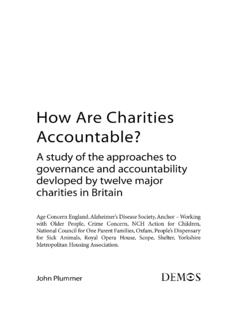
1 How Are CharitiesAccountable?A study of the approaches togovernance and accountabilitydevloped by twelve major Charities in BritainAge Concern England, Alzheimer s Disease Society, Anchor Workingwith Older People, Crime Concern, NCH Action for Children,National Council for One Parent Families, Oxfam, People s Dispensaryfor Sick Animals, Royal Opera House, Scope, Shelter, YorkshireMetropolitan Housing Plummer Open access. Some rights reserved. As the publisher of this work, Demos has an open access policy which enables anyone to access our content electronically without charge. We want to encourage the circulation of our work as widely as possible without affecting the ownership of the copyright, which remains with the copyright holder.
2 Users are welcome to download, save, perform or distribute this work electronically or in any other format, including in foreign language translation without written permission subject to the conditions set out in the Demos open access licence which you can read here. Please read and consider the full licence. The following are some of the conditions imposed by the licence: Demos and the author(s) are credited; The Demos website address ( ) is published together with a copy of this policy statement in a prominent position; The text is not altered and is used in full (the use of extracts under existing fair usage rights is not affected by this condition); The work is not resold; A copy of the work or link to its use online is sent to the address below for our archive.
3 By downloading publications, you are confirming that you have read and accepted the terms of the Demos open access licence. Copyright Department Demos Elizabeth House 39 York Road London SE1 7NQ United Kingdom You are welcome to ask for permission to use this work for purposes other than those covered by the Demos open access licence. Demos gratefully acknowledges the work of Lawrence Lessig and Creative Commons which inspired our approach to copyright. The Demos circulation licence is adapted from the attribution/no derivatives/non-commercial version of the Creative Commons licence. To find out more about Creative Commons licences go to AcknowledgementsviiIntroduction1 Methodology6 PART I9 What is charity governance?
4 11 Why is charity governance reviewed?14 How are charity trustees recruited?21 How are Charities Accountable? 28 Who are the stakeholders?37 The Charity Commissioners governance and accountability39 Charities politics and campaigning48 The relationship between trustees and executive management53 What are the risk of the new environment?59 Contents This page is covered by the Demos open access licence. Some rights reserved. Full details of licence conditions are available at PART II63 Age Concern England65 Alzheimer s Disease Society69 Anchor - Working With Older People72 Crime Concern76 NCH Action for Children87 National Council for One Parent Families81 Oxfam83 People s Dispensary for Sick Animals87 Royal Opera House90 Scope (formerly The Spastics Society)95 Shelter98 Yorkshire Metropolitan Housing Association100 PART III103 Observations and recommendations on governance and accountability105 Recommendations on general themes107 Recommendations on trustees108 Recommendations on governance110 Recommendations on accountability112 Notes114viDemosHow are Charities accountable ?
5 This page is covered by the Demos open access licence. Some rights reserved. Full details of licence conditions are available at The funding for this research was largely provided by the EsmeeFairbairn Trust with additional support from the Charities AidFoundation. Both these Charities have demonstrated a continuinginterest in the subjects of governance and research was only possible as a result of the cooperation of thedozen Charities which are its subjects. Their Chairmen and ChiefExecutives gave generously of their time and demonstrated a welcomedegree of openness by providing access to many documents and back-ground discussion papers about the organisational forms andapproaches to accountability which they have include:Robin Birch CB, Chairman of the Board of Trustees, and SallyGreengross OBE, Director General ofAge Concern England;BrayanRoycroft, Chairman, George Cyriax, Honorary Treasury, and HarryCayton, Executive Director of the Alzheimer s Disease Society.
6 Patricia Tindale, Board Member, John Belcher, Chief Executive, andBruce Moore, Company Secretary ofAnchor Working with OlderPeople; Tim Clement-Jones CBE, Chairman, and Nigel Whiskin MBE,Chief Executive, ofCrime Concern; Sir Michael Checkland, Chair ofthe Council, and Tom White CBE, Principal and Chief Executive ofNCH Action for Children; Anne Spackman, Chair of the Committeeof Management, and Karin Pappenheim, Director of the NationalCouncil for One Parent Families; Joel Joffe, Chair of the Council, andDemosviiAcknowledgements This page is covered by the Demos open access licence. Some rights reserved. Full details of licence conditions are available at David Bryer, Director ofOxfam; Francis Butters, Member of theCouncil and retired Chairman, and Malcolm Curtis, Director Generalof the People s Dispensary for Sick Animals;Sir James Spooner,Deputy Chairman, and Clive Timms, Company Secretary andDirector of Finance and Resources of the Royal Opera House;Anthony Hewson, Chairman of the Executive Council, and RichardBrewster, Chief Executive ofScope.
7 Christopher Pryce, Chair of theBoard of Management, and Chris Holmes, Director ofshelter,MurielStammers MBE, Member of the Committee of Management, BillPayne, Chief Executive and Sue Chandler, Assistant CompanySecretary ofYorkshire Metropolitan Housing addition to these people who represented the subjects of theresearch and gave valuable insights into the organisations of whichthey invariably commit substantial expertise and devotion, other pro-fessionals and academics have given crucial advice, guidance and assi-tance. These include Michael Brophy, Dorothy Dalton, Richard Fries,Margaret Hyde, Kate Kirkland, Surabajaya Kumar, Diana Leat, AndrewPhillips and Perri 6 and to all is owed a debt of remaining errors are entirely the responsibility of the are Charities accountable ?
8 This page is covered by the Demos open access licence. Some rights reserved. Full details of licence conditions are available at It is timely to examine how some major Charities approach governanceand accountability. Many Charities have become vast multimillionpound national and even international conglomerates. Increasinglythey operate under contracts with central or local government, orintermediate non-elected local bodies such as Training and EnterpriseCouncils and National Health Service Trusts in order to deliver publicgoods. Others, including Housing Associations, although proud oftheir history as independent organisations and part of the voluntarysector, have become the main vehicles for the use of public money toconstruct and manage social have been recent changes in the legislation affecting Charities ,most notably the Charities Acts of 1992 and 1993 and 1993.
9 Charitiesmust comply with the Charity Commissioners disclosure, reportingand accounting requirements and comply with the law on such mat-ters as trading, political activities and , many Charities and voluntary organisations are companieslimited by guarantee and thus bound by the Companies Acts of 1985and this, surprisingly little is known about how Charities aregoverned. The diversity and complexity of structural forms amongcharities is much greater than within either the private or the publicsectors. There is no single set of rules and conventions which governsthe relationship between donors, members, trustees and managementDemos1 Introduction This page is covered by the Demos open access licence.
10 Some rights reserved. Full details of licence conditions are available at of Charities to match that between shareholders and directors in theprivate sector, or the electorate, councillors and officers in the publicsector. Not only are the functions different, as they are between differ-ent commercial companies, but so too are the structural sector as a whole is not beset with scandals. Frauds such as theSalvation Army s missing millions are relatively rare. So was the curi-ous case of the Sherburn Hospital charity which was found to be runfor the personal benefit of the two principal employees and their fam-ilies who had spun a web of interest, patronage and rarity of scandals might be the result of good governance, effec-tive regulation, ever diligent trustees and a dominant culture of hon-esty.