Transcription of How to publish your research
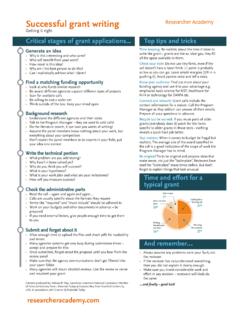
1 How to publish your researchThis guide will help you create a high quality article that will be a valuable addition to the scientific record. For more details and a selection of templates to help get your article ready for submission, visit our author resource centre: THE AUTHOR GUIDELINESOur journals have expected standards of conduct and provide guidance on good authorship and ethical practices. Always check the individual journal s guidelines as many journals have specific requirements. For more details visit the journal provide quality peer review, and does the policy suit your approach? Does the journal have a strong reputation? Is it where your peers publish ? Are the metrics good?Does it give you open access options that comply with your funding agency?
2 Is the journal s scope broad, or specialist, designed to be read by a certain community?Are times to publication important to you?Will it cost anything to publish in this journal ? Are there any extra charges? Which language does the journal use? Most international journals use EnglishIs the journal likely to be cited by other researchers in your field?Is it indexed in major online databases (Science Citation Index, PubMed, Scopus, MEDLINE)?Does the journal publish articles in the best format for your work (eg Communication, Full Paper)?All royal society of chemistry journals go through rigorous and fair peer reviewCHOOSE THE RIGHT JOURNALC onsidering these things will help you to adapt the way you write and format your article to suit the expectations of the journal s editors and of our journals have an open access option.
3 Visit for detailsTell a storyKeep your writing clear, using consistent language and short paragraphs. your reader will want an article that is concise, easy to read that makes a definite pointAlways emphasise the novelty of your findingsWRITE your ARTICLE3 Build up a strong structureSplit your article up into recognisable sections. For each, think about who you are writing for and how your work compares to existing researchTitle This should be short, straightforward, and emphasise the importance of your work. Think about the key words someone might use to search for this article , and stay generalAuthorshipAuthors should have made a significant contribution to the conception, design or execution of the workAbstractSummarise your findings, and their importance potential readers will use this to decide if the rest of your article is of interestIntroductionSet the scene.
4 Why is your work important? What has been done in this area before? What will you show in this article ?Results and discussionBack up your claims with evidence, explain complex arguments, and demonstrate the impact of your workExperimental sectionThere should be enough detail here for a skilled researcher to replicate your workConclusionInclude only the most significant results, their impact on the field, and plans for relevant future workAcknowledgementsHere you should include funding agencies, and possibly individuals who could not be added as authorsReferencesInclude previously published work that you have referenced in the articleSupplementary informationThis is the section in which to include spectra, additional data and more detail on proceduresIf you would like a second opinion.
5 Our language editing service can provide professional guidance and a comprehensive proofread of your article . Visit those guidelinesIs your authorship correct?Could anything have been plagiarised?Is any of the work fragmented?Have you supported all of your claims?Does the article meet ethical standards?Don t forget to keep your co-authors up to date and make sure they are happy before you submit the final articleAddress your cover letter to the Editor or Associate Editor, and make sure you mention the correct journal . It s surprisingly common to name the wrong oneCHECK your ARTICLEYOUR SUBMISSION CHECKLISTYour chosen journal will be looking for key information when you submit your thoroughly1 A cover letter which includes: A summary of your work Statement of importance (a chance to sell your work to the editor why is this article a good fit for the journal ?)
6 The impact of this research on the community Its future potentialCheck grammar2 your graphical abstract3 Any supplementary information files4 Suggestions for suitable reviewers5 your articleCheck spellingREVISING your ARTICLER evisions are a natural part of the publication process generally all authors will be asked to make at least a few changes, to make sure that the article is of the highest possible to any deadlines given, or ask for an extension if you need oneIncluding personal comments about the reviewer focus on making direct responsesRead each report carefully, and ask if anything is unclearTaking critical comments personally they are provided to increase the quality of your articleMake sure that you address all reviewer comments, and if you have decided not to make a change, explain whyRemember that reviewing is voluntary, and that the reviewer will have made all comments to help improve your workARTICLE ASSESSMENTOnce your article arrives with the editorial team, it goes through a thorough assessment process in line with the journal s editorial peer review, hopefully your article will be accepted for publication (usually subject to some revisions)
7 An article might be rejected for a lot of different reasons, including if the subject makes it better suited to another journal . If this is the case, a transfer might be recommendedPROMOTING your WORKA fter publication, the next step is to get your work seen by the community. 8 royal society of charity number: 207890 royal society of chemistry 2018 Thomas Graham HouseScience Park, Milton RoadCambridge, CB4 0WF, UKT +44 (0) 1223 420066 Burlington HousePiccadilly, LondonW1J 0BA, UKT +44 (0) 20 7437 8656 International offices S o Paulo, Brazil Beijing, ChinaShanghai, ChinaBerlin, GermanyBangalore, India Tokyo, JapanPhiladelphia, USAW ashington, USAWhat we can do:Promote hot articles via blogs, social media and chemistry World Send press releases to science websites and magazinesWhat you can do.
8 Contact your university press office to see how they can support youShare a link to your article online via social media and online networking platformsPresent your work at conferencesFor best practice when sharing work online, visit find out more about publishing with the royal society of chemistry , visit