Transcription of Human Development Report 2020
1 The next frontier Human Development and the AnthropoceneHuman Development Report 2020 The next frontierHuman Development and the AnthropoceneCopyright @ 2020 By the United Nations Development Programme 1 UN Plaza, New York, NY 10017 USAAll rights reserved. No part of this publication may be reproduced, stored in a retrieval system or transmitted, in any form or by means, electronic, mechanical, photocopying, recording or otherwise, without prior no.: ISBN: 978-92-1-126442-5 eISBN: 978-92-1-005516-1 Print ISSN: 0969-4501 eISSN: 2412-3129A catalogue record for this book is available from the British Library and Library of CongressGeneral disclaimers. The designations employed and the presentation of the material in this publication do not imply the expression of any opinion whatsoever on the part of the Human Development Report Office (HDRO) of the United Nations Development Programme (UNDP) concerning the legal status of any country, territory, city or area or of its authorities, or concerning the delimitation of its frontiers or boundaries.
2 Dotted and dashed lines on maps represent approximate border lines for which there may not yet be full findings, analysis, and recommendations of this Report , as with previous Reports, do not represent the official position of the UNDP or of any of the UN Member States that are part of its Executive Board. They are also not necessarily endorsed by those mentioned in the acknowledgments or mention of specific companies does not imply that they are endorsed or recommended by UNDP in preference to others of a similar nature that are not of the figures included in the analytical part of the Report where indicated have been estimated by the HDRO or other contributors to the Report and are not necessarily the official statistics of the concerned country, area or territory, which may use alternative methods.
3 All the figures included in the Statistical Annex are from official sources. All reasonable precautions have been taken by the HDRO to verify the information contained in this publication. However, the published material is being distributed without warranty of any kind, either expressed or responsibility for the interpretation and use of the material lies with the reader. In no event shall the HDRO and UNDP be liable for damages arising from its in the USA, by AGS, an RR Donnelley Company, on Forest Stewardship Council certified and elemental chlorine-free papers. Printed using vegetable-based 2020 Human Development ReportThe 30th Anniversary 2020 Human Development Report is the latest in the series of global Human Development Reports published by the United Nations Development Programme (UNDP)
4 Since 1990 as independent and analytically and empirically grounded discussions of major Development issues, trends and resources related to the 2020 Human Development Report can be found online at Resources on the website include digital versions and translations of the Report and the overview in more than 10 languages, an interactive web version of the Report , a set of background papers and think pieces commissioned for the Report , interactive data visualizations and databases of Human Development indicators, full explanations of the sources and methodologies used in the Report s composite indices, country profiles and other background materials, and previous global, regional and national Human Development Reports.
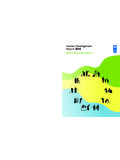
5 Corrections and addenda are also available cover conveys the complex connections between people and the planet, whose interdependence is a hallmark of the Anthropocene. The image evokes the many possibilities for people and planet to flourish if humanity makes different Development choices, ones that aim to enhance equity, foster innovation and instill a sense of stewardship of next frontier Human Development and the AnthropoceneHuman Development Report 2020 The next frontierHuman Development and the AnthropoceneThe next frontierHuman Development and the AnthropoceneHUMAN DEVELOPMENTREPORT 2020 Empowered lives. Resilient nations. Human Development Report 2020Te a mDirector and lead authorPedro Concei oResearch and statisticsJacob Assa, Cecilia Calderon, Fernanda Pavez Esbry, Ricardo Fuentes, Yu Chieh Hsu, Milorad Kovacevic, Christina Lengfelder, Brian Lutz, Tasneem Mirza, Shivani Nayyar, Josefin Pasanen, Carolina Rivera V zquez, Heriberto Tapia and Yanchun ZhangProduction, communications, operationsRezarta Godo, Kristin Hageg rd, Jon Hall, Seockhwan Bryce Hwang, Admir Jahic, Fe Juarez Shanahan, Sarantuya Mend, Anna Ortubia, Yumna Rathore, Dharshani Seneviratne and Marium SoomroiiHUMAN Development Report / 2020 ForewordHidden in the long shadow of Covid 19, 2020 has been a dark year.
6 Scientists have been forewarning a pandemic like this for years, pointing to the rise in zoonotic pathogens those that jump from animals to humans as a reflection of the pressures people put on planet pressures have grown exponentially over the past 100 years. Humans have achieved incredible things, but we have taken the Earth to the brink. Climate change, ruptur ing inequalities, record numbers of people forced from their homes by conflict and crisis these are the results of societ ies that value what they measure instead of measuring what they fact, the pressures we exert on the planet have become so great that scientists are considering whether the Earth has entered an entirely new geological epoch: the Anthro pocene, or the age of humans.
7 It means that we are the first people to live in an age defined by Human choice, in which the dominant risk to our survival is Human Development while erasing such plan etary pressures is the next frontier for Human Development , and its exploration lies at the heart of this 30th anniversary edition of UNDP s Human Development survive and thrive in this new age, we must redesign a path to progress that respects the intertwined fate of people and planet and recognizes that the carbon and material footprint of the people who have more is choking the op portunities of the people who have example, the actions of an indigenous person in the Amazon, whose stewardship helps protect much of the world s tropical forest, offsets the equivalent of the carbon emissions of a person in the richest 1 percent of people in the world.
8 Yet indigenous peoples continue to face hardship, persecution and thousand generations could live and die before the carbon dioxide released from the Industrial Revolution to today is scrubbed from our atmosphere, and yet decision makers continue to subsidize fossil fuels, prolonging our car bon habit like a drug running through the economy s while the world s richest countries could experience up to 18 fewer days of extreme weather each year within our life time because of the climate crisis, the poorest countries face up to 100 extra days of extreme weather. That number could still be cut in half if the Paris Agreement is fully is time to make a change.
9 Our future is not a question of choosing between people or trees; it is neither or the Human Development Report first challenged the primacy of growth as the measure of progress in 1990, the Cold War still shaped geopolitics, the World Wide Web had just been invented and very few people had heard of climate change. In that moment UNDP offered a forward looking alternative to GDP, ranking all countries by whether people had the freedom and opportunity to live a life they valued. In so doing, we gave voice to a new conversation on the meaning of a good life and the ways we could achieve years on, much has changed, but hope and possi bility have not. If people have the power to create an entirely new geological epoch, then people also have the power to choose to change.
10 We are not the last generation of the Anthropocene; we are the first to recognize it. We are the ex plorers, the innovators who get to decide what this the first generation of the Anthropocene will be remembered we be remembered by the fossils we leave behind: swaths of species, long extinct, sunken and fossilized in the mud alongside plastic toothbrushes and bottle caps, a legacy of loss and waste? Or will we leave a much more valu able imprint: balance between people and planet, a future that is fair and just?The Next Frontier: Human Development and the Anthro-pocene sets out this choice, offering a thought provoking, necessary alternative to paralysis in the face of rising poverty and inequalities alongside alarming planetary change.