Transcription of Hydrogen Peroxide Solution 20% - 40%
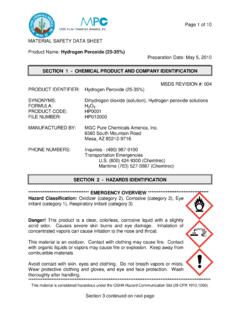
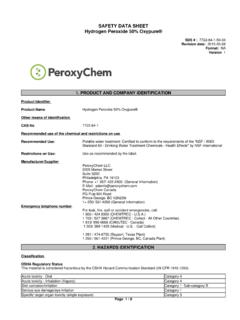
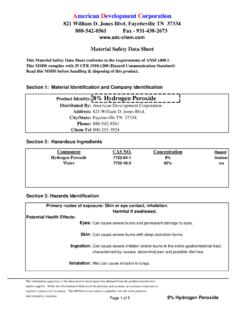
1 MATERIAL SAFETY DATA SHEET Effective Date: 08/01/07 Hydrogen Peroxide Solution 20% - 40% G. S. Robins and Company: Page 1 of 4 1 CHEMICAL PRODUCT AND COMPANY IDENTIFICATION Product Name: Hydrogen Peroxide Manufacturer: G. S. Robins and Company 126 Chouteau Avenue St. Louis, MO 63102 (314) 621-5155 Chemical Name/Synonyms: Hydrogen Peroxide , Aqueous Solution , 20% to 40% EMERGENCY PHONE NUMBER CAS Registry Number: Mixture, see below CHEMTREC: (800) 424-9300 2 COMPOSITION / INFORMATION ON INGREDIENTS OSHA HAZARDS Component CAS Number % By Weight OSHA PEL ACGIH TLV Hydrogen Peroxide (H2O2) 7722-84-1 20 to 40 1 ppm (TWA).
2 1 ppm (TWA), A3: Animal carcinogen. Water 7732-18-5 60 to 80 Not applicable 3 HAZARD IDENTIFICATION Emergency Overview DANGER! STRONG OXIDIZER. CONTACT WITH OTHER MATERIAL MAY CAUSE FIRE. CORROSIVE. CAUSES BURNS TO SKIN, EYES, AND RESPIRATORY TRACT. HARMFUL IF SWALLOWED OR INHALED. Potential Health Effects Inhalation: Vapors are corrosive and irritating to the respiratory tract. Inhalation of mist may burn the mucous membrane of the nose and throat. In severe cases, exposures may result in pulmonary edema and death. Ingestion: Corrosive and irritating to the mouth, throat, and abdomen. Large doses may cause symptoms of abdominal pain, vomiting, and diarrhea as well as blistering or tissue destruction.
3 Stomach distention (due to rapid liberation of oxygen), and risk of stomach perforation, convulsions, pulmonary edema, coma, possible cerebral edema (fluid on the brain), and death are possible. Skin Contact: Corrosive. Symptoms of redness, pain, and severe burn can occur. Eye Contact: Vapors are very corrosive and irritating to the eyes. Symptoms include pain, redness and blurred vision. Splashes can cause permanent tissue destruction. Chronic Exposure: No information found. Aggravation of Pre-existing Conditions: Persons with pre-existing skin disorders or eye problems or impaired respiratory function may be more susceptible to the effects of the substance. 4 FIRST AID MEASURES Inhalation: Move to fresh air. If breathing has stopped, perform artificial respiration.
4 Call a physician. Eye Contact: Flush thoroughly with water for at least 15 minutes, also under the eyelids. Call a physician. Skin Contact: Wash thoroughly with water for at least 15 minutes. Remove contaminated clothing and wash before reuse. In case of persistent skin irritation, consult a physician. Ingestion: If swallowed, DO NOT INDUCE VOMITING. Give large quantities of water. Never give anything by mouth to an unconscious person. Get medical attention immediately. MATERIAL SAFETY DATA SHEET Effective Date: 08/01/07 Hydrogen Peroxide Solution 20% - 40% G. S. Robins and Company: Page 2 of 4 5 FIRE FIGHTING MEASURES Fire & Explosion Hazards: Not combustible, but substance is a strong oxidizer and its heat of reaction with reducing agents or combustibles may cause ignition.
5 Increases the flammability of combustible, organic and readily oxidizable materials. Heated containers may explode due to pressure. Extinguishing Media: Cool containers with water fog. Fire Fighting Instructions: Use whatever extinguishing media is appropriate. Respiratory and eye protection required. Decomposition Products: Produces oxygen upon decomposition. 6 ACCIDENTAL RELEASE MEASURES General: CAUTION! Strong Oxidizer. Causes fires with organic material. Ventilate area of leak or spill. Wear appropriate personal protective equipment as specified in Section 8. Contain and recover liquid when possible. Do not return spilled material to original container. May be neutralized with sodium metabisulfite or sodium sulfite after diluting to 5-10% Peroxide .
6 Do not flush undiluted material to sewer. This oxidizing material can increase the flammability of adjacent combustible materials. Empty containers should be rinsed with water before discarding. 7 HANDLING AND STORAGE Handling: Avoid contact with skin, eyes, and clothing. Do not breathe vapors or mist. When using, do not smoke. Practice good hygiene. Storage: Store in a cool, dry, dark area between 32F/0C and 120F/49C separated from combustible substances, reducing agents, strong bases, and/or organics. Avoid exposure to continuous high temperatures. Do not store on wood or cardboard surfaces. 8 EXPOSURE CONTROLS / PERSONAL PROTECTION Engineering Controls: General exhaust recommended.
7 Wear suitable respiratory protection for dust/mist. Personal Protection: Full face splash guard; NIOSH approved full face respirator/breathing apparatus if exposure limit is exceeded; Waterproof protective clothing, including boots, gloves, lab coat, apron or coveralls, as appropriate, to prevent skin contact. Work Practices: Wear PPE. Wash thoroughly after handling. Handle in accordance with good industrial hygiene and safety practices. Unsatisfactory Materials of Construction: Not available 9 PHYSICAL AND CHEMICAL PROPERTIES Appearance: clear, colorless liquid Specific Gravity: varies by concentration Vapor Pressure: 25 mm Hg @ 30C (86F) Vapor Density: (Air= ) Solubility in Water: completely soluble Freezing Point: -25C (-13F) % Volatile by Weight: not specified Boiling Point: 108C (226F) Flash Point: not specified pH: >3 MATERIAL SAFETY DATA SHEET Effective Date: 08/01/07 Hydrogen Peroxide Solution 20% - 40% G.
8 S. Robins and Company: Page 3 of 4 10 STABILITY AND REACTIVITY Stability: Slowly decomposes to release oxygen, may decompose faster if contaminated or exposed to heat. Strong oxidizer - reacts violently upon contact with many organic substances, particularly textile and paper. Avoid light and heat - keep in a closed, vented container to prevent evaporation (concentration) and contamination Hazardous Polymerization: No hazardous polymerization will occur. Conditions to Avoid: Heat, reducing agents may cause rapid decomposition and/or exothermic reactions. Incompatibility: organics, reducing agents. Decomposition Products: Decomposes to water and oxygen with rapid heat release.
9 Use vented containers. The Solution can decompose violently upon heating. 11 TOXICOLOGICAL INFORMATION No LD50/LC50 information found relating to normal routes of occupational exposure. Investigated as a tumorigen and mutagen. 12 ECOLOGICAL INFORMATION Ecotoxicity: Not available Environmental Fate: Not available Bioaccumulation: Does not bioaccumulate. Persistence/ Degradability: Readily biodegradable. 13 DISPOSAL CONSIDERATIONS Disposal Guidance: Dispose of container and unused contents in accordance with federal, state and local requirements State and local disposal regulations may differ from federal disposal regulations.
10 Dilute with water and flush to sewer if local ordinances allow, otherwise, whatever cannot be saved for recovery or recycling should be managed in an appropriate and approved waste disposal facility. 14 TRANSPORTATION INFORMATION DOT Hazardous Materials Classification: ID Number: UN2014 Proper Shipping Name: Hydrogen Peroxide , Aqueous Solution Description: (not less than 20% but not more than 40% Hydrogen Peroxide , stabilized as necessary) Class/Division: , (8) Packing Group: II Label Info: DANGER! STRONG OXIDIZER. CONTACT WITH OTHER MATERIAL MAY CAUSE FIRE. CORROSIVE. CAUSES BURNS TO SKIN, EYES, AND RESPIRATORY TRACT. HARMFUL IF SWALLOWED OR INHALED. 15 REGULATORY INFORMATION TSCA: Appears on the EPA TSCA inventory list.