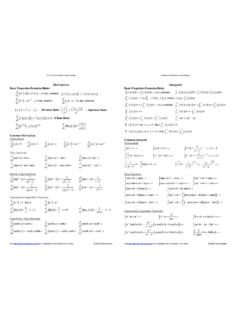
Transcription of Hyperbolic functions (CheatSheet)
1 Hyperbolic functions (CheatSheet)1 IntroFor historical reasons Hyperbolic functions have little or no room at all in the syllabus of a calculuscourse, but as a matter of fact they have the same dignity as trigonometric functions . Unfortu-nately this can be completely understood only if you have some knowledge of the complex speaking ordinary trigonometric functions are trigonometric functions of purely real num-bers, and Hyperbolic functions are trigonometric functions of purely imaginary numbers. For themoment we have to postpone this discussion to the end of Calc3 or Calc4, but still we should beaware of the fact that the impressive similarity between trig formulas and Hyperbolic formulas isnot a pure of the formulas that follow correspond precisely to a trig formula or they differ by at mosta change of sign. For each formula I will explicitly state if some change of sign occurs or not (thedifferent sign is marked in green).
2 The main purpose of this paper is not to give you a bunch of formulas to memorize, but tomake you aware of the fact that Hyperbolic formulas are just like trig formulas up to signs; andcorrect signs can always be checked with some very quick DefinitionsDefinition of Hyperbolic sine and cosine:sinhx=ex e x2coshx=ex+e x2 There are two equivalent formulas for sine and cosine (Euler s formulas) but they require someknowledge of the complex numbers:sinx=eix e ix2icosx=eix+e ix2wherei= 1 or if you preferi2= 1. Substitutingxwithixin these two formulas and keepingin mind thati2= 1 it s immediate to deduce that coshx= cos (ix) and sinhx= isin (ix)(I mention this just for the sake of completeness and because it s fun!). From the definition ofhyperbolic sine and cosine we define Hyperbolic tangent, cotangent, secant, cosecant in the same1way we did for trig functions :tanhx=sinhxcoshxcothx=coshxsin hxsechx=1coshxcschx=1sinhx3 Basic propertiesFirst of all we notice that Hyperbolic functions have the same parity as the corresponding trigfunctions:sinh ( x) = sinhx(1)cosh ( x) = coshx(2)tanh ( x) = tanhx(3)coth ( x) = cothx(4)sech ( x) = sechx(5)csch ( x) = cschx(6)(7)All these formulas follow immediately from the definitions we gave in the previous section.
3 Unliketrig functions , Hyperbolic functions are not periodic!Using the definition of Hyperbolic sine and cosine it s possible to derive identities similar tocos2x+ sin2x= 1 and tan2x+ 1 = sec2x:cosh2x sinh2x= 1(8)tanh2x+ sech2x= +1(9)These identities do not require Pythagoras theorem, they can be derived from the definition witha direct calculation and using properties of the Addition formulasUnlike the case of ordinary addition trig formulas, the two basic addition formulas for hyperbolicfunctions can be retrieved immediately from the (x+y) = sinhxcoshy+ coshxsinhy(10)cosh (x+y) = coshxcoshy+ sinhxsinhy(11)Combining these formulas with (1) we easily derive the following:sinh (x y) = sinhxcoshy coshxsinhy(12)cosh (x y) = coshxcoshy sinhxsinhy(13)2 Using the definition of Hyperbolic tangent and equations (10,11) we can derive the addition formula :tanh (x y) =tanhx tanhy1 tanhxtanhy(14)5 Formulas for the double and half angleUsing equations (10,11) withx=ywe immediately have:sinh 2x= 2 sinhxcoshx(15)cosh 2x= cosh2x+ sinh2x(16)By plugging (8) into (16) we have the following two formulas for the squares of sine and cosine:cosh2x=1 + cosh 2x2(17)sinh2x=cosh 2x 12(18)Notice that both (16) and (8) differ from the corresponding trig formulas by a sign, but the resultingformula for cosh2is the same as in the trigonometric case, and the formula for sinh2has a globalchange of sign.
4 By substitutingxwithx2and taking the square root we have formulas for the halfangle:coshx2= 1 + coshx2(19)sinhx2= coshx 12(20)The first formula is the same1as the trigonometric one, and in the second one we have a globalchange of sign in the radicand. In the same way, but using (14) we have:tanh 2x=2 tanhx1+ tanh2x(21)6 Inverse Hyperbolic functionsIt s easy to check that Hyperbolic sine is a monotonic increasing function on the real numbers, andfor this reason it s invertible on all the real axis . Hyperbolic cosine has a global minimum atx= 0whose value isy= 1 and it s decreasing from to 0 and increasing from 0 to + , for this reasonwe can invert it on the positive half-axis or the negative one. By convention we choose the positiveone [0, ). Hyperbolic tangent is defined for all real numbers, it s monotonic increasing and it hashorizontal asymptotes:limx tanhx= 1(22)1 You don t need to choose the sign in front of the radical since cosh is always positive3 The inverse of an Hyperbolic function can always be written as the logarithm of an algebraic2function:arsinhx= ln (x+ x2+ 1),Domain=( ,+ ), Range=( ,+ )(23)arcoshx= ln (x+ x2 1),Domain=[1,+ ), Range=[0,+ )(24)artanhx=12ln(1 +x1 x),Domain=( 1,1), Range=( ,+ )(25)Remember that the domain of the inverse is the range of the original function, and the range of theinverse is the domain of the original function.]]]
5 To retrieve these formulas we rewrite the definitionof the Hyperbolic function as a degree two polynomial inex; then we solve forexand invert theexponential. For example:y= sinhx=ex e x2 e2x 2yex 1 = 0 ex=y y2+ 1and since the exponential must be positive we select the positive DerivativesThe calculation of the derivative of an Hyperbolic function is completely straightforward, so I willjust report a list of formulas with no additional comments:ddxsinhx= coshx(26)ddxcoshx= + sinhx(27)ddxtanhx= sech2x(28)ddxcothx= csch2x(29)ddxsechx= tanhxsechx(30)ddxcschx= cothxcschx(31)Formulas for the derivative of an inverse Hyperbolic function can be quickly calculated from (23)using basic properties of derivatives. They can also be calculated using the formula for the derivativeof the inverse:ddxarsinhx=1 +x2+ 1(32)ddxarcoshx=+1 x2 1(33)ddxartanhx=11 x2(34)2An algebraic function is a function containing the four operations and radicals Obvious PrimitivesThe list of primitives of Hyperbolic functions that you should actually remember is incredibly short: sinhx dx= + coshx(35) coshx dx= sinhx(36)Every other primitive can be derived very quickly using some technique of integration and some ofthe formulas that we have seen so far; and if you really don t know how to integrate an hyperbolicfunction, just remember that an Hyperbolic function can be written using the exponential, andusually functions containing the exponential are easy to