Transcription of IB Chemistry Unit Assignment Sheet UNIT 1: Atomic …
1 Student Name : _____ Date: _____ IB Chemistry unit Assignment Sheet unit 1: Atomic Structure Remember to be resourceful!! These answers can be found in various textbooks and websites. Make sure to spend time understanding the concept and be prepared to discuss/share your answers in class! Essential Vocabulary Terms 1.) Atomic Theory 2.) Atomic Number 3.) Mass Number 4.) Atomic Mass 5.) Subatomic Particles 6.) Isotopes 7.) Percent Abundance 8.) Radioisotopes 9.) Nuclear Reactors 10.) Mass Spectrometer 11.) Electromagnetic Spectrum 12.) Continuous Spectrum 13.) Line Spectrum 14.) Emission Spectrum 15.) Absorption Spectrum 16.) Electron Energy Levels 17.) Electron Arrangement (Configuration) 18.) Heisenburg Uncertainty Principle 19.) Aufbau Principle 20.) Hund s Rule 21.) Pauli Exclusion Principle 22.) Ionization Energy 23.) Electron Orbital The Nuclear Atom Essential Idea: The mass of an atom is concentrated in its minute, positively-charged nucleus.
2 Understandings: Atoms contain a positively charged dense nucleus composed of protons and neutrons (nucleons). Negatively charged electrons occupy the space outside the nucleus. The mass spectrometer is used to determine the relative Atomic mass of an element from its isotopic composition. Applications & Skills: Use of the nuclear symbol notation to deduce the number of protons, neutrons, and electrons in atoms and ions. Calculations involving non-integer relative Atomic masses and abundance of isotopes from given data, including mass spectra. Electron Configuration Essential Idea: The electron configuration of an atom can be deduced from its Atomic number. Understandings: Emission spectra are produced when photons are emitted from atoms as excited electrons return to a lower energy level. The line emission spectrum of hydrogen provides evidence for the existence of electrons in discrete energy levels, which converge at higher energies.
3 The main energy level or shell is given in integer number, n, and can hold a maximum number of electrons, 2n2. A more detailed model of the atom describes the division of the main energy level into s, p, d, and f sub-levels of successively higher energies. Sub-levels contain a fixed number of orbitals, regions of space where there is a high probability of finding an electron. Student Name : _____ Date: _____ Each orbital has a defined energy state for a given electronic configuration and chemical environment and can hold electrons of opposite spin. Applications & Skills: Description of the relationship between color, wavelength, frequency, and energy across the electromagnetic spectrum. Distinction between a continuous spectrum and a line spectrum. Descriptions of the emission spectrum of the hydrogen atom, including the relationships between the lines and energy transitions to the first, second, and third energy levels.
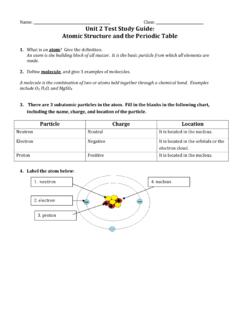
4 Recognition of the shape of an s orbital and the px, py, and pz Atomic orbitals. Application of the Aufbau principle, Hund s rule, and the Pauli exclusion principle to write electron configurations for atoms and ions up to Z=36. Critical Thinking Free-Response/Calculations 24.) Draw a model of an atom (of your choice) with its labeled parts. Include protons, neutrons, and electrons, and make note of the atom s mass number and Atomic number. 25.) None of the subatomic particles can (or will be) directly observed. Which ways of knowing do we use to interpret indirect evidence gained through the use of technology? Do we believe or know of their existence? 26.) Investigate historical models of the atom and how it has changed over time. Use diagrams to explain your findings. 27.) Create a data table to describe the relative masses and relative charges of each of the three subatomic particles. 28.) Compare the properties of the isotopes of an element (choose one or two as examples).
5 29.) Discuss the uses of radioisotopes. What dangers do radioisotopes present to living things? 30.) How can you justify the usefulness of radioisotopes? 31.) Describe the basic operation of a nuclear reactor and how they are useful. 32.) Describe and explain the operation of a mass spectrometer. 33.) Describe how the mass spectrometer may be used to determine relative Atomic mass using the 12C scale. Include in your description the following terms: vaporization, ionization, acceleration, deflection, and detection. (There are many computer simulations out there, if you can find one USE IT!!) 34.) Draw an example and describe the difference between a continuous spectrum and a line spectrum. 35.) Identify each region of the electromagnetic spectrum, and their corresponding variations in wavelength, frequency, and energies. 36.) Infrared and ultraviolet spectroscopies are dependent on technology for their existence. What are the knowledge implications of this?
6 37.) Draw an energy level diagram and show the transitions between different energy levels. Explain what happens to electrons as they transition between energy levels. How are the lines on an emission spectrum directly related to these differences? How or why is Bohr significant when it comes to Atomic spectra and electron transition energy? 38.) Create a reference table that shows the electron arrangements for atoms and ions up to Z = 20. 39.) How many protons and neutrons are in each of the following elements? a. 89Y b. 73Ge c. 24Mg2+ d. 238U e. 35Cl- f. 65Zn Student Name : _____ Date: _____ 40.) Describe how you might use a sample of calcium phosphate, containing traces of a radioisotope of phosphorus, to measure the rate of uptake of phosphorus by root systems of various plants. 41.) Naturally occurring copper is a mixture of two isotopes. One of these has 29 protons and 34 neutrons, the other one two more neutrons.
7 Complete the table for both isotopes: # Protons # Neutrons # Electrons Atomic # Mass # Isotope 1 29 34 Isotope 2 If the relative Atomic mass of copper is , calculate the natural abundance of the two isotopes. 42.) Germanium contains 20% germanium-70, 27% germanium-71, 8% germanium-74. Draw a graph of the mass spectrum that you would expect germanium to produce. If an atom of germanium-70 lost two electrons to become a doubly charged ion, at what m/z would appear? 43.) Lead has a molar mass of g mol-1. Assuming that it is composed entirely of 206Pb, 207Pb, and 208Pb, and that the percentages of the two lightest isotopes are equal, calculate the relative percentages of these isotopes in the natural element. 44.) Which of the following would produce a line spectrum rather than a continuous spectrum? EXPLAIN WHY a. A yellow sodium street light b. A normal filament light bulb. c. Sunlight d. A white hot piece of steel.
8