Transcription of Ibilex - Medicines
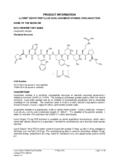
1 Ibilex Cephalexin PRODUCT INFORMATION NAME OF THE MEDICINE Active ingredient : Cephalexin Chemical name : 7-(D- -amino- -phenyl-acetamido)-3-methyl-3-cephem-4-c arboxylic acid, monohydrate Structural formula : Molecular formula : C16H17N3O4S H2O Molecular weight : CAS Registry no. : 23325-78-2 DESCRIPTION The nucleus of cephalexin is related to that of other cephalosporin antibiotics. The compound is a zwitterion; the molecule contains both a basic and an acidic group. The isoelectric point of cephalexin in water is approximately to 5. The crystalline form of cephalexin which is available is a monohydrate.
2 It is a white crystalline solid having a bitter taste. Solubility in water is low at room temperature; 1 or 2 mg/mL may be dissolved readily, but higher concentrations are obtained with increasing difficulty. The cephalosporins differ from penicillins in the structure of the bicyclic ring system. Cephalexin has a D-phenylglycyl group as substituent at the 7-amino position and an unsubstituted methyl group at the 3-position. Each capsule (pulvule) contains cephalexin monohydrate equivalent to 250 mg or 500 mg of cephalexin. They also contain Microcrystalline cellulose, Carmellose Sodium, Dimethicone 350, Magnesium Stearate, Patent Blue V (CI42051), Quinoline Yellow (CI47005), Titanium Dioxide and Gelatin.
3 Powder for Suspensions in bottles contains cephalexin monohydrate equivalent to 125 mg or 250 mg of cephalexin per 5 mL upon reconstitution. They also contain Sodium Lauryl Sulphate, Allura Red AC CI16035, Methylcellulose 15, Dimeticone 350, Xanthan Gum, Pregelatinised Starch, Imitation Guarana Flavour 51880T and Sucrose. PHARMACOLOGY Human Pharmacology. Ibilex is acid stable and may be given without regard to meals. It is rapidly absorbed after oral administration. Following doses of 250 mg, 500 mg, and 1 g, average peak serum levels of approximately 9, 18, and 32 mcg/mL, respectively, were obtained at 1 hour.
4 Measurable levels were present 6 hours after administration. Cephalexin is excreted in the urine by glomerular filtration and tubular secretion. Studies showed that over 90% of the drug Ibilex Product Information 2 was excreted unchanged in the urine within 8 hours. During this period, peak urine concentrations following the 250 mg, 500 mg, and 1 g doses were approximately 1000, 2200, and 5000 mcg/mL, respectively. Microbiology. In vitro tests demonstrate that the cephalosporins are bactericidal because of their inhibition of cell-wall synthesis. Ibilex is active against the following organisms in vitro: Beta-haemolytic streptococci Staphylococci, including coagulase-positive, coagulase-negative, and penicillinase-producing strains Streptococcus (Diplococcus) pneumoniae Escherichia coli Proteus mirabilis Klebsiella sp.
5 Note. Most strains of enterococci (Enterococcus faecalis) and a few strains of staphylococci are resistant to Ibilex . It is not active against most strains of Enterobacter sp., Morganella morganii (formerly Proteus morganii), and Proteus vulgaris. It has no activity against Pseudomonas or Acinetobacter calcoaceticus (formerly Mima and Herellea sp.). When tested by in vitro methods, staphylococci exhibit cross-resistance between cephalexin and methicillin-type antibiotics. Disc Susceptibility Tests. Dilution or diffusion techniques - either quantative (MIC) or breakpoint, should be used following a regularly updated, recognised and standardised method ( NCCLS).
6 Standardised susceptibility test procedures require the use of laboratory control microorganisms to control the technical aspects of the laboratory procedures. A report of "Susceptible" indicates that the pathogen is likely to be inhibited if the antimicrobial compound in the blood reaches the concentrations usually achievable. A report of "Intermediate" indicates that the result should be considered equivocal, and if the microorganism is not fully susceptible to alternative, clinically feasible drugs, the test should be repeated. This category implies possible clinical applicability in body sites where the drug is physiologically concentrated or in situations where high dosage of drug can be used.
7 This category also provides a buffer zone, which prevents small-uncontrolled technical factors from causing major discrepancies in interpretation. A report of "Resistant" indicates that the pathogen is not likely to be inhibited if the antimicrobial compound in the blood reaches the concentrations usually achievable; other therapy should be selected. Note: The prevalence of resistance may vary geographically for selected species and local information on resistance is desirable, particularly when treating severe infections. Minimal Inhibitory Concentration (MIC) Breakpoints. Zone diameters, reported off cephalothin discs, are provided with corresponding breakpoints: Organisms Zone Diameter MIC Breakpoint* Susceptible 18 mm or greater 8 mcg/mL or less Moderately susceptible 15 17 mm 1 16 mcg/mL Resistant 14 mm or less More than 16 mcg/mL * Please note that quality control strains are needed to assure that the procedure being run is consistent with expected results.
8 Ibilex Product Information 3 INDICATIONS Ibilex is indicated in the treatment of the following infections when caused by susceptible strains of the designated microorganisms: Respiratory tract infections caused by S. pneumoniae and group A beta-haemolytic streptococci. (Penicillin is the usual drug of choice in the treatment and prevention of streptococcal infections, including the prophylaxis of rheumatic fever. Cephalexin is generally effective in the eradication of streptococci from the nasopharynx; however, substantial data establishing the efficacy of cephalexin in the subsequent prevention of rheumatic fever are not available at present.)
9 Bacterial sinusitis caused by streptococci, S. pneumoniae and S. aureus (methicillin-sensitive only) Otitis media due to S. pneumoniae, staphylococci Skin and soft-tissue infections caused by staphylococci and/or streptococci Genitourinary tract infections, including acute prostatitis caused by E. coli, P. mirabilis, and Klebsiella sp. The effectiveness of Ibilex in the treatment of bacterial infections of the brain and spinal column has not been established and Ibilex is not indicated in these conditions. Note. Appropriate culture and susceptibility tests should be initiated prior to and during therapy to determine susceptibility of the causative organism to Ibilex .
10 Renal function studies should be performed when indicated. CONTRAINDICATIONS Ibilex is contraindicated in patients with known allergy to the cephalosporin group of antibiotics or who have previously experienced a major allergy to penicillin (see PRECAUTIONS). PRECAUTIONS BEFORE INSTITUTING THERAPY WITH CEPHALEXIN, EVERY ATTEMPT SHOULD BE MADE TO DETERMINE IF THE PATIENT HAS HAD PREVIOUS HYPERSENSITIVITY REACTIONS TO THE CEPHALOSPORINS, PENICILLINS, OR OTHER DRUGS. THIS PRODUCT SHOULD BE GIVEN CAUTIOUSLY TO PENICILLIN-SENSITIVE PATIENTS. There is some clinical and laboratory evidence of partial cross-allergenicity of the penicillins and the cephalosporins.