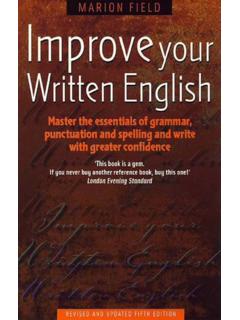
Transcription of Improveyour Written English
1 Improve your Written English Visit our How To website at At you can engage in conversation with our authors all of whom have been there and done that' in their specialist fields. You can get access to special offers and additional content but most importantly you will be able to engage with, and become a part of, a wide and growing community of people just like yourself. At you'll be able to talk and share tips with people who have similar interests and are facing similar challenges in their lives. People who, just like you, have the desire to change their lives for the better be it through moving to a new country, starting a new business, growing your own vegetables, or writing a novel.
2 At you'll find the support and encouragement you need to help make your aspirations a reality. For more information on punctuation and grammar visit How To Books strives to present authentic, inspiring, practical information in their books. Now, when you buy a title from How To Books, you get even more than just words on a page. Improve your Written English Master the essentials of grammar, punctuation and spelling and write with greater confidence MARION FIELD. Published by How To Content, A division of How To Books Ltd, Spring Hill House, Spring Hill Road, Begbroke, Oxford OX5 1RX, United Kingdom.
3 Tel: (01865) 375794. Fax: (01865) 379162. How To Books greatly reduce the carbon footprint of their books by sourcing their typesetting and printing in the UK. All rights reserved. No part of this work may be reproduced or stored in an information retrieval system (other than for purposes of review) without the express permission of the publisher in writing. The right of Marion Field to be identified as author of this work has been asserted by her in accordance with the Copyright, Designs and Patents Act 1988.
4 2009 Marion Field Second edition 1998. Reprinted with amendments 1999. Third edition 2001. Fourth edition 2003. Reprinted 2005 (twice). Reprinted 2006. Reprinted 2007. Fifth edition 2009. First published in electronic form 2009. British Library Cataloguing in Publication Data. A catalogue record for this book is available from the British Library. ISBN: 978 1 84803 330 6. Produced for How To Books by Deer Park Productions, Tavistock Typeset by kestrel Data, Exeter NOTE: The material contained in this book is set out in good faith for general guidance and no liability can be accepted for loss or expense incurred as a result of relying in particular circumstances on statements made in the book.
5 Laws and regulations are complex and liable to change, and readers should check the current position with the relevant authorities before making personal arrangements. Contents List of illustrations ix Preface xi PART ONE: THE BASICS. 1 Discovering Grammar 3. Identifying nouns 3. Using capital letters 5. Replacing nouns with pronouns 7. Knowing the articles 10. Understanding verbs 10. Revising the points 17. Practising what you've learnt 17. 2 Expanding your Knowledge 19. Making words agree' 19. Introducing clauses 21.
6 Handling phrases 25. Using adjectives to colour your writing 25. Employing adverbs 27. Using prepositions 28. Revising the points 29. Practising what you've learnt 30. 3 Polishing up your Punctuation 32. Knowing when to stop 32. Using commas correctly 33. Making use of the semi-colon, the colon and the dash 37. v vi / I M P R O V E Y O U R W R I T T E N E N G L I S H. Remembering the question mark and the exclamation mark 39. Revising the points 40. Practising what you've learnt 41. 4 Paragraphing your Work 43.
7 Structuring a paragraph 43. Setting out direct speech 46. Changing to indirect speech 49. Writing a play 50. Revising the points 50. Practising what you've learnt 51. 5 Checking your Spelling 53. Establishing the ground rules 53. Avoiding common mistakes 57. Using the dictionary 63. Making use of the thesaurus 65. Revising the points 66. Practising what you've learnt 66. 6 Looking at Apostrophes and Abbreviations 68. Showing possession 68. Abbreviating words 70. Handling contractions 72. Using initial letters 73.
8 Looking at acronyms 73. Revising the points 74. Practising what you've learnt 74. 7 Improving your Style 76. Recognising common mistakes 76. Avoiding unnecessary repetition 83. Making comparisons 84. Eliminating jargon 86. Stimulating your imagination 87. Checking your work 92. Using the checklist 95. Practising what you've learnt 95. C O N T E N T S / vii PART TWO: English IN ACTION. 8 Writing an Essay and a Short Story 99. Researching your essay 99. Structuring your essay 103. Writing the essay 104. Plotting the short story 105.
9 Editing your work 106. Practising what you've learnt 108. 9 Summarising and Reporting 109. Writing a summary 109. Compiling a report 111. Checking your summary 115. Checking your report 115. Practising what you've learnt 115. 10 Filling in Forms 117. Working online 117. Providing the basic information 117. Coping with a variety of forms 119. Writing legibly 130. Asking for help 131. Witnessing the signature 131. Checking for errors 131. Practising what you've learnt 132. 11 Writing Letters 133. Using e-mail 133.
10 Writing a personal letter 135. Writing a formal letter 136. Ending the letter 137. Drafting your letter 137. Producing a variety of letters 140. Checking your work 146. Practising what you've learnt 147. 12 Making Applications 148. Applying to university 148. Applying for a job 148. viii / I M P R O V E Y O U R W R I T T E N E N G L I S H. Preparing a Curriculum Vitae (CV) 149. Filling in the application form 155. Writing a covering letter 157. Acquiring referees 157. Checking for errors 159. Practising what you've learnt 159.