Example: stock market
Improving behaviour in schools - …
Improving behaviour in schools Acting on this guidance Major decisions about your school’s approach to behaviour are likely to be most effective if made in conjunction with a range of stakeholders including teaching and non-teaching staff, pupils, and parents. To maximise its impact, this report should be read in
Tags:
Information
Domain:
Source:
Link to this page:
Documents from same domain
IMPROVING LITERACY IN SECONDARY SCHOOLS
d2tic4wvo1iusb.cloudfront.net‘Improving Literacy in Secondary Schools Guidance Report’, which sets out seven recommendations for teachers and school leaders to support students to develop their literacy skills. The Literacy Vignettes are drawn directly from guidance report and they describe typical literacy practices that occur in many secondary schools across the country.

IMPROVING LITERACY IN SECONDARY SCHOOLS
d2tic4wvo1iusb.cloudfront.netin English and maths at GCSE, and fewer than 2% to achieve the English Baccalaureate. Historically, however, many secondary school teachers have not seen themselves as literacy experts. Teaching children to read has been the domain of primary schools, or the responsibility of teachers in the English department at a push.

SPECIAL EDUCATIONAL NEEDS IN MAINSTREAM SCHOOLS
d2tic4wvo1iusb.cloudfront.netThe starting points for educating all pupils are the same: an acceptance of diversity, pupils’ rights, and the knowledge that all pupils can learn if they receive good teaching. All pupils have a right to effective teaching and full participation in the community of a school as set out in international agreements ( the
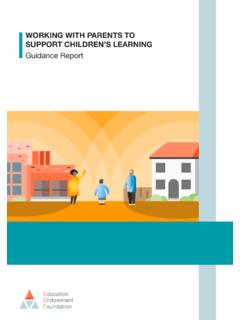
WORKING WITH PARENTS TO SUPPORT CHILDREN’S LEARNING
d2tic4wvo1iusb.cloudfront.netparental engagement are consistently associated with children’s academic outcomes. We also know that a parent’s job, education and income matters less to their child’s development than what they actually do with them. Schools and parents have …
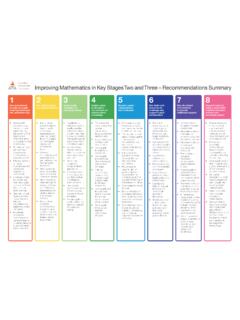
Improving Mathematics in Key Stages Two and Three ...
d2tic4wvo1iusb.cloudfront.netteach a specific mathematical concept • Manipulatives should be temporary; they should act as a ‘scaffold’ that can be removed once independence is achieved 3 Teach pupils strategies for solving problems • If pupils lack a well-rehearsed and readily available method to solve a problem they need to draw on problem-solving strategies to

IMPROVING MATHEMATICS IN KEY STAGES TWO AND THREE
d2tic4wvo1iusb.cloudfront.net• Teach pupils that fractions and decimals extend the number system beyond whole numbers • Teach pupils to recognise and use mathematical structure 2 Use manipulatives and representations • Manipulatives (physical objects used to teach maths) and representations (such as number lines and graphs) can help pupils engage with mathematical ...
IMPROVING LITERACY IN KEY STAGE 2
d2tic4wvo1iusb.cloudfront.netIn their pairs/triads children make a close reading of their section of text and think about meaning, audience, and purpose. This requires children to look closely at the writer’s use of language and consider characterisations, etc. Each child has a copy of the text to annotate in order to inform their performance. This is discussed and agreed
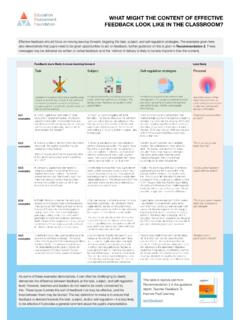
WHAT MIGHT THE CONTENT OF EFFECTIVE FEEDBACK LOOK …
d2tic4wvo1iusb.cloudfront.netIn science, a class is identifying the components of a circuit. The teacher notes that they are missing some key features. ‘Many of you are identifying the bulbs and wires in this circuit. Can you also label the switches and cells?’ In history, pupils are having a class debate on whether Boudica was a hero. The teacher notes
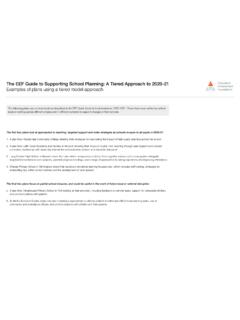
The EEF Guide to Supporting School Planning: A Tiered ...
d2tic4wvo1iusb.cloudfront.netA plan from Kingsbridge Community College detailing their strategies for maximising the impact of high-quality teaching across the school 2. A plan from Edith Cavell Academy and Nursery in Norwich showing their focus on Quality First Teaching through peer support and a broad ... Long Stratton High School, Norwich Targeted academic support 3 2 ...
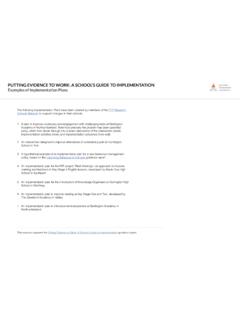
PUTTING EVIDENCE TO WORK: A SCHOOL’S GUIDE TO ...
d2tic4wvo1iusb.cloudfront.netA plan to improve vocabulary and engagement with challenging texts at Bedlington ... Monitoring • Periodic SLT drop-ins, lesson observation, work scrutiny, planner check and SOW. Clear, actionable ... need to if we are going to improve our vulnerable students’ attendance rates.
Related documents

What works in promoting social and emotional well-being ...
www.ncb.org.ukl improving school behaviour and reductions in risky behaviour. It deals with two overlapping areas of central importance in schools, which need to be integrated to be effective: l ‘social and emotional well-being’ refers to a state of positive mental health and wellness. It involves a sense of optimism, confidence,
School attendance parental responsibility measures - …
assets.publishing.service.gov.ukLocal authorities and all schools have legal powers to use parenting contracts, parenting orders and penalty notices to address poor attendance and behaviour in school. In addition to using these powers, local authorities and schools candevelop other practices to improve attendance.

What equality law means for you as an education provider ...
www.equalityhumanrights.comWhat equality law means for you as an education provider: schools . Section 1: Introduction 1.1 The schools provisions of the Act This guidance deals with the schools provisions of the Equality Act 2010 which prohibit schools from discriminating against, harassing or victimising: • prospective pupils • pupils at the school

The Impact of Parental Involvement on Children’s Education
dera.ioe.ac.ukParental behaviour has a bigger effect than school quality on pupils’ attainment at Key Stage 2.11 However this research also found that a child’s ability on entry to school is the most important factor in predicting Key Stage 2 attainment across subjects (followed by socio-economic background factors including income and parental education).