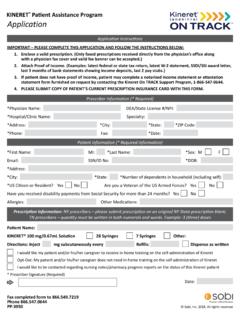
Transcription of (incidence - KineretRx.com
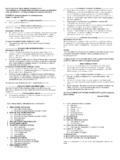
1 HIGHLIGHTS OF PRESCRIBING INFORMATION These highlights do not include all the information needed to use KINERET safely and effectively. See full prescribing information for KINERET. KINERET (anakinra) injection, for subcutaneous use Initial Approval: 2001 ----------------------------RECENT MAJOR CHANGES-------------------------- Warnings and Precautions ( ) ----------------------------INDICATIONS AND USAGE--------------------------- Kineret is an interleukin-1 receptor antagonist indicated for.
2 Rheumatoid Arthritis (RA) Reduction in signs and symptoms and slowing the progression of structural damage in moderately to severely active rheumatoid arthritis, in patients 18 years of age or older who have failed 1 or more disease modifying antirheumatic drugs (DMARDs) ( ) Cryopyrin-Associated Periodic Syndromes (CAPS) Treatment of Neonatal-Onset Multisystem Inflammatory Disease (NOMID) ( ) ----------------------DOSAGE AND ADMINISTRATION----------------------- Rheumatoid Arthritis (RA) The recommended dose of Kineret for the treatment of patients with rheumatoid arthritis is 100 mg/day administered daily by subcutaneous injection.
3 The dose should be administered at approximately the same time every day ( ) Physicians should consider a dose of 100 mg of Kineret administered every other day for RA patients who have severe renal insufficiency or end stage renal disease (defined as creatinine clearance < 30 mL/min, as estimated from serum creatinine levels) ( ) Cryopyrin-Associated Periodic Syndromes (CAPS) The recommended starting dose of Kineret is 1-2 mg/kg daily for NOMID patients. The dose can be individually adjusted to a maximum of 8 mg/kg daily to control active inflammation.
4 ( ) Physicians should consider administration of the prescribed Kineret dose every other day for NOMID patients who have severe renal insufficiency or end stage renal disease (defined as creatinine clearance < 30 mL/min, as estimated from serum creatinine levels) ( ) See full prescribing information for administration instructions ( ) ---------------------DOSAGE FORMS AND STRENGTHS---------------------- Injection: 100 mL solution in a single-use prefilled syringe for subcutaneous injection. Graduated syringe allows for doses between 20 mg and 100 mg.
5 (3) -------------------------------CONTRAIND ICATIONS------------------------------ Known hypersensitivity to E coli-derived proteins, Kineret, or to any component of the product. (4) -----------------------WARNINGS AND PRECAUTIONS------------------------ In RA, discontinue use if serious infection develops. In Kineret-treated NOMID patients, the risk of a NOMID flare when discontinuing Kineret treatment should be weighed against the potential risk of continued treatment. Do not initiate Kineret in patients with active infections.
6 ( ) Use in combination with Tumor Necrosis Factor (TNF) blocking agents is not recommended ( ) Hypersensitivity reactions, including anaphylactic reactions and angioedema, have been reported ( ) The impact of treatment with Kineret on active and/or chronic infections and the development of malignancies is not known ( ) Live vaccines should not be given concurrently with Kineret ( ) Neutrophil counts should be assessed prior to initiating Kineret treatment, and while receiving Kineret, monthly for 3 months, and thereafter quarterly for a period up to 1 year ( ) ------------------------------ADVERSE REACTIONS------------------------------- Rheumatoid Arthritis (RA) Most common adverse reactions (incidence 5%)
7 Are injection site reaction, worsening of rheumatoid arthritis, upper respiratory tract infection, headache, nausea, diarrhea, sinusitis, arthralgia, flu like-symptoms, and abdominal pain ( ) NOMID The most common AEs during the first 6 months of treatment (incidence >10%) are injection site reaction, headache, vomiting, arthralgia, pyrexia, and nasopharyngitis ( ) To report SUSPECTED ADVERSE REACTIONS, contact 1-866-547-0644 or FDA at 1-800-FDA-1088 or ------------------------------DRUG INTERACTIONS---------------------------- --- A higher rate of serious infections has been observed in RA patients treated with concurrent Kineret and etanercept therapy than in patients treated with etanercept alone.
8 Use of Kineret in combination with TNF blocking agents is not recommended (7) -----------------------USE IN SPECIFIC POPULATIONS------------------------ Pediatric use: Kineret is indicated for use in pediatric patients with NOMID ( ) Geriatric use: Because there is a higher incidence of infections in the elderly population in general, caution should be used in treating the elderly ( ) Renal impairment: This drug is known to be substantially excreted by the kidney, and the risk of toxic reactions to this drug may be greater in patients with impaired renal function ( ) See 17 for PATIENT COUNSELING INFORMATION and FDA-approved patient labeling.
9 Revised: 05/2016 _____FULL PRESCRIBING INFORMATION: CONTENTS* 1 INDICATIONS AND USAGE Active Rheumatoid Arthritis Cryopyrin-Associated Periodic Syndromes (CAPS) 2 DOSAGE AND ADMINISTRATION Active Rheumatoid Arthritis Cryopyrin-Associated Periodic Syndromes (CAPS) Renal Impairment Administration 3 DOSAGE FORMS AND STRENGTHS 4 CONTRAINDICATIONS 5 WARNINGS AND PRECAUTIONS Serious Infections Use With TNF Blocking Agents Hypersensitivity Reactions Immunosuppression Immunizations Neutrophil Count 6 ADVERSE REACTIONS Clinical Studies Experience in RA Clinical Studies Experience in NOMID Postmarketing Experience 7 DRUG INTERACTIONS TNF Blocking Agents 8 USE IN SPECIFIC POPULATIONS Pregnancy Nursing Mothers Pediatric Use Geriatric Use
10 Renal Impairment Hepatic Impairment 10 OVERDOSAGE 11 DESCRIPTION 12 CLINICAL PHARMACOLOGY Mechanism of Action Pharmacokinetics 13 NONCLINICAL TOXICOLOGY Carcinogenesis, Mutagenesis, Impairment of Fertility 14 CLINICAL STUDIES Clinical studies in RA Clinical studies in NOMID 15 REFERENCES 16 HOW SUPPLIED/STORAGE AND HANDLING 17 PATIENT COUNSELING INFORMATION *Sections or subsections omitted from the full prescribing information are not PRESCRIBING INFORMATION 1 INDICATIONS AND USAGE Active Rheumatoid Arthritis Kineret is indicated for the reduction in signs and symptoms and slowing the progression of structural damage in moderately to severely active