Transcription of Increasing Intake Interview Skills: A Creative Approach
1 VISTAS Online is an innovative publication produced for the American Counseling Association by Dr. Garry R. Walz and Dr. Jeanne C. Bleuer of Counseling Outfitters, LLC. Its purpose is to provide a means of capturing the ideas, information and experiences generated by the annual ACA Conference and selected ACA Division Conferences. Papers on a program or practice that has been validated through research or experience may also be submitted. This digital collection of peer-reviewed articles is authored by counselors, for counselors. VISTAS Online contains the full text of over 500 proprietary counseling articles published from 2004 to present.
2 VISTAS articles and ACA Digests are located in the ACA Online Library. To access the ACA Online Library, go to and scroll down to the LIBRARY tab on the left of the Under the Start Your Search Now box, you may search by author, title and key The ACA Online Library is a member s only benefit. You can join today via the web: and via the phone: 800-347-6647 is commissioned by and is property of the American Counseling Association, 5999 Stevenson Avenue, Alexandria, VA 22304. No part of Vistas may be reproduced without express permission of the American Counseling Association. All rights ACA at: VISTAS OnlineSuggested APA style reference: Freeburg, M.
3 N., & Van Winkle, J. L. (2011). Increasing Intake Interview skills: A Creative Approach . Retrieved from vistas/vistas11 Article 33 Increasing Intake Interview Skills: A Creative Approach Melissa N. Freeburg and Joseph L. Van Winkle Freeburg, Melissa, N., is an Assistant Professor as Bridgewater State University. She teaches Assessment, Research, Internship Experiences, and Creativity in Counseling. Melissa is active in professional organizations and has held leadership positions at the national, regional, and state level. Van Winkle, Joseph, L., is a licensed Mental Health Counselor at Atlantic Counseling in Massachusetts.
4 His clinical focus is in marriage and family, children, and adolescents. Introduction Most every professional counseling relationship between a counselor and a client begins with an Intake Interview . Depending on the clinical setting, the Intake process may vary from structured to unstructured models, each with a similar core theme of information customarily gathered. Effective initial Intake interviews are considered a balance between gathering information and developing a therapeutic working alliance (Whiston, 2009). Furthermore, research indicates that to become effective in Intake interviewing so that a working alliance is fostered, counselors need to follow guidelines and receive training to obtain accurate and valid information (Duley, Cancelli, Kratochwill, Bergan & Meredith, 1983).
5 Undoubtedly, this need for training to be successful in executing Intake interviews is why counseling education textbooks on assessment and appraisal (psychological testing) include chapters dedicated to the Intake Interview . These chapters include discussions on: the importance of Intake interviews, information relevant and typically gathered, defining the client s presenting concern, interviewing and communication skills, and specific techniques (Hood & Johnson, 2007; MacCluskie, 2010; Whiston, 2009). Occasionally these same text books provide case studies so that counselors may interact with a conceptualized client and how that client s personal information may be retrieved during the Intake process.
6 However, these case studies rarely represent a comprehensive exposure to the plethora of client personality and presenting concern dynamics. And the counselor reads such statements as, A good Intake Interview will enable you to answer these broad questions and generate a comprehensive, culturally sensitive conceptualization of your client (MacCLuskie, 2010, p. 224), with little applied understanding that the Intake Interview is really quite dynamic and that a great deal of skill is necessary to adapt to each individual client s needs. Ideas and Research You Can Use: VISTAS 2011 2 Recognizing that counseling students, and even professionals practicing in the field, could use an additional set of vignettes to interact with, and more comprehensively express challenges in the Intake Interview , the current authors pose ten new ones in this article.
7 In Irvin Yalom s book, The Theory and Practice of Group Psychotherapy (2005), he includes a chapter dedicated to problem patients. In this chapter he presents general client types with a description, effects on the group, and therapeutic considerations. Modeling his theoretical design, the ten vignettes each represent a type of client that represents different and unique challenges in the Intake Interview process. Furthermore, to reduce anxiety commonly connected to assessment based activities (Centra, 1993), and to make the interaction more Creative , the use of commonplace storybook characters have been used.
8 Storybook Assessment Activity The intent of the ten vignettes presented here are to challenge students and practicing counselors to reflect on the dynamics and diverseness that different clients may present. This set of ten is not a comprehensive work of all potential client types, but a solid starting point. Additionally, this material may be useful in a variety of settings, for example, practitioners as a method to refresh and challenge skill sets, at a workshop, and as a classroom experiential activity. The initial design was intended for students to engage in the Creative , silly, character activities by acting out their character while their partner/counselor practiced Intake skills.
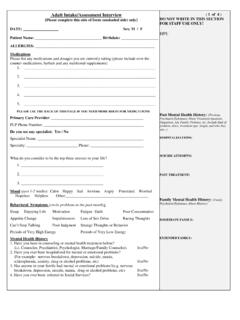
9 A variety of Intake instruments (psychosocial, bio-psychosocial, general Intake forms, and the Mini Mental Status Exam) were provided for experimentation. Students were told that all characters are based on popular storybook characters so that during the Intake process there were no immediate assumptions that each person acting in their role was delusional. Providing the dyads with about 10-15 minutes in each role is sufficient. One method to debrief the experience is to tackle each character individually. The individual acting as the counselor can be given the opportunity to share what challenges they may have faced when interviewing their client.
10 Probing questions may be used to see what assumptions about the client they may have drawn, what strategy changes did they make in action, what stumped them, and of course, what went well? Following each vignette below is further discussion unique for each character presented. The origination of the characters stemmed from the creator s creativity but also a desire to provide students with an integration of the Council for Accreditation of Counseling and Related Programs (CACREP, 2009) core areas; helping relationships, human growth and development, social and cultural diversity, and professional orientation and ethics.