Transcription of Info Sheet - Smoke Alarm Legislation
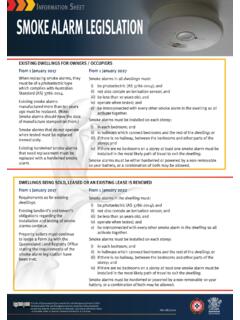
1 InformatIon Sheet State of Queensland (Queensland Fire and Emergency Services) 2020 All Queensland Fire and Emergency Services material in this document - except any material protected by a trademark, and unless otherwise noted - is licensed under a Creative Commons Attribution license. Smoke Alarm LEGISLATIONVer 08/2020 EXISTING DWELLINGS FOR OWNERS / OCCUPIERSFrom 1 January 2017 From 1 January 2027 When replacing Smoke alarms, they must be of a photoelectric type which complies with Australian Standard (AS) 3786-2014. Existing Smoke alarms manufactured more than ten years ago must be replaced. (Note: Smoke alarms should have the date of manufacture stamped on them.) Smoke alarms that do not operate when tested must be replaced hardwired Smoke alarms that need replacement must be replaced with a hardwired Smoke Alarm . Smoke alarms in all dwellings must:i) be photoelectric (AS 3786-2014); andii) not also contain an ionisation sensor; and iii) be less than 10 years old; andiv) operate when tested; andv) be interconnected with every other Smoke Alarm in the dwelling so all activate alarms must be installed on each storey:i) in each bedroom; andii) in hallways which connect bedrooms and the rest of the dwelling; or iii) if there is no hallway, between the bedrooms and other parts of the storey; andiv) if there are no bedrooms on a storey at least one Smoke Alarm must be installed in the most likely path of travel to exit the alarms must be either hardwired or powered by a non-removable 10 year battery, or a combination of both may be BEING SOLD, LEASED OR AN EXISTING LEASE IS RENEWEDFrom 1 January 2017 From 1 January 2022 requirements as for existing dwellings.
2 Existing landlord s and tenant s obligations regarding the installation and testing of Smoke alarms sellers must continue to lodge a Form 24 with the Queensland Land Registry Office stating the requirements of the Smoke Alarm Legislation have been alarms in the dwelling must:i) be photoelectric (AS 3786-2014); andii) not also contain an ionisation sensor; and iii) be less than 10 years old; andiv) operate when tested; andv) be interconnected with every other Smoke Alarm in the dwelling so all activate alarms must be installed on each storey:i) in each bedroom; andii) in hallways which connect bedrooms and the rest of the dwelling; or iii) if there is no hallway, between the bedrooms and other parts of the storey; andiv) if there are no bedrooms on a storey at least one Smoke Alarm must be installed in the most likely path of travel to exit the alarms must be hardwired or powered by a non-removable 10-year battery, or a combination of both may be 2 NEW DWELLINGS AND DWELLINGS BEING SUBSTANTIALLY RENOVATEDFrom 1 January 2017 Smoke alarms in the dwelling must:i) be photoelectric (AS 3786-2014); andii) not also contain an ionisation sensor; and iii) be hardwired to the mains power supply with a secondary power source ( battery); andiv) be interconnected with every other Smoke Alarm in the dwelling so all activate alarms must be installed on each storey:i) in each bedroom; andii) in hallways which connect bedrooms and the rest of the dwelling; or iii) if there is no hallway, between the bedrooms and other parts of the storey.
3 Andiv) if there are no bedrooms on a storey at least one Smoke Alarm must be installed in the most likely path of travel to exit the development approval process for new dwellings and substantial renovations will ensure that building approvals received on or after this date will bring dwellings into compliance with the new LOCATIONS FOR INSTALLING Smoke ALARMSW here practicable Smoke alarms must be placed on the ceiling. Smoke alarms must not be placed:i) within 300mm of a corner of a ceiling and a wall;ii) within 300mm of a light fitting;iii) within 400mm of an air-conditioning vent;iv) within 400mm of the blades of a ceiling are special requirements for stairways, sloping ceilings, and ceilings with exposed beams. These requirements are explained in the Building Fire Safety Regulation 2008. Penalties may be imposed for non compliance with the OF TERMS*Dwellings - houses, townhouses (Class 1A) and units (Class 2).Photoelectric - the method the device uses to detect Smoke .
4 Hardwired - connected to the domestic dwelling s electricity - if one Smoke Alarm sounds all the other Smoke alarms will also sound. Interconnection can be wired or - a space within a building which is situated between one floor level and the floor level or roof above. *Refer to specific Legislation for full definitions. For more information visit or email Source documents Fire and Emergency Services Act 1990 Building Fire Safety Regulation 2008 Building Regulation 2006 Australian Standard (AS) 3786-2014 Land Title Act 1994