Example: air traffic controller
Information about your procedure from The British ...
chest infection, pulmonary embolus, stroke, deep vein thrombosis, heart attack and death) Between 1 in 50 & 1 in 250 patients (your anaesthetist can estimate your individual risk) ... • the Patient Information Forum; and • the Plain English Campaign. Disclaimer
Tags:
Information
Domain:
Source:
Link to this page:
Documents from same domain

Key Points - BAUS
www.baus.org.ukTemporary insertion of a bladder catheter Most patients Recurrent (new) stone formation over the next five to 10 years, requiring further surgery or other treatment 1 in 2 patients (50%) Urinary infection requiring antibiotic treatment Between 1 in 2 & 1 in 10 patients Need for more than one puncture to clear
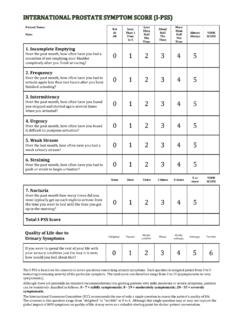
0 1 2 3 4 5 0 1 2 3 4 5 - Home | The British Association ...
www.baus.org.ukindicating increasing severity of the particular symptom. The total score can therefore range from 0 to 35 (asymptomatic to very symptomatic). ... The International Consensus Committee (ICC) recommends the use of only a single question to assess the patient's quality of life.
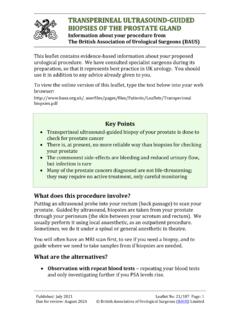
Information about your procedure from The British ...
www.baus.org.ukthrough your perineum (the skin between your scrotum and rectum). We usually perform it using local anaesthetic, as an outpatient procedure. Sometimes, we do it under a spinal or general anesthetic in theatre. You will often have an MRI scan first, to see if you need a biopsy, and to guide where we need to take samples from if biopsies are needed.
Information about your procedure from The British ...
www.baus.org.uk• the Information Standard; • the Patient Information Forum; and • the Plain English Campaign. Disclaimer We have made every effort to give accurate information but there may still be errors or omissions in this leaflet. BAUS cannot accept responsibility for any loss from action taken (or not taken) as a result of this information.
Key Points - BAUS
www.baus.org.ukYour surgeon will try to preserve the muscle fibres and nerves that control continence. If you still leak some urine after a year (as 1 in 20 to 1 in 33 patients do), this can be corrected by another procedure such as an artificial urinary sphincter or a male sling. The erection nerves lie very close to your prostate, forming a cobweb of
Key Points - BAUS
www.baus.org.uknot a treatment for stress urinary incontinence (leakage of urine when you exercise, sneeze or strain). The procedure involves passing a telescope into your bladder, through your urethra (waterpipe), and giving several injections of Botox (botulinum Key Points • Botulinum toxin-A bladder injections are performed to treat overactive bladder
Key Points - BAUS
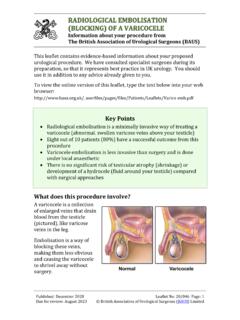
www.baus.org.uk• bleeding from the puncture site when you get home is very rare but, if it does happen, press firmly on the site for 10 to 20 minutes; this should stop the bleeding • if the bleeding does not stop, you should contact your GP or go to your local Accident & Emergency Department Recurrence of the varicocele Between 1 in 10 &
Information about your procedure from The British ...
www.baus.org.ukInformation about your procedure from The British Association of Urological Surgeons (BAUS) Published: December 2020 Leaflet No: 20/129 Page: 1
What are lower urinary tract symptoms? - BAUS
www.baus.org.ukbladder and bowel are close to each other, a full bowel can affect your bladder function. • Eat a balanced diet - include both soluble fibre (oats, barley, berries & fruit) and insoluble fibre (roughage such as wheat-based foods, cereal, vegetables & nuts) • Eat regular meals • Empty your bowel when you feel the need - delaying may lead to
Key Points - BAUS
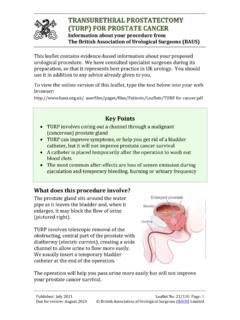
www.baus.org.uk• TURP involves coring out a channel through a malignant (cancerous) prostate gland • TURP can improve symptoms, or help you get rid of a bladder catheter, but it will not improve prostate cancer survival • A catheter is placed temporarily after the operation to wash out blood clots
Related documents

Intravenous drugs used for the induction of anaesthesia
www.frca.co.ukA patient with intestinal obstruction requires an emergency laparotomy. 2. A patient with a history of throat cancer, showing marked stridor and ... • To maintain anaesthesia for longer procedures by intravenous infusion. ... venous blood to the right side of the heart, through the pulmonary circulation, and via the left side of the heart ...
DRUG NAME: Bleomycin - BC Cancer
www.bccancer.bc.caIdentification of patients with bleomycin induced pulmonary toxicity can be very difficult due to the non-specific signs and symptoms. 6. Treatment includes corticosteroids for pneumonitis to prevent pulmonary fibrosis and antibiotics for infectious pneumonitis. See Special Precaution section for risk factors which can predispose a patient to BPT.

Opioid-Free Anaesthesia
resources.wfsahq.orgThe adequate control of haemodynamic responses during anaesthesia does not guarantee that a patient will emerge from ... (OSAS), chronic obstructive pulmonary disease, asthma, acute or chronic opioid addiction, or chronic regional pain syndromes, as well as those undergoing cancer surgeries and for patients in an ERAS pathway.
DRUGS USED IN ICU - Department Of Pulmonary Medicine
chestgmcpatiala.weebly.comanaesthesia. ii) Topically prior to nasal intubation. iii) Hypotension following sympathetic ... obstructive pulmonary disease (COPD) ii) Acute severe asthma or exacerbation of COPD iii) Bronchospasm 2° to infection, aspiration or during mechanical ventilation, ... examine patient while awake (calm or agitated)
ICS Guidance for Prone Positioning of the Conscious COVID ...
emcrit.orgApr 12, 2020 · David Whitmore – Consultant in Intensive Care and Anaesthesia, Countess of Chester NHS Trust Disclaimer: Neither the Intensive Care Society or the authors accept any responsibility for any loss or damage arising from actions or decisions based on the information contained within this publication. Ultimate responsibility for patient safety with
Sedation, analgesia and anaesthesia in the radiology ...
www.rcr.ac.ukto rescue the patient by correcting the physiological consequences and returning the patient to the intended level of sedation. § Analgesia and sedation are closely related. Anxiety potentiates pain and vice versa. Analgesia is therefore crucial and can be multimodality including local and regional anaesthesia and opioid and non-opioid drugs. 3.
Pulse Oximetry Training Manual - WHO
www.who.intstores in the lungs. If a patient stops breathing and is not ventilated, the amount of oxygen in the lungs will rapidly diminish. If the patient has been given 100% oxygen to breathe for several minutes prior to induction of anaesthesia, the increased oxygen reservoir will supply much needed oxygen, adding potentially life-saving minutes.

Using Pulse Oximeters - WHO
www.who.intan early warning whenever the patient starts to desaturate. Most oximeters have an audible tone which gets lower in pitch as the SpO 2 falls. This audible note allows the anaesthetist to concentrate on looking after the patient but still hear the pulse rate and SpO 2. Pulse oximeters have made anaesthesia much safer since their introduction.

British Thoracic Society guideline for diagnostic exible ...
thorax.bmj.comTopical anaesthesia Lidocaine should be used for topical anaesthesia during bronchoscopy, unless contraindicated. (Grade A) Nasal topical anaesthesia is most effectively provided using 2% lidocaine gel. (Grade A) Both cricothyroid and spray-as-you-go techniques are effect-ive in delivering lidocaine to the vocal cords and trachea. (Grade B)