Transcription of InfoSheet - Clavicle Fracture - KWOC
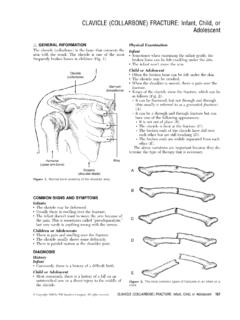
1 InfoSheet Clavicle Fracture David M. Klein, MD Kennedy-White Orthopaedic Center WHAT IS A Clavicle Fracture ? A Clavicle Fracture is a partial or complete break in the Clavicle or collarbone . This bone connects the breastbone (sternum) to your shoulder blade (scapula) and the rest of your upper extremity. The Clavicle is one of the most commonly broken bones in the body. HOW DOES IT HAPPEN? Because of its small size, any strong force on the shoulder can cause the Clavicle to break. This can happen from falling on an outstretched arm and hand, falling on your shoulder, or a powerful blow to the collarbone . WHAT ARE THE SYMPTOMS? You may hear a snap or crack when bone breaks. Typical symptoms include pain, swelling, deformity, and difficulty moving your arm or shoulder.
2 WHAT IS THE TREATMENT? Immediate care includes immobilizing the arm and shoulder. The arm should be held close to the body with a sling or using your other arm. You can place an ice pack wrapped in a towel on the area. A sling or a figure-of-8 brace may be applied for support while the Clavicle heals. A special bone stimulator or surgery may be needed if the Fracture does not heal well. The bone stimulator creates an electromagnetic field around the Fracture that can help nonunions unite. If surgery is chosen, the bony fragments will be reshaped (if needed) and re-attached with hardware, such as a plate or pin and screws. WHAT CAN I EXPECT DURING MY RECOVERY? You will likely have some pain for several weeks.
3 Black-and-blue marks will form and may travel down the chest and down the arm. Your doctor may recommend medications and ice packs (3 to 4 times per day, 15 to 20 minutes at a time) to reduce swelling and pain. You will be given instructions on how to protect your Clavicle during the healing process. Movement at the forearm, wrist, and fingers may begin a few days after the injury. You can begin shoulder movement when cleared by your doctor. You may also be referred for physical and occupational therapy during your rehabilitation. The goal of rehabilitation is to restore function of the Clavicle and help you return to your regular activities. Full recovery for a Clavicle Fracture may take 3 to 6 months or longer.
4 The deformity or bump on shoulder is permanent. Recuperation depends on several factors including your age, overall health, extent of the break, and how well you follow your rehabilitation program. At the end of the healing process, you should be able to move your shoulder and arm without much pain.