Transcription of Innocents Who Plead Guilty
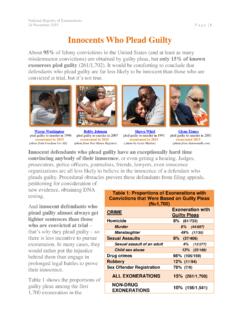
1 National Registry of Exonerations 24 November 2015 P a g e | 1 Innocents Who Plead Guilty About 95% of felony convictions in the United States (and at least as many misdemeanor convictions) are obtained by Guilty pleas, but only 15% of known exonerees pled Guilty (261/1,702). It would be comforting to conclude that defendants who Plead Guilty are far less likely to be innocent than those who are convicted at trial, but it s not true. Wayne Washington Bobby Johnson Shawn Whirl Glenn Tinney pled Guilty to murder in 1996 pled Guilty to murder in 2007 pled Guilty to murder in 1991 pled Guilty to murder in 2001 exonerated in 2015 exonerated in 2015 exonerated in 2015 exonerated 2015 (photo from Freedom For All) (photo from New Haven Register) ( photo by Lewis Marien) (photo from )
2 Innocent defendants who Plead Guilty have an exceptionally hard time convincing anybody of their innocence, or even getting a hearing. Judges, prosecutors, police officers, journalists, friends, lawyers, even innocence organizations are all less likely to believe in the innocence of a defendant who pleads Guilty . Procedural obstacles prevent these defendants from filing appeals, petitioning for consideration of new evidence, obtaining DNA testing. And innocent defendants who Plead Guilty almost always get lighter sentences than those who are convicted at trial that s why they Plead Guilty so there is less incentive to pursue exoneration.
3 In many cases, they would rather put the injustice behind them than engage in prolonged legal battles to prove their innocence. Table 1 shows the proportions of Guilty pleas among the first 1,700 exoneration in the Table 1: Proportions of Exonerations with Convictions that Were Based on Guilty Pleas (N=1,700) CRIME Exoneration with Guilty Pleas Homicide 8% (61/732) Murder 6% (44/697) Manslaughter 49% (17/35) Sexual Assaults 8% (37/466) Sexual assault of an adult 4% (12/277) Child sex abuse 13% (25/189) Drug crimes 66% (105/159) Robbery 12% (11/94) Sex Offender Registration 78% (7/9) ALL EXONERATIONS 15% (261/1,700)
4 NON-DRUG EXONERATIONS 10% (156/1,541) National Registry of Exonerations 24 November 2015 P a g e | 2 Harris County District Attorney Devon Anderson (photo from Houston Chronicle) Registry, for all cases and for those crimes that have more than 5 such exonerations. As the Table 1 shows, two-thirds of drug-crime exonerations include Guilty pleas. Only 9% of exonerations are for drug crimes, but drug crimes comprise 40% of all Guilty -plea cases (105/261).1 Most of this bulge is recent: 57% of known drug-crime exonerations occurred in 2014 and 2015 (90/159), and 90% of these recent drug cases are based on Guilty pleas (81/90).
5 In fact 67% of drug/ Guilty -plea exonerations are not only recent but from a single jurisdiction. Since early 2014 there have been 71 drug exonerations in Harris County (Houston), Texas, and the defendants pled Guilty in every one of them. As we ve discussed elsewhere, most of these defendants accepted plea bargains to possession of illegal drugs because they faced months in jail before trial, and years more if convicted. They were exonerated when crime labs tested those drugs after conviction and found no controlled substances. Drug testing after Guilty pleas is highly unusual, but it s a regular practice in Harris County.
6 If it were done across the country we would no doubt learn of thousands of unknown false drug convictions. And of course hundreds of thousands of additional defendants Plead Guilty every year to avoid pre-trial detention in non-drug cases. It s anyone s guess how many are innocent, but judging from drug pleas in Harris County it s a lot. Because of this recent one-county cluster of exonerations, Table 1 also displays the proportion of Guilty -plea cases among non-drug exonerations: 10% (156/1,541). Excluding drug cases, most Guilty -plea exonerations are for homicide or sexual assault, two categories that account for 70% of all known exonerations.
7 The 1 The highest proportion of Guilty pleas 78% is among the small group of exonerees who were convicted of failing to register as sex offenders (7/9). The reason seems to be that most of them thought they were Guilty (even though they may have failed to register by mistake) only to be exonerated when it was determined that they were under no duty to register. Drug testing after Guilty pleas is highly unusual, but it s a regular practice in Harris County. If it were done across the country we would no doubt learn of thousands of unknown false drug convictions.
8 National Registry of Exonerations 24 November 2015 P a g e | 3 proportion of Guilty pleas for both types of exoneration is 8%, a bit below the overall rate for non-drug cases. The proportion among adult sexual assault exonerations is particularly low, 4%. Perhaps avoiding the stigma of a sex-crime conviction is so important that few innocent rape defendants Plead Guilty unless they can Plead to non-sex crimes and those that do Plead Guilty to non-sex crimes avoid reopening their cases. We don t know. Almost three-quarters of homicide exonerees who pled Guilty were convicted of murder (44/61).
9 It appears that the great majority did so to avoid the risk of execution. All but 2 were prosecuted in death penalty states, and 70% had falsely confessed (31/44) which greatly increases the risk of conviction. They all avoided the death penalty, but the sentences they did receive were stiff: 14 were sentenced to life or life without parole, the rest got sentences that averaged 22 years. The remaining 17 homicide exonerees pled Guilty to manslaughter. They faced lesser risks more than a third were in non-death penalty states (6/17), fewer than a quarter had falsely confessed (4/17) and they received much lighter sentences: the average was 12 years; none were sentenced to life.
10 Almost all manslaughter Guilty -plea exonerations started as murder cases and were plea bargained down to manslaughter which accounts for the high rate of Guilty pleas among the comparatively small number of manslaughter exonerations, 49% (17/35). This is one piece of a general pattern across homicide exonerations. As we see in Table 2, the harsher the penalty for homicide exonerees, the fewer the Guilty pleas. No innocent defendant that we know of pled Guilty to homicide and got the maximum punishment in return. There are zero Guilty -plea exonerations with death sentences and only one plea to life without parole, Johnny Lee Wilson in Missouri who could have been sentenced to death.