Transcription of Installation Note
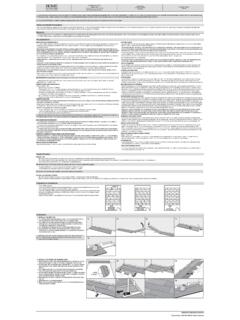
1 5 WALL AND COUNTERTOP PROFILESI nstallationJOLLY, QUADEC, RONDEC, DECO-DE, DIADEC, FINEC, INDEC, DECO-SG, ECK-E, RONDEC-DB, SCHIENE-STEP, RONDEC-STEP, and RONDEC-CT1. Select the profile according to the tile thickness and format. Note: RONDEC-DB can be used with tiles 1/4" - 1/2" (6 - mm).2. Using a notched trowel , apply thin-set mortar to the area where the profile is to be placed. If JOLLY, QUADEC, RONDEC, RONDEC-DB, DECO-DE, FINEC, or DIADEC is to be used as edging for an outside wall corner, finish tiling one wall first; then trowel thin-set mortar over the corner area of the second Press the perforated anchoring leg of profile into the mortar and trowel additional thin-set mortar over the perforated anchoring leg to ensure full coverage and support of the tile Solidly embed the tiles so that the tiled surface is flush with the top of the profile.
2 The profile should not be higher than the tiled surface, but rather up to approx. 1/32" (1 mm) lower. 5a. If the FINEC profiles, in aluminum, are used to create a 3 way external corner, into which the two upper profiles were fitted at an angle of 45 , cut the adjoining lower profile to size. The trapezoid-perforated anchor-ing leg, including the joint spacer, must be cut off straight to the visible area by a minimum dimension x, depending on the profile length; see the AE illustration below. 5b. If the FINEC profiles, in stainless steel, are used to create a 3 way external corner, into which the two upper profiles were fitted at an angle of 45 , cut the adjoining lower profile to size.
3 In this case, the trapezoid-perforated anchoring leg must be cut off by a minimum dimension x, depending on the profile length, including the visible area has to be chamfered at a 45 angle; see the E illustration below. Note: With FINEC, chamfer tiles adjacent to the profile by 45 . RONDEC-DB is intended to be higher than the tiled surface. 6. Set the tile to the integrated joint spacer, which ensures a uniform joint of 1/16" - 1/8" ( - 3 mm). With the stainless steel profiles, DECO-SG, FINEC, and RONDEC-DB, leave a space of approximately 1/16" - 1/8" ( - 3 mm).
4 7. To set tile along the face of RONDEC-CT, apply thin-set mortar to the back of the tile using a margin trowel . Press the back-buttered tiles into the face of the profile, making sure to force thin-set mortar fully into the dovetailed grooves. The tiled surface should be flush with the outer edge of the profile; the profile should not be higher than the tiled surface, but rather up to approx. 1/32" (1 mm) lower. Note: The recessed face accepts tile widths up to 1-1/8" (29 mm).8. Fill joints completely with grout or setting material.
5 Note: Remove the protective foil from ECK-E immediately after Work with materials and tools that will not scratch or damage sensitive surfaces. Setting materials must be removed immediately, especially from : Matching corners are available for DIADEC, QUADEC, RONDEC, INDEC, SCHIENE-STEP (stainless steel version, depending on vertical leg length), RONDEC-STEP, and RONDEC-CT. Connectors are available for QUADEC, RONDEC , and SCHIENE-STEP (stainless steel version).Corners and end caps are held in place with thin-set mortar. Fill the ends of the profile with thin-set mortar prior to inserting the accessories.
6 Connectors are held in place with a friction fit. Insert the connector into the profile approximately half the length of the connector piece and connect the adjacent Installation of SCHIENE-STEP corners and connectors: Install using KERDI-FIX, silicone, or similar adhesive. Prior to application, any contact-inhibiting substances ( , grease, etc.) must be removed. The accessories should overlap the profiles by at least 3/8 (10 mm). The accessories must be slid on the profiles during profiles Installation (cannot be placed over the profiles after Installation ).
7 For Installation of RONDEC sink corners(1-1/2" radius): 1. Insert the sink corner connectors into the profiles. Apply thin-set mortar to the substrate and firmly embed the profiles into the Using a margin trowel , fill the back of the sink corners with thin-set mortar. Install the corners over the connectors and align. Setting materials must be removed QUADEC-K may be used to cover assembly edges up to 1/2" ( mm) thick. DIADEC-K may be used to cover assembly edges at least 1/4" (6 mm) Fill the profile cavity with thin-set Using a notched trowel , apply thin-set mortar to the area where the profile is to be Press the profile into the mortar and align.
8 Leave a space of approximately 1/16"-1/8" ( 3 mm) between the profile and Fill joints completely with grout or setting Work with materials and tools that will not scratch or damage sensitive surfaces. Setting materials must be removed immediately. Note: QUADEC-K may also be adhered using KERDI-FIX. Matching inside/outside corners and connectors are caps are held in place with thin-set mortar. Fill the ends of the profile with thin-set mortar prior to inserting the accessories. Connectors are held in place with a friction fit.
9 Insert the connector into the profile approximately half the length of the connector piece and connect the adjacent DESIGNBASE-SL is applied to prepared walls using KERDI-FIX or other suitable adhesive. Prior to applying the adhesive, make sure that all surfaces are free from adhesion-inhibiting substances such as oil or grease. 2. Apply beads of adhesive to the back of the profile and press the profile into the wall, ensuring solid contact throughout. In the case of the stainless steel version, apply adhesive above and below the foam spacer; see illustration on page Aluminum accessories must be slid on the profiles during Installation .
10 Stainless steel accessories must be applied on top after the profile is installed. Install corners, connectors, and end caps using a permanently elastic, waterproof adhesive ( KERDI-FIX or silicone). Prior to application, any contact-inhibiting substances ( grease, etc.) must be Use a suitable cleaning agent to remove any excess adhesive from around the profile. Remove the protective foil. Note: The optional sealing lip is inserted into the profile prior to Installation . The lip must be pressed firmly into the profile (from the front for the aluminum version and from the rear for the stainless steel version) so that the front edge of the sealing lip is flush with the ECK-K/-KHK/-KI are applied to prepared wall corners using KERDI-FIX, silicone, or a similar adhesive.