Transcription of Installation, Operation and Maintenance Manual
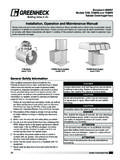
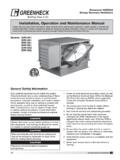
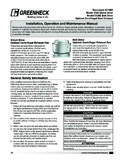
1 Sidewall Propeller Fans1 Document 471755 Sidewall Propeller FansBelt Drive, Direct Drive and ReversibleExhaust, Supply and Filtered SupplyInstallation, Operation and Maintenance ManualPlease read and save these instructions for future reference. Read carefully before attempting to assemble, install, operate or maintain the product described. Protect yourself and others by observing all safety information. Failure to comply with these instructions will result in voiding of the product warranty and may result in personal injury and/or property Propeller FansGreenheck s sidewall propeller fan line is the ideal choice for factory and warehouse applications where high volumes of air and low pressures are required.
2 From general ventilation to industrial duty, the range of construction and performance capabilities offered represent the most comprehensive sidewall propeller fan line in the spans the range between 250 to 87,000 cfm (425 to 147,814 m3/hr) with static pressures to in. wg (610 Pa). Fan sizes range from 8 to 54 inches (203 to 1372 mm) for direct drive and 20 to 72 inches (508 to 1829 mm) for belt drive. Regardless of fan size, performance or duty level, all Greenheck sidewall propeller fans are built to perform with the same high standards of reliability and durability. All models are available in exhaust or supply AER, SE1, SS1, SE2, SS2, SCE3, SCS3, SCR3, SBE-1, SBS-1, SBE-2, SBS-2, SBE-3, SBS-3, SBCE, SBCS, and SupplyFiltered supply wall housings are available in seven sizes for fans ranging from size 24 to 54 inches (610 to 1372 mm).
3 They are designed with the draw-thru concept to achieve the highest filter and fan efficiencies. Permanent 2-inch (51 mm) washable filters are accessed through a bolted panel and can be easily removed for Safety InformationOnly qualified personnel should install this fan. Personnel should have a clear understanding of these instructions and should be aware of general safety precautions. Improper installation can result in electric shock, possible injury due to coming in contact with moving parts, as well as other potential hazards. Other considerations may be required if high winds or seismic activity are present. If more information is needed, contact a licensed professional engineer before moving Follow all local electrical and safety codes, as well as the National Electrical Code (NEC) and the National Fire Protection Agency (NFPA), where applicable.
4 Follow the Canadian Electric Code (CEC) in The rotation of the propeller is critical. It must be free to rotate without striking or rubbing any stationary Motor must be securely and adequately Do not spin fan propeller faster than max cataloged fan RPM. Adjustments to fan speed significantly effects motor load. If the fan RPM is changed, the motor current should be checked to make sure it is not exceeding the motor nameplate Do not allow the power cable to kink or come in contact with oil, grease, hot surfaces or chemicals. Replace cord immediately if Verify that the power source is compatible with the Never open access doors to a duct while the fan is disconnect, lock and tag power source before installing or servicing.
5 Failure to disconnect power source can result in fire, shock or serious servicing the fan, motor may be hot enough to cause pain or injury. Allow motor to cool before should be taken in explosive carter les risques d incendie, de choc lectrique ou de blessure grave, veiller toujours d brancher, verrouiller et tiqueter la source de courant avant l installation ou l de toute intervention sur la soufflante, le moteur peut tre suffisamment chaud pour provoquer une douleur voire une blessure. Laisser le moteur refroidir avant toute preuve de pr caution dans les atmosph res Propeller Fans2 ReceivingUpon receiving the product, check to ensure all items are accounted for by referencing the delivery receipt or packing list.
6 Inspect each crate or carton for shipping damage before accepting delivery. Alert the carrier of any damage detected. The customer will make notification of damage (or shortage of items) on the delivery receipt and all copies of the bill of lading which is countersigned by the delivering carrier. If damaged, immediately contact your Greenheck Representative. Any physical damage to the unit after acceptance is not the responsibility of Greenheck Fan that all required parts and the correct quantity of each item have been received. If any items are missing, report shortages to your local representative to arrange for obtaining missing parts. Sometimes it is not possible that all items for the unit be shipped together due to availability of transportation and truck space.
7 Confirmation of shipment(s) must be limited to only items on the bill of : The filtered supply unit ships with all ordered components completely factory-assembled. The optional weatherhood ships knocked down for field assembly and are protected against damage during shipment. If the unit cannot be installed and operated immediately, precautions need to be taken to prevent deterioration of the unit during storage. The user assumes responsibility of the fan and accessories while in storage. The manufacturer will not be responsible for damage during storage. These suggestions are provided solely as a convenience to the - The ideal environment for the storage of fans and accessories is indoors, above grade, in a low humidity atmosphere which is sealed to prevent the entry of blowing dust, rain or snow.
8 Temperatures should be evenly maintained between 30 to 110 F (-1 to 43 C). Wide temperature swings may cause condensation and sweating of metal parts. All accessories must be stored indoors in a clean, dry any accumulations of dirt, water, ice or snow and wipe dry before moving to indoor storage. To avoid sweating of metal parts allow cold parts to reach room temperature. To dry parts and packages use a portable electric heater to get rid of any moisture build up. Leave coverings loose to permit air circulation and to allow for periodic unit should be stored at least 3 in. (89 mm) off the floor on wooden blocks covered with moisture proof paper or polyethylene sheathing. Aisles between parts and along all walls should be provided to permit air circulation and space for - Fans designed for outdoor applications may be stored outdoors, if absolutely necessary.
9 Roads or aisles for portable cranes and hauling equipment are fan should be placed on a level surface to prevent water from leaking into the fan. The fan should be elevated on an adequate number of wooden blocks so that it is above water and snow levels and has enough blocking to prevent it from settling into soft ground. Locate parts far enough apart to permit air circulation, sunlight and space for periodic inspection. To minimize water accumulation, place all fan parts on blocking supports so that rain water will run not cover parts with plastic film or tarps as these cause condensation of moisture from the air passing through heating and cooling propellers should be blocked to prevent spinning caused by strong & Maintenance During StorageWhile in storage, inspect fans once per month.
10 Keep a record of inspection and Maintenance moisture or dirt accumulations are found on parts, the source should be located and eliminated. At each inspection, rotate the wheel by hand ten to fifteen revolutions to distribute lubricant on motor. If paint deterioration begins, consideration should be given to touch-up or repainting. Fans with special coatings may require special techniques for touch-up or parts coated with rust preventive should be restored to good condition promptly if signs of rust occur. Immediately remove the original rust preventive coating with petroleum solvent and clean with lint-free cloths. Polish any remaining rust from surface with crocus cloth or fine emery paper and oil. Do not destroy the continuity of the surfaces.