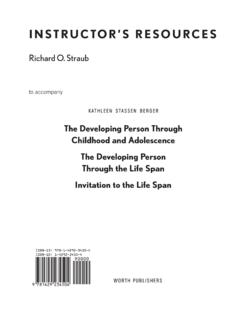
Transcription of INSTRUCTOR S RESOURCE GUIDE - Black2d.com
1 INSTRUCTOR SRESOURCEGUIDEEDWARDB. SAFFV anderbilt UniversityA. DAVIDSNIDERU niversity of South FloridaFUNDAMENTALSOFDIFFERENTIALEQUATIO NSSIXTHEDITIONFUNDAMENTALS OFDIFFERENTIALEQUATIONSANDBOUNDARY VALUEPROBLEMSFOURTHEDITIONR. Kent NagleEdward B. SaffA. David SniderReproduced by Pearson Addison-Wesley from electronic files supplied by the 2004 Pearson Education, as Pearson Addison-Wesley, 75 Arlington Street, Boston MA 02116 All rights reserved. No part of this publication may be reproduced, stored in a retrieval system, or transmitted,in any form or by any means, electronic, mechanical, photocopying, recording, or otherwise, without the priorwritten permission of the publisher. Printed in the United States of 2 3 4 5 6 QEP 06 05 04 03 Contents Notes to INSTRUCTOR 1 Software Supplements 1 Instructional Utility Software 1 Interactive Differential Equations CD-ROM 2 INSTRUCTOR s Maple/Matlab/Mathematica Manual 2 Computer Labs 2 Group Projects 2 Technical Writing Exercises 3 Student Presentations 3 Homework Assignments
2 3 Syllabus Suggestions 3 Numerical, Graphical, and Qualitative 4 Engineering/Physics Applications 5 Biology/Ecology Applications 6 Supplemental Group Projects 8 Answers to Even-Numbered Problems 15 Chapter 1 15 Chapter 2 21 Chapter 3 25
3 Chapter 4 31 Chapter 5 43 Chapter 6 57 Chapter 7 61 Chapter 8 71 Chapter 9 81 Chapter 10 91 Chapter 11 97 Chapter 12 103 Chapter 13 117 Notes to the INSTRUCTOR One goal in our writing has been to create flexible texts that afford the INSTRUCTOR a variety of topics and make available to the student an abundance of practice problems and projects.
4 We recommend that the INSTRUCTOR read the discussion given in the preface in order to gain an overview of the prerequisites, topics of emphasis, and general philosophy of the texts. An additional RESOURCE to accompany the texts is the on-line tool, MyMathLab. MyMathLab is ideal for lecture-based, lab-based, and on-line courses and provides students and instructors with a centralized point of access to the multimedia resources available with the texts. The pages of the actual text are loaded into MyMathLab and extensive course-management capabilities, including a host of communication tools for course participants, are provided to create a user-friendly and interactive on-line learning environment. Instructors can also remove, hide, or annotate Addison-Wesley preloaded content, add their own course documents, or change the order in which material is presented.
5 A link to the Instructional Utility Software package is also included. For more information visit our Web site at or contact your Addison-Wesley sales representative for a live demonstration. INSTRUCTIONAL UTILITY SOFTWARE Written specifically for the texts and available via MyMathLab, this utility has the following items: GRAPHICAL METHODS Graph, tabulate or evaluate functions Direction field Phase plane diagram MATRIX OPERATIONS Solve a system of linear equations Determinant and inverse of a matrix Matrix multiplication Eigenvalues and eigenvectors NUMERICAL SOLUTIONS OF INITIAL VALUE PROBLEMS Euler s method subroutine Euler s method with tolerance Improved Euler s method subroutine Improved Euler s method with tolerance Fourth order Runge-Kutta method subroutine Fourth order Runge-Kutta method with tolerance FOURTH ORDER RUNGE-KUTTA METHOD FOR SYSTEMS System with 2 equations System with 3 equations System with 4 equations OTHER COMPUTATIONAL METHODS Roots of a polynomial equation Newton s method Simpson s Rule for definite integrals Simpson s Rule for linear differential
6 Equations 2 NOTES TO THE INSTRUCTOR INTERACTIVE DIFFERENTIAL EQUATIONS CD-ROM Written by Beverly West (Cornell University), Steven Strogatz (Cornell University), Jean Marie McDill (California Polytechnic State University San Luis Obispo), John Cantwell (St. Louis University), and Hubert Hohn (Massachusetts College of Art), this CD-ROM is a revised version of a popular software directly tied to the text. It focuses on helping students visualize concepts with applications drawn from engineering, physics, chemistry, and biology. This software runs on supported Windows or Macintosh operating systems and is bundled free with every book. INSTRUCTOR S MAPLE/MATLAB/MATHEMATICA MANUAL The INSTRUCTOR s Maple/Matlab/Mathematica Manual, 0-321-17320-1, was written as an aid for anyone interested in coordinating the use of computer algebra systems with their course.
7 This supplement, including sample worksheets, is available upon request from Addison Wesley and includes the following. specific instruction in the use of Maple, Matlab and Mathematica to obtain graphic (direction fields, solution curves, phase portraits), numeric (built-in and user defined), and symbolic information about differential equations; a sampling of techniques that can be used to ease the introduction of Maple into the differential equations classroom (including sample worksheets directly related to the text); and a collection of additional projects that are particularly amenable to solution using a computer algebra system. While this supplement is written for use with MAPLE, the general ideas can be adapted for use with MATHEMATICA, MATLAB, or any other sophisticated numerical and/or computer algebra software.
8 Computer Labs: A computer lab in connection with a differential equations course can add a whole new dimension to the teaching and learning of differential equations. As more and more colleges and universities set up computer labs with software such as MATLAB, MAPLE, DERIVE, MATHEMATICA, PHASEPLANE, and MACMATH, there will be more opportunities to include a lab as part of the differential equations course. In our teaching and in our texts, we have tried to provide a variety of exercises, problems, and projects that encourage the student to use the computer to explore. Even one or two hours at a computer generating phase plane diagrams can provide the students with a feeling of how they will use technology together with the theory to investigate real world problems.
9 Furthermore, our experience is that they thoroughly enjoy these activities. Of course the software provided free with the texts is especially convenient for such labs. Group Projects: Although the projects that appear at the end of the chapters in the texts can be worked out by the conscientious student working alone, making them group projects adds a social element that encourages discussion and interactions that simulate a professional work place atmosphere. Group sizes of 3 or 4 seem to be optimal. Moreover, requiring that each individual student separately write up the group s solution as a formal technical report for grading by the INSTRUCTOR also contributes to the professional flavor. Typically our students each work on 3 or 4 projects per semester. If class time permits, oral presentations by the groups can be scheduled and help to improve the communication skills of the students.
10 The role of the INSTRUCTOR is, of course, to help the students solve these elaborate problems on their own and to recommend additional reference material when appropriate. Some additional Group Projects are presented in this GUIDE (see page 8). INSTRUCTOR S MAPLE/MATLAB/MATHEMATICA MANUAL 3 Technical Writing Exercises: The technical writing exercises at the end of most chapters invite students to make documented responses to questions dealing with the concepts in the chapter. This not only gives students an opportunity to improve their writing skills, but it helps them organize their thoughts and better understand the new concepts. Moreover, many questions deal with critical thinking skills that will be useful in their careers as engineers, scientists, or mathematicians.