Transcription of Introduction Deflection Testing
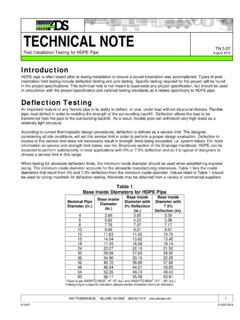
1 4640 TRUEMAN BLVD. HILLIARD, OH 43026 (800) 821-6710 1 ATN517 ADS 2016 Introduction Sanitary sewer is often tested after or during installation to ensure a sound installation was accomplished. Types of post installation field Testing include Deflection Testing and joint Testing . Specific Testing required for the project will be found in the project specifications. This technical note is not meant to supersede any project specification, but should be used in conjunction with the project specification and national Testing standards as it relates specifically to SaniTite HP pipe. Deflection Testing An important feature of any flexible pipe is its ability to deflect, or oval, under load without structural distress.
2 Deflection allows the load to be transferred from the pipe to the surrounding backfill. The result is flexible pipe can withstand very high loads as a relatively light structure. Flexible pipe including SaniTite HP must deflect in order to mobilize the strength of the surrounding backfill. According to current thermoplastic design procedures, Deflection is defined as a service limit. The designer, considering all site conditions, will set this service limit in order to perform a proper design evaluation. Deflection in excess of this service limit does not necessarily result in strength limits being exceeded, system failure. For more information on service and strength limit states, see the Structures section of the Drainage Handbook.
3 SaniTite HP can be expected to perform satisfactorily in most applications with 5% or Deflection and so it is typical of designers to choose a service limit in this range. When Testing for allowable Deflection limits, the minimum inside diameter should be used when establishing mandrel sizing. The minimum inside diameter accounts for the allowable manufacturing tolerances. Table 1 lists the inside diameters that result from 5% and Deflection from the minimum inside diameter. Values listed in Table 1 should be used for sizing mandrels for Deflection Testing . Mandrels may be obtained from a variety of commercial suppliers. Table 1 SaniTite HP Recommended Mandrel Settings Pipe Type Pipe Diameter Minimum Inside Diameter Inside Diameter with 5% Deflection Inside Diameter with Deflection Dual Wall 12 15 18 21 24 30 Triple Wall 30 36 42 48 60 TECHNICAL NOTE Post installation Testing of SaniTite HP TN August 2016 2 4640 TRUEMAN BLVD.
4 HILLIARD, OH 43026 (800) 821-6710 ATN517 ADS 2016 It is important to understand that mandrel Testing is a go/no-go test. If any line were to not pass a mandrel, it is important to ascertain the cause. Obstructions in the line, not associated with Deflection , may influence the test. Visual inspection is recommended in the event of a no-go result. Joint Testing Joint Testing is an important part of any sanitary sewer system, both in Testing for infiltration and exfiltration. Infiltration aids to estimate the amount of sewer water that will be conveyed to, and ultimately treated by, the waste water treatment plant. Exfiltration aids to estimate the loss of sewage water into the surrounding soil.
5 The two primary ways of Testing sewer pipe joints for infiltration and/or exfiltration is using air or water to create a constant pressure within the system. Exfiltration Testing with Air Air is a compressible gas and so it is extremely important one adheres to the appropriate safety regulations outlined in OSHA and project specifications. There are two primary national Testing standards that may be applied to joint Testing SaniTite HP: ASTM F1417 Standard Test Method for installation Acceptance of Plastic Gravity Sewer Lines Using Low-Pressure Air, and ASTM F3058 Preliminary Field Testing of Thermoplastic Pipe Joints for Gravity Flow (Non-Pressure) Sewer Lines. When either standard is specified by the project plans, one should review the standards carefully and follow the Testing procedure and safety precautions outlined.
6 The below commentary on the ASTM Testing procedures should be considered a summary and does not replace the Testing procedures outlined in their respective specifications. ASTM F1417 entails Testing a run of pipe from one manhole to the next adjacent manhole. Inflatable plugs are positioned into the manholes and secured. Air is introduced into the pipe line and gradually builds pressure. Once the line has been pressurized and is stable at , the pressure is decreased to at which time the line must not lose more than or (whichever is specified by the design engineer) in the specified amount of time. Table 2 below summarizes the minimum time that must be reached for less than or of pressure drop, depending on the diameter and length of pipe being tested.
7 Table 2 Time to Pressure Drop for SaniTite HP (per ASTM F1417) Pipe Diameter Pressure Drop (psi) Minimum Test Time (min:sec) Length for Minimum Time, (ft) Time for Longer Lengths, (sec) Time for Length Shown, (min:sec) 100 ft 150 ft 200 ft 250 ft 300 ft 350 ft 400 ft 450 ft 12 5:40 199 L 5:40 5:40 5:42 7:08 8:33 9:58 11:24 12:50 11:20 L 11:20 11:20 11:24 14:15 17:05 19:56 22:47 25:38 15 7:05 159 L 7:05 7:05 8:54 11:08 13:21 15:35 17:48 20:02 14:10 L 14:10 14:10 17:48 22:15 26:42 31:09 35:36 40:04 18 8:30 133 L 8:30 9:37 12:49 16:01 19:14 22:26 25:38 28:51 17:00 L 17:00 19:13 25:38 32:03 38:27 44:52 51:16 57:41 21 9:55 114 9:55 13:05 17:27 21:49 26:11 30:32 34:54 39:16 19:50 19:50 26:10 34:54 43:37 52:21 61:00 69:48 78:31 24 11:20 99 L 11:24 17:57 22:48 28:30 34:11 39:53 45:35 51:17 22:40 L 22:47 34:11 43:34 56:58 68:22 79:46 91:10 102:33 30 14:10 80 L 17:48 26:43 35:37 44:31 53:25 62:19 71:13 80:07 28:20 L 35:37 53:25 71:13 89:02 106:50 124:38 142:26 160:15 Data taken from ASTM F 14171 and Uni-Bell, Uni-B-6-983.
8 It may not be necessary to hold the test for the entire time period listed above when it is evident that the rate of air loss is zero or less than the allowable pressure drop and authorized by the approving authority1. When the pipe is large enough to be physically accessed, it may be desirable to test individual joints for safety reasons. In these cases, one may consider joint Testing in accordance with ASTM F3058, also known as a joint isolation test. ADS recommends a joint isolation test, in lieu of a full line test, for Testing pipe diameters 36 and larger for safety reasons. This test is typically done with air, though water may also be used, and involves the use of special Testing equipment. The equipment consists of two inflatable bladders, placed on each side of the joint, creating an open center cavity between them.
9 The bladders are inflated and then the center cavity is pressurized to psi. The joint passes the 4640 TRUEMAN BLVD. HILLIARD, OH 43026 (800) 821-6710 3 ATN517 ADS 2016 test if the pressure is held for 5 seconds without dropping more than For all practical purposes, this is a go/no-go test. Final acceptance of the pipeline per this Testing method shall be at the discretion of the Design Engineer. One advantage of this type of test is the ability for the installer to quickly test the joint immediately after installation , allowing for any corrective measures to be taken early on in the project. Infiltration/Exfiltration with Water Testing sanitary sewer joints via water infiltration or exfiltration is a common practice.
10 For SaniTite HP, this Testing should be conducted in accordance with ASTM F2487 Standard Practice for Infiltration and Exfiltration Acceptance Testing of Installed Corrugated High Density Polyethylene standards entail first observing the ground water conditions and, if applicable, measuring the infiltration rate of the ground water through the joints. If ground water is not applicable, then the line is filled with water and the leakage is observed through exfiltration. For the infiltration test the ground water must be at least 2 feet above the crown of the pipe for the entire test section. If this groundwater condition is not present, exfiltration Testing should be used. Measure the groundwater elevation and determine the average head, relative to the pipe invert, over the test section.