Example: quiz answers
Introduction to Bayesian Learning
for the world, physics for the objects, and behaviors or animations for the characters. Although tools exist for all of these tasks, the sheer scale of even the most prosaic world can require months or years of labor. An alternative approach is to create these models from existing data, either designed by artists or captured from the world.
Tags:
Information
Domain:
Source:
Link to this page:
Documents from same domain
Stable Fluids - Dynamic Graphics Project
www.dgp.toronto.eduStable Fluids Jos Stam Alias wavefront Abstract Building animation tools for fluid-like motions is an important and challenging problem with many applications in computer graphics. The use of physics-based models for fluid flow can greatly assist in creating such tools. Physical models, unlike key frame or pro-

Computer Graphics Lecture Notes - University of …
www.dgp.toronto.eduAffine transformations. An important case in the previous section is applying an affin e trans-′′ ′′ ′′ ′

Interaction Techniques for 3D Modeling on Large Displays
www.dgp.toronto.eduInteraction Techniques for 3D Modeling on Large Displays Tovi Grossman1,2, Ravin Balakrishnan1,2, Gordon Kurtenbach1,2, George Fitzmaurice1, ... 2D and 3D views, tape drawing as the primary curve and line creation technique, visual viewpoint markers, and continuous two-handed interaction.

Machine Learning and Data Mining Lecture Notes
www.dgp.toronto.eduCSC 411 / CSC D11 Acknowledgements Conventions and Notation Scalars are written with lower-case italics, e.g.,x. Column-vectors are written in bold, lower-case: x, and matrices are written in bold uppercase: B. The set of real numbers is represented by R; N-dimensional Euclidean space is writtenRN. Aside:
Computer Graphics Lecture Notes
www.dgp.toronto.eduThe convention in these notes will follow that of OpenGL, placing the origin in the lower left corner, with that pixel being at location (0,0). Be aware that placing the origin in the upper left is another common convention. One of 2N intensities or colors are associated with each pixel, where N is the number of bits per pixel.
Real-Time Fluid Dynamics for Games
www.dgp.toronto.eduIn this paper we present a simple and rapid implementation of a fluid dynamics solver for game engines. Our tools can greatly enhance games by providing realistic fluid-like effects such as swirling smoke past a moving character. The potential applications are endless. Our algorithms

The Fundamental Principles of Animation
www.dgp.toronto.edudownward motion more and more rapidly (Ease Out), until it hits the ground. Note that this doesn’t mean slow movement. This really means keep the in between frames close to each extreme. 3. Arcs In the real world almost all action moves in an arc. When creating animation one should try to have motion follow curved paths rather than linear ones.
Related documents
Microstates and Macrostates - Physics Department
www.physics.usu.eduPhysics 3700 Microstates and Macrostates. Multiplicities. The Second Law. Relevant sections in text: x2.2 { 2.5 ... So, for example, the probability of rolling a 4 is 3=36 = 1=12. (Note that the mulitiplicities add up to 36, so that the probability for getting anything ... Paramagnetism is like coin tosses! Einstein Solid As a last, but ...

Probability, physics, and the coin toss
softmath.seas.harvard.eduExactly how physics and probability come together in the coin-toss problem was analyzed by Joseph Keller, who studied a coin of zero thickness that spins end over end with-out air resistance and lands without bouncing. Keller proved mathematically that the idealized coin becomes fair only in the limit of infinite vertical and angular velocity.

1 Complex Numbers in Quantum Mechanics
courses.physics.illinois.eduexperiment. At this level, quantum probability is like coin-tossing. One cannot say what the outcome will be for a toss of an individual coin. Many tosses are needed to see that the chance of “heads” is 0.50 for an unbiased coin. The idea of “hidden” variables in quantum mechanics can be explained using coin tosses. While we say that ...

Grinstead and Snell’s Introduction to Probability
math.dartmouth.eduLet Y be the random variable which represents the toss of a coin. In this case, there are two possible outcomes, which we can label as H and T. Unless we have reason to suspect that the coin comes up one way more often than the other way, it is natural to assign the probability of 1/2 to each of the two outcomes.
A Short Introduction to Probability
people.smp.uq.edu.auExample 1.1 (Coin Tossing) The most fundamental stochastic experiment is the experiment where a coin is tossed a number of times, say ntimes. Indeed, much of probability theory can be based on this simple experiment, as we shall see in subsequent chapters. To better understand how this experiment behaves,
Poisson Statistics - MIT
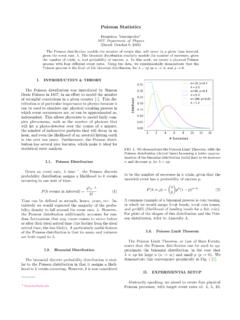
web.mit.eduOct 09, 2019 · modeled event has a probability of success p. P(k;n;p) = n k p (1 p)n (2) A common example of a binomial process is coin tossing, in which we would assign k=# heads, n=# coin tosses, and p=50% (likelihood of landing heads for a fair coin). For plots of the shapes of this distribution and the Pois-son distribution, refer to Appendix A. I.3.

Section 2 Introduction to Statistical Mechanics
personal.rhul.ac.ukThe physical significance of this result derives from the fundamental assumption of statistical physics that each of these microstates is equally likely. It follows that is the statistical weight of the distribution m (recall m determines ), that is the relative probability of that distribution occurring. t (m) NÍ and NÏ

Probability - University of Cambridge
www.statslab.cam.ac.uk1.The probability that a fair coin will land heads is 1=2. 2.The probability that a selection of 6 numbers wins the National Lottery Lotto jackpot is 1 in 49 6 =13,983,816, or 7:15112 10 8. 3.The probability that a drawing pin will land ‘point up’ is 0:62. 4.The probability that a large earthquake will occur on the San Andreas Fault in
Combinatorics - Harvard University
www.people.fas.harvard.edua probability once you’ve counted the relevant things, so the bulk of the work we’ll need to do will be in the present chapter. 1.1 Factorials Before getting into the discussion of actual combinatorics, we’ll flrst need to look at a certain quantity that comes up again and again. This quantity is called the factorial. We’ll see