Transcription of Introduction to Path Analysis
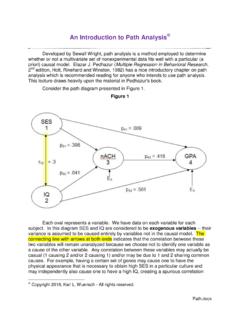
1 Introduction to path Analysis Ways to think about path Analysis path coefficients A bit about direct and indirect effects What path Analysis can and can t do for Measured vs. manifested the when of variables About non-recursive cause in path models Some ways to improve a path Analysis model Mediation analyses Model Identification & TestingOne way to think about path Analysis is as a way of sorting out the colinearity patterns amongst the predictors asking yourself what may be the structure -- temporal &/or causal relationships -- among these predictors that produces the pattern of colinearity. Structure of a MR model with hypotheses about which predictors will contribute A proposed structure for the colinearity among the predictors and how they relate to the criterion with hypotheses about which paths will contribute 1122334455 CritCritearlierMore recentdistal causeproximal causeWhere do the path coefficients come from?
2 One way is to run a series of multiple each Analysis : a variable with arrows pointing at it will be the criterion variable and each of the variables having arrows pointing to it will be the predictors12345 Crit1. Crit = 3 Pred = 52. Crit = 1 Preds = 3 & 53. Crit = 4 Pred = 54. Crit = Crit Preds = 1, 2, 3 & 4 The path coefficients are the weights from the respective regression analyses (remember that = r for bivariate models)What path Analysis canand can t for a given structural model you evaluate the contribution of any path or combination of paths tothe overall fit of that structural model help identify sources of suppressor effects (indirect paths)Can ts non-recursive (bi-directional) models help decide among alternative structural models provide tests of causality (unless experimental data) You have to convince yourself and your audience of the reasonableness of your structural model (the placing of the predictors)
3 , and then you can test hypotheses about which arrows amongst the variables have unique ways to think about path to capture the causal paths among the predictors and to the criterion to capture the temporal paths among the predictors and to the criterion to distinguish direct and indirect paths of relationship to investigate mediation effects .. to distinguish direct and indirect paths of a direct effecton Crit a contributor in both the regression and the path models12345 Crit5does not have a direct effect on Crit but does have multiple indirect effects not contributing in the regression model could mistakenly lead us to conclude 5 doesn t matter in understanding Crit ..to distinguish direct and indirect paths of , has an indirecteffect on Crit there s more to the 3 Crit relationship than was captured in the regression model12345 Crit3has a direct effect on to investigate mediation effects.
4 Mediation effects and analyses highlight the difference between bivariate and multivariate relationships between a variable and a criterion (collinearity & suppressor effects).For Teaching Quality & Exam Performance r = .30, p = .01 for binary regression = r, so we have the path =.3It occurs to one of the researchers that there just might be something else besides Teaching Quality related to (influencing, even) Exam Performance. The researcher decides that Study Time (ST) might be such a variable. Thinking temporally/causally, the researcher considers that Study Time comes in between Teaching and Testing. So the researcher builds a mediation model, getting the weights from a multiple regression with TQ and ST as predictors of to investigate mediation effects ..The resulting model looks like ..TQEP =.0ST =.4 =.3We might describe model as, The apparent effect of Teaching Quality on ExamPerformance (r=.)
5 30) is mediated by Study Time. We might describe the combination of the bivariate Analysis and the multiple regression from which the path coefficients were obtained as, While Teaching Quality has a bivariate relationship with Exam Performance (r=.30), it does not contribute to a multiple regression model ( =.0) that also includes Study Time ( =.40).Either Analysis reminds us that the bivariate contribution of a given predictor might not hold up when we look at that relationship within a multivariate model!Notice that TQ is still important because it seems to have something to do with study time an indirect effect upon Exam when of variables and their place in the model ..When a variable is measured when we collect the data: usually concurrent often postdictive (can be a problem memory biases, etc.) sometimes predictive (hypothetical can really be a problem)When a variable is manifested when the value of thevariable came into being when it comes into being for that participant may or may not be before the measure was , State vs.
6 Trait anxiety trait anxiety is intended to be characterological, long term and context free earlier in model state anxiety is intended to be short term & contextual depends when it was measuredSome caveats about the when of path & Mediation The Causal Ordering must be theoretically supported path Analysis can t sort out alternative arrangements -- it can only decide what paths of a specific arrangement can be dropped2. Mediating variables must come afterwhat they are mediatingTxCrit =.0 Sex =.4 =.3 Looks like a participant s sex mediates the it also looks like treatment causes a participant s sex ???rCrit,Tx= .4So we run a mediation The Treatment is related to the criterion. But the researcher thinks that one s gender mediates how the treatment has its MotivSt. Time GPA % Pinkr(p) .28(<.01).
7 45 (<.01) .46 (<.01) .33(<.01)All of these predictors have substantial correlations with Exam grades!!An example when and operational definition matter!!!Bivariate & Multivariate contributions DV = Exam 1% grade (p).32(.02) (.04) .09(.51) .58 (.01)GPA does not have a significant regression weights after taking the other variables into account, it has no unique contribution!Exam study time has a significant regression weight, however, notice that it is part of a suppressor effect! After taking the other variables into account, those who study more for the test actually tend to do poorer on the does have a significant regression weight. Even after taking the other variables into account, those who do more MTAs do better on the that only two of the 4 predictors had the same story from the bivariate and multivariate Analysis !
8 !!!Motivation does have a significant regression weight. After taking the other variables into account, those who are more motivated do better on the Analysis allows us to look at how multiple predictors relate to the criterion considering both direct and indirect relationships!!Exam 1%St Time%PinkMotivGPAD irect effects (same as MReg s) effects no direct effect but indirect effects thru %pink & St Time Motiv directeffect also indirecteffects thru %pink & St Time %Pink directeffect also indirecteffect thru St Time- for St Time? Less %Pink predicts more St Time, suggesting that those who study more were those who did less work before they started to study for the exam, and they also did poorer on the exam! About non-recursive (bi-directional) models12345 CritSometimes we want to consider whether two things that happen at the same time might have reciprocal causation so we want to put in a sideways arrowNeither of these can be handled by path , this isn t really a problem because both are a misrepresentation of the involved causal paths!
9 The real way to represent both of these is ..Sometimes we want to consider whether two things that happen sequentially might have iterative causation so we want to put in a back-and-forth arrow12345 CritThe things to remember are that:1. cause takes time or cause is not immediate even the fastest chemical reactions take time behavioral causes take an appreciable amount of time2. Something must be to cause something else to be a variable has to be manifested as an effect of some cause before it can itself be the cause of another effect Cause comes before effect not at the same timeWhen you put these ideas together, then both sideways and back-and-forth arrows don t make sense and are not an appropriate portrayal of the causations being causal path has to take these two ideas into About non-recursive (bi-directional) modelsIf 5 causes 4 , then 4 changes 5 , which changes 4 again, all before the criterion is caused, we need to represent that we have 2 4s and 2 5s in a hypothesized sequence.
10 12345 Crit45 Crit45We also have to decide when1, 2 & 3 enter into the model, temporally &/or causally. Say ..45 Crit45132 About non-recursive (bi-directional) models, applying these ideas to sideways arrows we need to remember that the cause comes before the do that, we have to decide (& defend) which comes first often the hardest part) and then add in the second causation, As well as sort out where the other variables fall temporally &/or causally. Perhaps ..1 Some of the ways to improve a path Analysis For a given model, consider these 4 Antecedents to the current model Variables that come before or cause the variables in the model2. Effects of the current model Variables that come after or are caused by the variables in the model3. Intermediate causes Variables that come in between the current causes and Non-linear variations of the model Curvilinear & interaction effects of & among the variablesMediation AnalysesThe basic mediation Analysis is a 3-variable path we wonder if we have the whole story is it really that variable that causes Crit ?