Transcription of Invariant Information Clustering for Unsupervised Image ...
1 Invariant Information Clustering forUnsupervised Image Classification and SegmentationXu JiUniversity of o F. HenriquesUniversity of VedaldiUniversity of present a novel Clustering objective that learns a neu-ral network classifier from scratch, given only unlabelleddata samples. The model discovers clusters that accuratelymatch semantic classes, achieving state-of-the-art resultsin eight Unsupervised Clustering benchmarks spanning im-age classification and segmentation . These include STL10,an Unsupervised variant of ImageNet, and CIFAR10, wherewe significantly beat the accuracy of our closest competi-tors by and absolute percentage points method is not specialised to computer vision and op-erates on any paired dataset samples; in our experimentswe use random transforms to obtain a pair from each im-age. The trained network directly outputs semantic labels,rather than high dimensional representations that need ex-ternal processing to be usable for semantic Clustering .
2 Theobjective is simply to maximise mutual Information betweenthe class assignments of each pair. It is easy to implementand rigorously grounded in Information theory, meaning weeffortlessly avoid degenerate solutions that other clusteringmethods are susceptible to. In addition to the fully unsu-pervised mode, we also test two semi-supervised first achieves accuracy on STL10 classification,setting a new global state-of-the-art over all existing meth-ods (whether supervised, semi-supervised or Unsupervised ).The second shows robustness to 90% reductions in labelcoverage, of relevance to applications that wish to make useof small amounts of IntroductionMost supervised deep learning methods require largequantities of manually labelled data, limiting their applica-bility in many scenarios. This is true for large-scale im-age classification and even more for segmentation (pixel-wise classification) where the annotation cost per imageis very high [38,21].
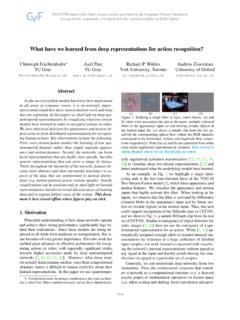
3 Unsupervised Clustering , on theother hand, aims to group data points into classes entirelyFigure 1: Models trained with IIC on entirely unlabelled data learn tocluster images (top, STL10) and patches (bottom, Potsdam-3). The rawclusters found directly correspond to semantic classes (dogs, cats, trucks,roads, vegetation etc.) with state-of-the-art accuracy. Training is end-to-end and randomly initialised, with no heuristics used at any labels [25]. Many authors have sought to com-bine mature Clustering algorithms with deep learning, forexample by bootstrapping network training with k-meansstyle objectives [51,24,7]. However, trivially combin-ing Clustering and representation learning methods oftenleads to degenerate solutions [7,51]. It is precisely toprevent such degeneracy that cumbersome pipelines in-volving pre-training, feature post-processing (whitening orPCA), Clustering mechanisms external to the network have evolved [7,17,18,51].
4 In this paper, we introduce Invariant Information Clus-tering (IIC), a method that addresses this issue in a moreprincipled manner. IIC is a generic Clustering algorithm that19865directly trains a randomly initialised neural network into aclassification function, end-to-end and without any involves a simple objective function, which is the mutualinformation between the function s classifications for paireddata samples. The input data can be of any modality and,since the Clustering space is discrete, mutual informationcan be computed its simplicity, IIC is intrinsically robust to twoissues that affect other methods. The first is Clustering de-generacy, which is the tendency for a single cluster to dom-inate the predictions or for clusters to disappear (which canbe observed with k-means, especially when combined withrepresentation learning [7]). Due to the entropy maximisa-tion component within mutual Information , the loss is notminimised if all images are assigned to the same class.
5 Atthe same time, it is optimal for the model to predict for eachimage a single class with certainty ( one-hot) due to theconditional entropy minimisation ( ). The second issueis noisy data with unknown or distractor classes (present inSTL10 [10] for example). IIC addresses this issue by em-ploying an auxiliary output layer that is parallel to the mainoutput layer, trained to produce an overclustering ( sameloss function but greater number of clusters than the groundtruth) that is ignored at test time. Auxiliary overclusteringis a general technique that could be useful for other algo-rithms. These two features of IIC contribute to making itthe only method amongst our Unsupervised baselines that isrobust enough to make use of the noisy unlabelled subset ofSTL10, a version of ImageNet [14] specifically designed asa benchmark for Unsupervised the rest of the paper, we begin by explaining the differ-ence between semantic Clustering and intermediate repre-sentation learning (section2), which separates our methodfrom the majority of work in Unsupervised deep then describe the theoretical foundations of IIC in sta-tistical learning (section3), demonstrating that maximisingmutual Information between pairs of samples under a bottle-neck is a principled Clustering objective which is equivalentto distilling their shared abstract content (co- Clustering ).
6 Wepropose that for static images, an easy way to generate pairswith shared abstract content from unlabelled data is to takeeach Image and its random transformation, or each patchand a neighbour. We show that maximising MI automat-ically avoids degenerate solutions and can be written as aconvolution in the case of segmentation , allowing for effi-cient implementation with any deep learning perform experiments on a large number ofdatasets (section4) including STL, CIFAR, MNIST,COCO-Stuff and Potsdam, setting a new state-of-the-art onunsupervised Clustering and segmentation in all cases, withresults of , and on STL10, CIFAR10and COCO-Stuff-3 beating the closest competitors ( , , ) with significant margins. Note that train- ( , )CNNCNN = ( , )ObjectiveClusterprobabilities ( | ) FC FC ( | )FCFC ( , ) ( , )Optional overclustering Figure 2: IIC for Image Clustering . Dashed line denotes shared parameters,gis a random transformation, andIdenotes mutual Information (eq.)
7 (3)).ing deep neural networks to perform large scale, real-worldsegmentations from scratch, without labels or heuristics, is ahighly challenging task with negligible precedent. We alsoperform an ablation study and additionally test two semi-supervised modes, setting a new global state-of-the-art on STL10 over all supervised, semi-supervised andunsupervised methods, and demonstrating the robustness insemi-supervised accuracy when 90% of labels are Related workCo- Clustering and mutual use of in-formation as a criterion to learn representations is not of the earliest works to do so is by Becker and Hin-ton [3]. More generally, learning from paired data has beenexplored in co- Clustering [25,16] and in other works [50]that build on the Information bottleneck principle [20].Several recent papers have used Information as a toolto train deep networks in particular. IMSAT [28] max-imises mutual Information between data and its representa-tion and DeepINFOMAX [27] maximizes Information be-tween spatially-preserved features and compact , IMSAT and DeepINFOMAX combine informa-tion with other criteria, whereas in our method informationis the only criterion used.
8 Furthermore, both IMSAT andDeepINFOMAX compute mutual Information over contin-uous random variables, which requires complex estima-tors [4], whereas IIC does so for discrete variables withsimple and exact computations. Finally, DeepINFOMAX considers the informationI(x, f(x))between the featuresxand a deterministic functionf(x)of it, which is in prin-ciple the same as the entropyH(x); in contrast, in IIC in-formation does not trivially reduce to Clustering versus intermediate semantic Clustering , the learned functiondirectly outputs discrete assignments for high level ( 3: Training with IIC on unlabelled MNIST in successive epochs from random initialisation (left). The network directly outputs cluster assignmentprobabilities for input images, and each is rendered as a coordinate by convex combination of 10 cluster vertices. There is no cherry-picking as the entiredataset is shown in every snapshot. Ground truth labelling (unseen by model) is given by colour.)
9 At each cluster the average Image of its assignees is neither labels nor heuristics, the clusters discovered by IIC correspond perfectly to unique digits, with one-hot certain prediction (right).semantic) clusters. Intermediate representation learners,on the other hand, produce continuous, distributed, high-dimensional representations that must be post-processed,for example by k-means, to obtain the discrete low-cardinality assignments required for Unsupervised semanticclustering. The latter includes objectives such as genera-tive autoencoder Image reconstruction [48], triplets [46] andspatial-temporal order or context prediction [37,12,17],for example predicting patch proximity [30], solving jig-saw puzzles [41] and inpainting [43]. Note it also in-cludes a number of Clustering methods (DeepCluster [7],exemplars [18]) where the Clustering is only auxiliary;a Clustering -style objective is used but does not producegroups with semantic correspondence.
10 For example, Deep-Cluster [7] is a state-of-the-art method for learning highly-transferable intermediate features using overclustering asa proxy task, but does not automatically find semanticallymeaningful clusters. As these methods use auxiliary objec-tives divorced from the semantic Clustering objective, it isunsurprising that they perform worse than IIC (section4),which directly optimises for it, training the network end-to-end with the final clusterer implicitly wrapped Image -to- Image approachesto deep Clustering , whether semantic or auxiliary, utilise adistance function between input images that approximates agiven grouping criterion. Agglomerative Clustering [2] andpartially ordered sets [1] of HOG features [13] have beenused to group images, and exemplars [18] define a groupas a set of random transformations applied to a single im-age. Note the latter does not scale easily, in particular toimage segmentation where a single200 200image wouldcall for 40k classes.