Transcription of Isopropyl Alcohol (2-Propanol)
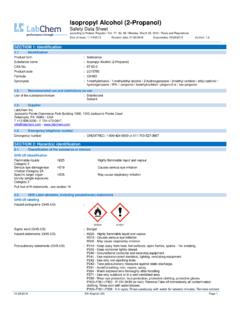
1 Isopropyl Alcohol (2-Propanol). safety data sheet according to Federal Register / Vol. 77, No. 58 / Monday, March 26, 2012 / Rules and Regulations Date of issue: 11/14/2013 Revision date: 01/26/2018 Supersedes: 09/29/2015 Version: SECTION 1: Identification Identification Product form : Substance Substance name : Isopropyl Alcohol (2-Propanol). CAS-No. : 67-63-0. Product code : LC15750. Formula : C3H8O. Synonyms : 1-methylethanol / 1-methylethyl Alcohol / 2-hydroxypropane / dimethyl carbinol / ethyl carbinol /. hydroxypropane / IPA / i-propanol / isoethylcarbinol / propan-2-ol / sec-propanol Recommended use and restrictions on use Use of the substance/mixture : Disinfectant Solvent Supplier LabChem Inc Jackson's Pointe Commerce Park Building 1000, 1010 Jackson's Pointe Court Zelienople, PA 16063 - USA. T 412-826-5230 - F 724-473-0647. - Emergency telephone number Emergency number : CHEMTREC: 1-800-424-9300 or 011-703-527-3887. SECTION 2: Hazard(s) identification Classification of the substance or mixture GHS-US classification Flammable liquids H225 Highly flammable liquid and vapour Category 2.
2 Serious eye damage/eye H319 Causes serious eye irritation irritation Category 2A. Specific target organ H335 May cause respiratory irritation toxicity (single exposure). Category 3. Full text of H statements : see section 16. GHS Label elements, including precautionary statements GHS-US labeling Hazard pictograms (GHS-US) : GHS02 GHS07. Signal word (GHS-US) : Danger Hazard statements (GHS-US) : H225 - Highly flammable liquid and vapour H319 - Causes serious eye irritation H335 - May cause respiratory irritation Precautionary statements (GHS-US) : P210 - Keep away from heat, hot surfaces, open flames, sparks. - No smoking. P233 - Keep container tightly closed. P240 - Ground/bond container and receiving equipment. P241 - Use explosion-proof electrical, lighting, ventilating equipment P242 - Use only non-sparking tools. P243 - Take precautionary measures against static discharge. P261 - Avoid breathing mist, vapors, spray. P264 - Wash exposed skin thoroughly after handling. P271 - Use only outdoors or in a well-ventilated area.
3 P280 - Wear eye protection, face protection, protective clothing, protective gloves. P303+P361+P353 - IF ON SKIN (or hair): Remove/Take off immediately all contaminated clothing. Rinse skin with water/shower. P305+P351+P338 - If in eyes: Rinse cautiously with water for several minutes. Remove contact 01/26/2018 EN (English US) Page 1. Isopropyl Alcohol (2-Propanol). safety data sheet according to Federal Register / Vol. 77, No. 58 / Monday, March 26, 2012 / Rules and Regulations lenses, if present and easy to do. Continue rinsing P312 - Call a POISON CENTER or doctor/physician if you feel unwell. P337+P313 - If eye irritation persists: Get medical advice/attention. P370+P378 - In case of fire: Use dry chemical powder, Alcohol -resistant foam, carbon dioxide (CO2) to extinguish P403+P233 - Store in a well-ventilated place. Keep container tightly closed. P405 - Store locked up. P501 - Dispose of contents/container to comply with local, state and federal regulations P235 - Keep cool. If inhaled: Remove person to fresh air and keep comfortable for breathing Other hazards which do not result in classification Other hazards not contributing to the : None.
4 Classification Unknown acute toxicity (GHS US). Not applicable SECTION 3: Composition/Information on ingredients Substances Substance type : Mono-constituent Name Product identifier % GHS-US classification Isopropyl Alcohol (2-Propanol) (CAS-No.) 67-63-0 100 Flam. Liq. 2, H225. (Main constituent) Eye Irrit. 2A, H319. STOT SE 3, H335. Full text of hazard classes and H-statements : see section 16. Mixtures Not applicable SECTION 4: First-aid measures Description of first aid measures First-aid measures general : Check the vital functions. Unconscious: maintain adequate airway and respiration. Respiratory arrest: artificial respiration or oxygen. Cardiac arrest: perform resuscitation. Victim conscious with labored breathing: half-seated. Victim in shock: on his back with legs slightly raised. Vomiting: prevent asphyxia/aspiration pneumonia. Prevent cooling by covering the victim (no warming up). Keep watching the victim. Give psychological aid. Keep the victim calm, avoid physical strain.
5 Depending on the victim's condition: doctor/hospital. Never give Alcohol to drink. First-aid measures after inhalation : Remove the victim into fresh air. Respiratory problems: consult a doctor/medical service. First-aid measures after skin contact : Rinse with water. Soap may be used. Do not apply (chemical) neutralizing agents. Take victim to a doctor if irritation persists. First-aid measures after eye contact : Rinse immediately with plenty of water. Do not apply neutralizing agents. Take victim to an ophthalmologist if irritation persists. First-aid measures after ingestion : Rinse mouth with water. Immediately after ingestion: give lots of water to drink. Do not induce vomiting. Give activated charcoal. Call Poison Information Centre ( ). Consult a doctor/medical service if you feel unwell. Ingestion of large quantities: immediately to hospital. Doctor: gastric lavage. Most important symptoms and effects (acute and delayed). Symptoms/effects after inhalation : EXPOSURE TO HIGH CONCENTRATIONS: Coughing.
6 Dry/sore throat. Central nervous system depression. Dizziness. Headache. Narcosis. Symptoms/effects after skin contact : Dry skin. Symptoms/effects after eye contact : Irritation of the eye tissue. Symptoms/effects after ingestion : AFTER ABSORPTION OF LARGE QUANTITIES: Central nervous system depression. Headache. Dilation of the blood vessels. Low arterial pressure. Nausea. Vomiting. Abdominal pain. Disturbed motor response. Disturbances of consciousness. FOLLOWING SYMPTOMS. MAY APPEAR LATER: Body temperature fall. Slowing respiration. Chronic symptoms : ON CONTINUOUS/REPEATED EXPOSURE/CONTACT: Red skin. Dry skin. Itching. Cracking of the skin. Skin rash/inflammation. Impaired memory. Immediate medical attention and special treatment, if necessary No additional information available 01/26/2018 EN (English US) 2/9. Isopropyl Alcohol (2-Propanol). safety data sheet according to Federal Register / Vol. 77, No. 58 / Monday, March 26, 2012 / Rules and Regulations SECTION 5: Fire-fighting measures Suitable (and unsuitable) extinguishing media Suitable extinguishing media : Water spray.
7 Polyvalent foam. Alcohol -resistant foam. BC powder. Carbon dioxide. Unsuitable extinguishing media : Solid water jet ineffective as extinguishing medium. Specific hazards arising from the chemical Fire hazard : DIRECT FIRE HAZARD. Highly flammable. Gas/vapor flammable with air within explosion limits. INDIRECT FIRE HAZARD. May be ignited by sparks. Gas/vapor spreads at floor level: ignition hazard. Explosion hazard : DIRECT EXPLOSION HAZARD. Gas/vapour explosive with air within explosion limits. INDIRECT EXPLOSION HAZARD. may be ignited by sparks. Reactions with explosion hazards: see "Reactivity Hazard". Reactivity : Upon combustion: CO and CO2 are formed. Violent to explosive reaction with (strong). oxidizers. Prolonged storage/in large quantities: may form peroxides. Special protective equipment and precautions for fire-fighters Firefighting instructions : Cool tanks/drums with water spray/remove them into safety . Do not move the load if exposed to heat. Protection during firefighting : Heat/fire exposure: compressed air/oxygen apparatus.
8 SECTION 6: Accidental release measures Personal precautions, protective equipment and emergency procedures For non-emergency personnel Protective equipment : Gloves. Protective goggles. Protective clothing. Large spills/in enclosed spaces: compressed air apparatus. See "Material-Handling" to select protective clothing. Emergency procedures : Keep upwind. Mark the danger area. Consider evacuation. Seal off low-lying areas. Close doors and windows of adjacent premises. Stop engines and no smoking. No naked flames or sparks. Spark- and explosion-proof appliances and lighting equipment. Keep containers closed. Wash contaminated clothes. For emergency responders Protective equipment : Equip cleanup crew with proper protection. Do not breathe gas, fumes, vapor or spray. Emergency procedures : Stop leak if safe to do so. Ventilate area. If a major spill occurs, all personnel should be immediately evacuated and the area ventilated. Environmental precautions Prevent spreading in sewers. Methods and material for containment and cleaning up For containment : Contain released substance, pump into suitable containers.
9 Consult "Material-handling" to select material of containers. Plug the leak, cut off the supply. Dam up the liquid spill. Try to reduce evaporation. Measure the concentration of the explosive gas-air mixture. Dilute/disperse combustible gas/vapour with water curtain. Provide equipment/receptacles with earthing. Do not use compressed air for pumping over spills. Methods for cleaning up : Take up liquid spill into absorbent material, : dry sand/earth/vermiculite or powdered limestone. Scoop absorbed substance into closing containers. See "Material-handling" for suitable container materials. Damaged/cooled tanks must be emptied. Do not use compressed air for pumping over spills. Carefully collect the spill/leftovers. Clean contaminated surfaces with an excess of water. Take collected spill to manufacturer/competent authority. Wash clothing and equipment after handling. Reference to other sections No additional information available SECTION 7: Handling and storage Precautions for safe handling Precautions for safe handling : Comply with the legal requirements.
10 Remove contaminated clothing immediately. Clean contaminated clothing. Handle uncleaned empty containers as full ones. Thoroughly clean/dry the installation before use. Do not discharge the waste into the drain. Do not use compressed air for pumping over. Use spark-/explosionproof appliances and lighting system. Take precautions against electrostatic charges. Keep away from naked flames/heat. Keep away from ignition sources/sparks. Observe normal hygiene standards. Keep container tightly closed. Measure the concentration in the air regularly. Work under local exhaust/ventilation. 01/26/2018 EN (English US) 3/9. Isopropyl Alcohol (2-Propanol). safety data sheet according to Federal Register / Vol. 77, No. 58 / Monday, March 26, 2012 / Rules and Regulations Hygiene measures : Wash hands and other exposed areas with mild soap and water before eating, drinking or smoking and when leaving work. Wash contaminated clothing before reuse. Conditions for safe storage, including any incompatibilities Incompatible products : Ammonia.