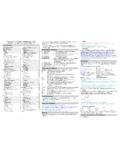
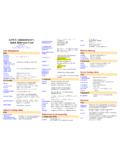
Transcription of JavaScript Quick Reference Card1 - cheat sheets
1 JavaScript Quick Reference , 2007-2008 BrandsPatch key overleafCode Structurevar ..//Global variable declarationsfunction funcA([param1,param2,..]){ var .. //Local variable declarations visible in nested functions [function innerFuncA([iparam1, ]) { var .. //Variables local to innerFuncA //your code here }]aName='ExplainThat!';//implicit global variable creation//your code here}Nomenclature RulesFunction and variable names can consist of any alphanumeric character. $ and _ are allowed. The first character cannot be numeric.
2 Many extended ASCII characters are allowed. There is no practical limit on name length. Names are two or more variables or functions or a variable & a function are declared with the same name the last declaration obliterates all previous ones. Using a keyword as a variable or function name obliterates that & ScopeAssignments without the use of the var keyword result in a new global variable of that name being declared with the var keyword outwith the body of a function are global. Variables declared with the var keyword inside the body of a function are local to that function.
3 Local variables are visible to all nested entities hide globals bearing the same Typesstring: var s = 'explainthat' or explainthat number: var n = , 100, : var flag = false or trueobject: var d = new Date();function: var Greet = function sayHello() {alert('Hello')} JavaScript is a weakly typed language a simple assignment is sufficient to change the variable type. The typeof keyword can be used to check the current variable ValuesThe special values false, Infinity, NaN, null, true & undefined are recognized. null is an object.
4 Infinity and NaN are + 3 + 2'explain' + 'that'5explainthat- 3 - 2-1* 3*26/ 3 ++i = 2;i++1, ++i23--i = 2;i--1, --i21 == ==3 = '3'2 == 3truefalse ===3 === 33 === '3'truefalse<2 < 3'a' < 'A'truefalse<=2 <= 3true>2 > 3false>=2 > 3false =i = 2i is assigned the value 2+=i+=13-=i-=12i*=i*=36/=i/=23%=i%=21i = 2;j = 5;&& (AND)(i <= 2) && (j < 7)true|| (OR)(i%2 > 0) || (j%2 == 0)false! (NOT)(i==2) && !(j%2 == 0)truei = 2;j = 7;& (bitwise)i & j2| (bitwise)i|j7^(XOR)i^j5<<2<<14>>2>>11>>>i=10 (binary 1010)i>>>223 Internal FunctionsdecodeURI - reverses encodeURIdecodeURIC omponent - reverses encodes everything except and encodes everything except !
5 ~*() and hexadecimal string encoding. Does not encode and reverses escapeeval evaluates JavaScript expressionsisNaN true if the argument is not a isFinite(2/0) returns falseparseInt - parseInt( ) returns 31parseFloat - parseFloat( ) returns Objectlength number of elements in the arrayconcat concatenates argument, returns new returns elements as a string separated by argument (default is ,)pop suppress & return last elementpush adds new elements to end of array & returns new inverts order of array elementsshift suppress & return first elementslice returns array slice.
6 1st arg is start position. 2nd arg is last position + 1sort alphanumeric sort if no argument. Pass sort function as argument for more discard and replace elementsunshift append elements to start & return new lengthDate Objectget# getUTC# set# setUTC#where # is one of Date, Day, FullYear, Hours, Milliseconds, Minutes, Month, Seconds, Time, TimezoneOffsettoDateString the date in the date & time in the date in the locale date & time in the locale time in the locale time in date & time in UTC, EnglishvalueOf milliseconds since midnight 01 January 1970, UTCMath ObjectE, LN10.
7 LN2, LOG10E, LOG2E, PI, SQRT1_2, SQRT2abs absolute value #(n) - trigonometric functionsa#(n) - inverse trigonometric functionswhere # is one of cos, sin or tanceil(n) smallest whole number >= nexp(n) returns enfloor(n) biggest whole number <= nlog(n) logarithm of n to the base emax(n1,n2) bigger of n1 and n2 min(n1,n2) smaller of n1 and n2 pow(a,b) - ab random random number between 0 and 1round(n) n rounded down to closest integersqrt(n) square root of nNumber ObjectMAX_VALUE - ca +308 MIN_VALUE ca 5E-324 NEGATIVE_INFINITY, (m) n in scientific notation with m decimal () - n rounded to the closest whole (m) n rounded to m numbers are designated with the prefix 0x or 0X.
8 0xFF is the number Objectlength number of characters in the string (n) returns s[n]. n starts at (n) Unicode value of s[n] (n1, ) - string built from Unicode values n1, (s2,n) location of s2 in s1 starting at position n (s2) location of s2 in s1 starting from the (n1, n 2) returns substring starting from n1 upto character preceding n2. No n2 = extract till end. n1 < 0 = extract from () - returns s in lower case () - care to guess? JavaScript Quick Reference Sequences\n - new line, \r - carriage return, \t tab character, \\ - \ character, \' - apostrophe, \'' - quote\uNNNN Unicode character at NNNN \u25BA gives the character JavaScript in HTMLE xternal JavaScript <script type= text/ JavaScript defer= defer src= / > </script>Inline JavaScript <script type= text/ JavaScript >//your code here</script>Comments/* Comments spanning multiple lines */// Simple, single line, commentConditional Executionif (Condition) CodeIfTrue.
9 Else CodeIfFalse4 Multiline CodeIf# must be placed in braces, {}switch (variable){ case Value1:Code; break; case Value2:Code; break; .. default:Code;}variable can be boolean, number, string or even date.(condition)?(CodeIfTrue):(CodeIfFal se)Parentheses are not necessary but advisableError HandlingMethod 1:The onerror event<script type= text/ JavaScript >function whenError(msg,url,lineNo){ //use parameters to provide meaningful messages} = whenError</script>Place this code in a separate <script>.
10 </script> tag pair to trap errors occurring in other scripts. This technique blocks errors without taking corrective 2:The statementfunction showLogValue(num){ var s = 'No Error'; try {if (num < 0) throw 'badnum'; if (num == 0) throw 'zero'; } catch (err) { s = err; switch (err) { case 'badnum':num = -num; break; case 'zero':num = 1; break; } }[finally{ alert([s, (num)]);}]}The finally block is optional. The two techniques can be used in whileLoop(num){ while (num > 0) { alert(num); num--;}}function doLoop(num){ do{ alert(num); num--; }while (num > 0);}function forLoop(num){ var i; for (i=0;i<num;i++){ alert(num); }}break causes immediate termination of the statements after continue are skipped and the next execution of the loop is forInLoop(){ var s,x; for (x in document) { s=x + ' = ' + document[x]; alert(s).}}