Transcription of JDR Manual - Protective Orders
1 JUVENILE & DOMESTIC RELATIONS DISTICT COURT Manual Protective Orders PAGE 8-1 Office of the Executive Secretary Department of Judicial Services Rev. 7/20 - Protective Orders Family Abuse and Criminal Cases Emergency Protective Orders An emergency Protective order under this section may be requested in person by a petitioner or a law enforcement officer or by telephone by a law enforcement officer of any circuit, general district or juvenile and domestic relations district court judge or by a magistrate . Va. Code An officer requesting an order by telephone writes the request on the form, reads it to the judge, and writes the judge s response in the order portion of the form. An emergency Protective order under this section, if granted, provides protection to family and household members by prohibiting acts of family abuse, prohibiting such contacts by respondent with family or household members as the judge or the magistrate deems necessary to protect the safety of such person and/or granting the family or household member possession of the premises occupied by the parties to the exclusion of the respondent.
2 A grant of possession does not affect title to any real or person property. Under Va. Code , when a warrant for domestic assault is issued, there exists a presumption that further family abuse will occur, therefore, requiring the issuance of an Emergency Protective order , unless rebutted by the victim. Virginia Code provides that a law-enforcement officer may affect service of an emergency Protective order by personally serving the respondent with a notification of the issuance of the order . The notice, district court form DC-633, NOTICE OF ISSUANCE OF EMERGENCY Protective order -FAMILY ABUSE, must contain the necessary information and the requirements of the emergency Protective order . The officer making service shall enter or cause to be entered the information into the Virginia Criminal Information Network (VCIN) and make due return to the court. JUVENILE & DOMESTIC RELATIONS DISTICT COURT Manual Protective Orders PAGE 8-2 Office of the Executive Secretary Department of Judicial Services Rev.
3 7/20 Emergency Protective order Family Abuse Procedures STEP DESCRIPTION 1 magistrate issued EPO: The Clerk receives district court form DC-626, EMERGENCY Protective order -FAMILY ABUSE. The case is indexed in JCMS using the following codes: CASE TYPE: PE-Emergency Protective order CHARGE: EPO/Family Abuse OFFENSE DATE: Date request for district court form DC-626, EMERGENCY Protective order -FAMILY ABUSE is signed. HEARING DATE: Date of filing with the court. HEARING TYPE: DS (recommended) 2 The order is not docketed for hearing by the court. Finalize the case using GR-Granted. VCIN entry is not required for magistrate issued EPO S. 3 Judge issued EPO: The victim asserts under oath that he/she is being subjected to an act of violence, force or threat. Upon issuance of a judge issued emergency Protective order , the clerk of the court shall make available to the petitioner information that is published by the Department of Criminal Justice Services for victims of domestic violence or for petitioners in Protective order cases.
4 The case is indexed in JCMS using the following codes: CASE TYPE: PE-Emergency Protective order CHARGE: EPO/Family Abuse OFFENSE DATE: Date request for district court form DC-626, EMERGENCY Protective order -FAMILY ABUSE is signed. HEARING DATE: Date of filing with the court. HEARING TYPE: DS (recommended) 4 The order is docketed for hearing by the court. Finalize the case using GR-Granted or D-Denied/Dismissed VCIN entry is required for judge issued EPO s. PO Type-E Time Issued: Judge will note time issued and expiration time (required for PO type E. PO type E will write back to the service index with notice type of EPO. COMMENTS: If the court receives the district court form DC-373, NOTICE OF ISSUANCE OF EMERGENCY Protective order , the document is filed with the case. The notice is not indexed in the system. No further action is required on the notice. JUVENILE & DOMESTIC RELATIONS DISTICT COURT Manual Protective Orders PAGE 8-3 Office of the Executive Secretary Department of Judicial Services Rev.)
5 7/20 Family Abuse Protective Orders The petitioner may initiate an action in which he or she seeks a Protective order to prevent the abusing adult from further abusing the victim and other family or household members by filing a district court form DC-611, PETITION FOR Protective order FAMILY ABUSE with the intake officer or, if the petitioner is represented by counsel, counsel may file the petition with the clerk of the juvenile and domestic relations district court. When a petition is filed with the intake office, the person seeking a Protective order shall be provided an information sheet that includes an explanation of the conditions, procedures and time limits applicable to various Protective Orders . The petitioner may request a preliminary Protective order or a Protective order be issued. If the party seeking protection is a juvenile, the case should be styled as _____, a minor, by his/her next friend, _____ v. _____ ( Suzy Q Smith, a minor, by her next friend, Steve Smith v.)
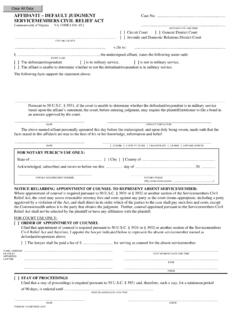
6 Bobby Brown ). The juvenile's name should appear first, followed by an indication that it is being filed by a next friend, then followed by the next friend's name. The names of the parents of any minor (petitioner by next friend or respondent), need to be provided, along with addresses, by the intake office, as notice to the parents is required. The information for service may be provided on the petition or another addendum. Note: The testimony of any child witness who is fourteen years of age or under at the time of the trial may be taken by closed-circuit television, upon proper application and order of the court. Va. Code Servicemembers Civil Relief Act Requirements for Default Judgment A default judgment may not be entered until the plaintiff files an affidavit (i) stating whether or not the defendant is in military service and showing necessary facts to support the affidavit; or (ii) if the plaintiff is unable to determine whether or not the defendant is in military service, stating that the plaintiff is unable to determine whether or not the defendant is in military service.
7 The district court form DC-418, AFFIDAVIT DEFAULT JUDGMENT SERVICEMEMBERS CIVIL RELIEF ACT is available for use by plaintiffs. Failure to file the affidavit is not grounds to set aside an otherwise valid default judgment against a defendant who was not, at the time of service of process or entry of the default judgment, a service member. However, case law indicates that failure to comply with the affidavit requirement in a case involving a defendant who is a service member and whose military service interfered with his ability to respond to a suit creates a voidable default judgment. See Flynn v. Great Atlantic Management Co., 246 Va. 93; Matthews v. Allstate Ins. Co., 194 F. Supp. 459 ( Va. 1961). If the defendant is believed to be in military service and is unaware of the action, the court must appoint an attorney to represent the defendant prior to entry of a default judgment. The court must grant a stay of not less than ninety days upon request by appointed counsel or upon its own motion if the court believes that (i) there may be a defense that requires the defendant s presence or (ii) counsel has been unable to contact JUVENILE & DOMESTIC RELATIONS DISTICT COURT Manual Protective Orders PAGE 8-4 Office of the Executive Secretary Department of Judicial Services Rev.
8 7/20 the defendant or otherwise determine if a meritorious defense exists after due diligence. If the service member cannot be contacted within the first ninety-day stay period, a default judgment may be entered, but the service member may attack the judgment and the attorney s actions shall not bind him. If the service member is believed to be in military service and has been provided notice of the action, the court may grant a stay of ninety days or more upon its own motion, and shall grant a stay upon application of a service member with notice, if such service member provides (i) a letter setting forth the reasons why his military duties materially affect his ability to appear, and a date on or after which he could appear and (ii) a letter from his commanding officer stating that his service precludes his ability to appear and that he is not authorized to take leave. Active duty status alone, even in another state, does not necessarily materially affect one s ability to appear.
9 Application for this stay does not constitute a waiver of jurisdictional defenses. A service member may apply for additional stays, but the court need not grant them. If the court refuses to grant an additional stay after the first ninety-day stay and the service member still cannot appear by reason of his military service, then the court must appoint an attorney to represent him before entering default judgment. If appointment of counsel is required, the court may assess attorneys fees and costs against any party, as the court deems appropriate, and shall direct in its order which of the parties shall pay. Such fees and costs shall not be assessed against the Commonwealth unless it is the party that obtains the judgment. The Servicemembers Civil Relief Act covers National Guard members who are in Title 10 status. Title 10 status means they are paid and under the direct control of the federal government. Members who are in a Title 32 status, paid and trained by the United States Armed Forces but under control of the respective state governors, are covered by the Servicemembers Civil Relief Act if they are in that status pursuant to a contingency mission specified by the President or Secretary of Defense.
10 Members who are paid by and under the command of their states governors are not covered under this Act. A service member who did not have notice of an action that resulted in a default judgment may petition the court to reopen a case within ninety days of his release from service. The court shall rehear the matter and allow the service member to defend the action only if (i) the service member was materially affected in making a timely defense by reason of military service and (ii) the service member has a meritorious or legal defense to the action or some part thereof. Upon issuance of a Protective order pursuant to or , the court shall order the person who is subject to the Protective order to within 24 hours after being served with a Protective order , surrender any firearm possessed by such person to a designated local law-enforcement agency, sell or transfer any firearm possessed by such person to a dealer, sell or transfer any firearm possessed by such person to any person who is not otherwise prohibited by law from possessing such firearm and within 48 hours after being served with a Protective order certify in writing, that the person does not possess any firearms or that all firearms possessed by the person have been surrendered, sold, or transferred and file such certification with the clerk of the court that entered the Protective order .