Transcription of Journalism/School Newspaper Rubric
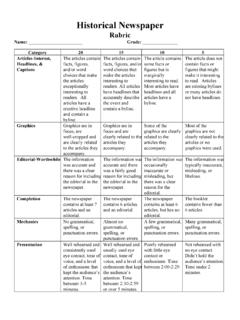
1 Journalism/School Newspaper Rubric CATEGORY 4 3 2 1 Headline & Byline article has a headline that captures the reader's attention and accurately describes the content. Includes author of the article . article has a headline that accurately describes the content. Includes author of the article . article has a headline that does not describe the content. May or may not include the author of the article . article is missing headline. Author is missing. Lead Sentence Lead sentence grabs the reader's attention and focuses the reader on the topic. Lead sentence tells most important details. Lead sentence is not clearly connected to the article . There is no clear lead sentence in the article .
2 Who, What, When, Where & How article adequately addresses the 5 W's (who, what, when, where and how). The article is missing one of the 5 W's. The article is missing 2 of the 5 W's. The article is missing 3 or more of the 5 W's. Supporting Details The details in the article are clear and supportive of the topic. The details in the article are clear but need to be developed more. Some details may not fit in with the topic. Most details in the article are clear. article does not focus on the topic well. The details the article are neither clear nor related to the topic. Spelling and Grammar No spelling or grammar errors. No more than a couple of spelling or grammar errors.
3 No more than 3 spelling or grammar errors. Several spelling or grammar errors Graphics Graphics are in focus, are well-cropped and are clearly related to the article they accompany. Graphics are in focus and are clearly related to the article they accompany. 80-100% of the graphics are clearly related to the article they accompany. More than 20% of the graphics are not clearly related to the article OR no graphics were used. Rubric (10 points) Rubric turned in with article No Rubric with article . Main Elements of a News article There are certain elements that are common to almost all articles that you will read in the Newspaper or find on the Internet. The following list explains the five major components, or parts, of a news article .
4 Headline (Heading) The headline is the title of the news article . The headline should be short, does not include a lot of detail, and should catch the readers attentions. It is normally not a complete sentence, and tries to summarize the main idea or subject of the article . It is often printed in larger letters than the rest of the article , and the major words are capitalized. Byline This line tells who is writing the article . It may also include the address of the author and the publication or news source for which he or she writes. Location This is usually placed at the beginning of the article in bold print. If the city or location is well-known, the name can be written alone, but if the city is less famous, more information is included.
5 For example, the byline of an article written in Atlanta, Georgia would read Atlanta , while an article from Leary, Georgia would have to include the name of the state. Lead Paragraph(s) The lead paragraph is found at the beginning of the article . The lead briefly answers the questions who , what , when , why , where , and how . The skeleton of the story can be found here. Supporting Paragraph(s) These are the paragraphs which follow the lead. They develop the ideas introduced by the lead, and give more information in the form of explanations, details, or quotes. In many newspapers, these paragraphs are found on subsequent pages.