Transcription of Junior Cycle Modern Foreign Languages - Curriculum
1 Junior Cycle Modern Foreign Languages Contents 3 Introduction to Junior cycle4 Rationale 6 Aim 7 Overview: LinksStatements of learningModern Foreign Languages and Key Skills11 Overview: Course15 Expectations for studentsLearning outcomes19 Assessment and reporting25 Appendix ADevelopment of Modern Foreign language exponents 38 Appendix B The CEFR Common Reference Levels global scale39 Appendix CThe Common Reference Levels self-assessment gridPagePagePagePagePagePagePagePagePage PageJunior Cycle Modern Foreign Languages Introduction to Junior cycle3 Introduction to Junior cycleJunior Cycle education places students at the centre of the educational experience, enabling them to actively participate in their communities and in society and to be resourceful and confident learners in all aspects and stages of their lives. Junior Cycle is inclusive of all students and contributes to equality of opportunity, participation and outcome for Junior Cycle allows students to make a greater connection with learning by focusing on the quality of learning that takes place and by offering experiences that are engaging and enjoyable for them, and relevant to their lives.
2 These experiences are of a high quality, contribute directly to the physical, mental and social wellbeing of learners, and where possible, provide opportunities for them to develop their abilities and talents in the areas of creativity, innovation and enterprise. The learner s Junior Cycle programme builds on their learning to date and actively supports their progress in learning and in addition, supports them in developing the learning skills that will assist them in meeting the challenges of life beyond Cycle Modern Foreign LanguagesRationale4 Rationale The study of Modern Foreign Languages enables students to build on their language learning in English and Irish in primary school and further develops their skills in and enjoyment of using Languages . Language learning is accessible to all students and contributes to their cognitive, personal and social growth by enhancing their communicative and thinking skills, as well as their participation in a global society.
3 Being able to communicate in the mother tongue and in Foreign Languages are also among the eight key competences for lifelong learning identified by the European Union and European Council in learning develops students general language awareness. It enhances their ability to analyse how language works, to compare Languages , and to reflect on how they learn Languages . This has a positive effect on their first language skills and on future language learning Foreign Languages , students are actively engaged in activities and tasks which integrate the five language skills of listening, reading, spoken production, spoken interaction and writing. As a result, they communicate with increasing independence, confidence and creativity. As learning is a social activity as well as a personal one and as communication is central to language, learning Languages offers students ample opportunities to work with others to develop their language skills and achieve appropriate goals.
4 A fundamental feature of Languages is that they give students access to new worlds and different ways of thinking. The resulting development of socio-cultural knowledge and intercultural awareness also enhances students cognitive development. By reflecting on other cultures and making comparisons they develop a deeper understanding of their own while appreciating diversity. Language learning also broadens students horizons and enables them to develop a lifelong learning skill for education, leisure and work, and to develop a positive attitude towards other Languages and cultures. Modern technologies play a key role in making language learning and language use increasingly more accessible and enjoyable for learners, by facilitating access to information and communication with people at a global level. The society we live in has become multilingual. Ireland needs to increase its language capacity and to foster plurilingualism (a person s ability to communicate in more than one language).
5 While English is an international language, knowledge of other Languages gives us cultural and competitive Recommendation 2006/962/EC of the European Parliament and of the Council of 18 December 2006 on key competences for lifelong learning [Official Journal L 394 of ]. Junior Cycle Modern Foreign LanguagesRationale5 Many studies attest to the benefits of bilingualism and plurilingualism. Students who have been exposed to language learning from an early age perform better than those who have not; not only in verbal skills, but also in mathematics. They display enhanced abilities in areas such as problem-solving, multi-tasking, creativity and pattern recognition2. Please note that this specification has been developed as a framework to be used for teaching Junior Cycle French, German, Italian and Spanish as Modern Foreign language exponents provide a detailed example of how a teacher will use the specification to plan for teaching and learning.
6 2 See Garc a, Ofelia (2009). Bilingual Education in the 21st Century: A Global Perspective. Malden, MA and Oxford, United Kingdom: Wiley-Blackwell. pp. Cycle Modern Foreign LanguagesAim6 Aim The Specification for Junior Cycle Modern Foreign Languages aims to develop communicative language skills broadly aligned with the A band (A1 to A2, basic user) of the Common European Framework of Reference for Languages (CEFR)3 and its descriptors. It also aims to enable students to explore the interdependence between language and culture, to develop their appreciation of the relevance of Languages to their lives for personal, social, educational, vocational and leisure purposes, and to derive enjoyment from language specifically it encourages all students to actively engage in language activities and tasks, developing the capacity to understand written and spoken language communicate effectively and confidently in the target language in familiar contexts through a range of media develop their capacity to use appropriate structures and vocabulary for the purposes of communication, both written and oral enjoy a language-learning experience that will facilitate and encourage them to continue learning Languages in future be reflective and autonomous in their language learning.
7 And become actively involved in monitoring and assessing their progress appreciate their own and other cultures develop skills that they can apply to other areas of study and to their lives. 13 Council of Europe. (2001). Common European Framework of Reference for Languages : Learning, teaching, assessment. Cambridge: Cambridge University Press. The full text is available on the Council of Europe website: Cycle Modern Foreign Languages Overview: Links7 Overview: LinksTables 1 and 2 on the following pages show how Junior Cycle Modern Foreign Languages are linked to central features of learning and teaching in Junior 1: Links between Junior Cycle Modern Foreign Languages and the statements of learningSTATEMENTS OF LEARNINGThe statementExamples of relevant learningSOL 2: The student listens, speaks, reads and writes in L2 and one other language at a level of proficiency that is appropriate to her or his ability. Students will develop their communicative language competence by actively engaging in language activities and tasks in the integrated language skills of listening, reading, spoken production, spoken interaction and writing.
8 SOL 6: The student appreciates and respects how diverse values, beliefs and traditions have contributed to the communities and culture in which she/he will reflect on the values, beliefs and traditions of another culture. By doing this, they will gain deeper insights into their own culture and develop a positive attitude towards as well as respect and curiosity for diversity. They will also develop an awareness and appreciation of the multilingual and multicultural society in which they 16: The student describes, illustrates, interprets, predicts and explains patterns and will learn how the target language works; they will explore, describe and explain patterns such as word order, word endings, sentence construction, and the verb system. By comparing the target language with other Languages they know, students will look at the relationships between Languages and will gain deeper insights into how their own language 24: The student uses technology and digital media tools to learn, communicate, work and think collaboratively and creatively in a responsible and ethical will use digital technologies to access information related to the target language and culture, to engage with a range of formats (written, audio, video) and to communicate with speakers of the target language using appropriate tools in a responsible and ethical Cycle Modern Foreign Languages Overview: Links8 KEY SKILLS In addition to their specific content and knowledge, the subjects and short courses of Junior Cycle provide students with opportunities to develop a range of key skills.
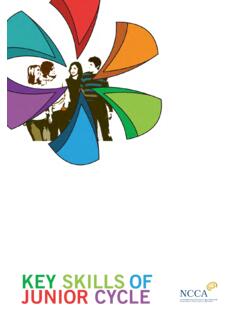
9 There are opportunities to support all key skills in this course but some are particularly significant. The examples below identify some of the elements that are related to learning activities in Modern Foreign Languages . Teachers can also build many of the other elements of particular key skills into their classroom planning. The eight key skills are set out in detail in Key Skills of Junior Junior Cycle Curriculum focuses on eight key skills: being creative being literate being numerate communicating managing information and thinking managing myself staying well working with Cycle Modern Foreign Languages Overview: Links9 Figure 1: Key skills of Junior Cycle MANAGING MYSELFBEINGCREATIVEMANAGINGINFORMATION& THINKINGSTAYINGWELLCOMMUNICATINGBEINGLIT ERATEBEINGNUMERATEWORKING WITH OTHERSKEY Skills of Junior Cycle Imagining Exploring options and alternatives Implementing ideas and taking action Learning creatively Stimulating creativity using digital technology Expressing ideas mathematically Estimating, predicting and calculating Developing a positive disposition towards investigating, reasoning and problem-solving Seeing patterns, trends and relationships Gathering, interpreting and representing data Using digital technology to develop numeracy skills and understanding Being curious Gathering, recording, organising and evaluating information and data Thinking creatively and critically Reflecting on and evaluating my learning Using digital technology to access.
10 Manage and share content Being healthy and physically active Being social Being safe Being spiritual Being confident Being positive about learning Being responsible, safe and ethical in using digital technology Knowing myself Making considered decisions Setting and achieving personal goals Being able to reflect on my own learning Using digital technology to manage myself and my learning Developing my understanding and enjoyment of words and language Reading for enjoyment and with critical understanding Writing for different purposes Expressing ideas clearly and accurately Developing my spoken language Exploring and creating a variety of texts, including multi-modal texts Using language Using numbers Listening and expressing myself Performing and presenting Discussing and debating Using digital technology to communicate Developing good relationships and dealing with conflict Co-operating Respecting difference Contributing to making the world a better place Learning with others Working with others through digital technology12914 NCCA Jr Cycle Key Skills Poster 110/06/2016 12:58 Junior Cycle Modern Foreign Languages Overview: Links10 Table 2: Links between Junior Cycle Modern Foreign Languages and key skillsKey skillKey skill elementStudent learning activityBeing literateDeveloping my spoken languageStudents will engage in meaningful communicative activities and tasks across all strands.