Transcription of K to 12 Basic Education Curriculum
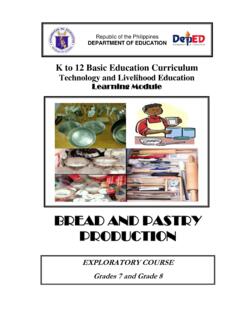
1 AUTOMOTIVE K to 12 Technology and Livelihood Education Page 1 K to 12 Basic Education Curriculum Technology and Livelihood Education Learning Module AUTOMOTIVE SERVICING EXPLORATORY COURSE Grades 7 and Grade 8 Republic of the Philippines DEPARTMENT OF Education AUTOMOTIVE K to 12 Technology and Livelihood Education 2 TABLE OF CONTENTS Page What Is This Module About? .. 3 1 How Do You Use This Module .. 5 1 LESSON 1 Use Hand tools .. 6 LESSON 2 Perform Mensuration and Calculations .. 57 LESSON 3 Interpret Plans and Drawings.
2 86 LESSON 4 Perform Shop Maintenance ..143 LESSON 5 Practice Occupational Health and Safety .187 ANSWER ..246 Acknowledgment .. 261 AUTOMOTIVE K to 12 Technology and Livelihood Education 3 Welcome to the course of Automotive! This Module is an exploratory and introductory course which leads you to Automotive Servicing National Certificate Level I ( NC I)1. It covers 5 common competencies that a Grade 7/Grade 8 Technology and Livelihood Education (TLE) student like you ought to possess, namely: 1). Use Hand Tools 2). Perform Mensuration and Calculations 3).
3 Interpret Plans and Drawings 4). Perform Shop Maintenance 5). Practice Occupational Health and Safety Procedure These 5 common competencies are covered separately in 5 Lessons. As shown below, each Lesson is directed to the attainment of one or more learning outcomes: Lesson 1 Use Hand Tools LO 1 - Plan and prepare for tasks to be undertaken. LO 2 - Prepare and use hand tools. LO 3 - Prepare report of malfunctioning tools. LO 4 - Maintain hand tools. Lesson 2 Perform Mensuration and Calculations LO 1-Select measuring instrument and carry out measurement and calculations. LO 2 - Maintain measuring instruments.
4 Lesson 3 Interpret Plans and Drawings LO 1 - Analyze signs, symbols and data. LO 2 - Interpret technical drawings and plans. Lesson 4 Perform Shop Maintenance LO 1 - Inspect and clean tools and shop equipment. LO 2 - Store and Arrange tools and shop equipment. LO 3 - Dispose waste/ used lubricants. Lesson 5 Practice Occupational Health and Safety Procedures LO 1 - Identify hazards and risks. LO 2 - Evaluate hazards and risks. LO 3 - Maintain occupational health and safety awareness. Your success in this exploratory course on Automotive is shown in your ability to perform the performance standards found in each lesson.
5 1 NATIONAL CERTIFICATE (NC) is a certification issued to individuals who achieved all the required units of competency for a national qualification as defined under the Training Regulations. NCs are aligned to specific levels within the PTQF. (TESDA Board Resolution No. 2004-13, Training Regulations Framework) NATIONAL CERTIFICATE LEVEL refers to the four (4) qualification levels defined in the Philippine TVET Qualifications Framework (PTQF) Where the worker in: a. NC I performs a routine and predictable tasks; has little judgment; and, works under supervision; b.
6 NC II performs prescribe range of functions involving known routines and procedures; has limited choice and complexity of functions, and has little accountability; What Is This Module About? AUTOMOTIVE K to 12 Technology and Livelihood Education 4 This Module has five Lessons. Each Lesson has the following parts: Learning Outcomes Performance Standards Materials/Resources Definition of Terms What Do You Already Know? What Do You Need to Know? How Much Have You Learned? How Do You Apply What You Have Learned? How Well Did You Perform? References To get the most from this Module, you need to do the following: 1.
7 Begin by reading and understanding the Learning Outcome/s and Performance Standards. These willtell you what you should know and be able to do at the end of this Module. 2. Find out what you already know by taking the Pretest then check your answer against the Answer Key. If you get 99 to 100% of the items correctly, you may proceed to the next Lesson. This means that you need not go through the Lesson because you already know what it is about. If you fail to get 99 to 100% correctly, go through the Lesson again and review especially thoseitems which youfailed to get.
8 3. Do the required Learning Activities. They begin with one or more Information Information Sheet contains important notes or Basic information that you need to know. After reading the Information Sheet, test yourself on how much you have learned by means of the Self-check. Refer to the Answer Key for correction. Do not hesitate to go back to the Information Sheet when you do not get all testitems correctly. This will ensure your mastery of Basic information. 4. Demonstrate what you learned by doing what the Activity / Operation /Job Sheet directs you to do.
9 5. You must be able to apply what you have learned in another activity or in a real life situation. 6. Accomplish the Scoring Rubrics for you to know how well you performed. Each Lesson also provides you with references and definition of key terms for your guide. They can be of great help. Use them fully. How Do You Use This Module? If you have questions, ask your teacher for assistance. AUTOMOTIVE K to 12 Technology and Livelihood Education 5 Use Hand Tools LESSON 1 LO 1. prepare hand tools; LO 2 use appropriate hand tools and test equipment; LO 3 prepare record of malfunctioning tools; and LO 4 maintain hand tools.
10 LEARNING OUTCOMES: At the end of this Lesson, you are expected to do the following: AUTOMOTIVE K to 12 Technology and Livelihood Education 6 Adjusting - an activity or task done to arrange parts in relation to position or regulate a clearance in relation to accuracy Air cleaner - apaper or cellulose element that filters the air before entering the engine Assembling - an activity or task of putting together of parts or mechanism in correct and complete position Bolt - a round rod metal with external threads. The external thread can be screwed in an internally threaded stock or nut. It usually has square or hexagonal head where wrench a can be inserted to loosen and tighten Checking - a process of verifying and confirming the condition of parts by observation or inspection Fault - a condition of flaw or imperfection Hand tools - a portable devices that are guided and operated by hands Hose - a flexible and heat resistant rubber that serves as a passage of coolant in the cooling system Inspection - examining or looking closely as a course of action Loosen - release from tightness or free from restraint Major task - a work which is reasonably great in scope Malfunction.