Transcription of KAIZEN - Stampings | Tedco Inc
1 KAIZEN TOPS/8D s DMAIC/DMADV 70 GLEN ROAD, CRANSTON, RI 02920 T: 401-461-1118 | F: 401-461-1119 problem solving Techniques TOPS 8D s DMAIC/DMADV 37 Companies are often surprised to learn that as much as 80% of their resources are typically allocated to problem solving activities sometimes better known as fire-fighting. Everyone knows that prevention is better than cure, but finding a way of escaping the problem solving spiral has not been easy.
2 Inevitably this infers a greater allocation of resources for more planning and better prevention. But how can more resources be allocated to prevention when they are being constantly used for putting out fires? 38 Originally developed at Ford Motor Company, 8D was introduced in 1987 in a manual titled "Team Oriented problem solving " (TOPS). As part of the Ford Lean Manufacturing initiative, this course was written at the request of senior management of the automaker's Power Train organization, which was facing growing frustration at the same problems that were recurring year after year. The focus of this system was to use this approach in a team environment. Teams are to be cross-functional and include members from both the manufacturing organization as well as design engineering.
3 39 The 8D process evolved from Dr. Deming s Plan-Do-Check-Act (PDCA) cycle, and the Kepner Tregoe problem solving Decision Making (PSDM) process. The common thread between all three techniques is the importance of focusing on finding the real reason for the problem (Root Cause Analysis) before looking for possible solutions. Auto repair is a case in point. A parts changer , if not told what to repair or replace, just starts replacing parts until the problem goes away, while a true auto mechanic knows how to analyze what is causing the problem before taking any corrective actions. 40 The Ford 8D s (disciplines) process is most effective in dealing with chronic recurring problems, primarily defects or warranty issues.
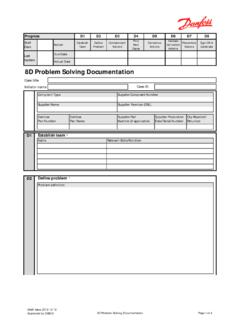
4 They were never intended to replace or stand as a systemic quality system. The 8Ds' focus was to deal with problems and discover the weaknesses in the management systems that allowed the problem to occur In the first place. In ISO terms, these are CAR s and PAR s. The real benefit would come by changing how management decisions allowed the problem to happen. The problem is merely a symptom of a greater systemic management issue. 41 Global 8D problem solving is made up of a detection cycle and a prevention cycle. It defines a corrective action methodology. The 8D s are: D#1 - Build the Team D#2 - Describe the problem . D#3 - Develop an Interim Containment Action D#4 - Define / Verify Root Cause D#5 - Verify Corrective Action D#6 - Implement / Validate Permanent Corrective Action D#7 - Prevent Recurrence D#8 - Recognize the Team 42 Increasingly, these days, companies practicing lean manufacturing are requiring their employees to also understand the 8-Discipline approach (Eight D) to team-based problem solving .
5 These essentially present a standard methodology for data analysis and statistical thinking and is a key lean tool. Discipline 1 Build The Team - Assemble a small team of people with the right mix of skills, experience and authority to resolve the problem and implement solutions. Ensure these people have the time and inclination to work towards the common goal. Get your people on board by using team building tools such as icebreakers and team activities. 43 Discipline 2 Describe the problem - How can you fix it if you don t know what s broken? The more clearly you describe the problem , the more likely you are to resolve it. Be specific and quantify the problem where possible. Clarify what, when, where and how much what is the impact to customers?
6 Consider using checklists from professional 8d problem solving suppliers to stimulate and open up your thinking. Discipline 3 Develop an Interim Containment Action - What sticking plaster can you use until you figure out what s really causing the problem ? Implement a temporary fix and monitor and measure the impact to ensure it s not making things worse. Remember to keep going, as a sticking plaster will never cure a broken leg! 44 Discipline 4 Define / Verify Root Cause - There will be many suspects causing the problem , but usually only one culprit. The key is figuring out which one. This is where it can get a bit numerically challenging, as statistical tools are often used to get a deep understanding of what is going on in a process.
7 Perform a Root Cause analysis by asking 5 Whys. The 5 Whys is a technique used in the Analyze phase of the Six Sigma DMAIC methodology. It's a great Six Sigma tool that doesn't involve data segmentation, hypothesis testing, regression or other advanced statistical tools, and in many cases can be completed without a data collection plan. 45 By repeatedly asking the question "Why" (five is a good rule of thumb), you can peel away the layers of symptoms which can lead to the root cause of a problem . Very often the ostensible reason for a problem will lead you to another question. Although this technique is called "5 Whys," you may find that you will need to ask the question fewer or more times than five before you find the issue related to a problem .
8 Benefits Of The 5 Whys Help identify the root cause of a problem . Determine the relationship between different root causes of a problem . One of the simplest tools; easy to complete without statistical analysis. 46 When Is 5 Whys Most Useful? When problems involve human factors or interactions. In day-to-day business life; can be used within or without a Six Sigma project. How To Complete The 5 Whys 1. Write down the specific problem . Writing the issue helps you formalize the problem and describe it completely. It also helps a team focus on the same problem . 2. Ask Why the problem happens and write the answer down below the problem . 3. If the answer you just provided doesn't identify the root cause of the problem that you wrote down in step 1, ask Why again and write that answer down.
9 4. Loop back to step 3 until the team is in agreement that the problem 's root cause is identified. Again, this may take fewer or more times than five Whys. 47 5 Whys Examples problem Statement: Customers are unhappy because they are being shipped products that don't meet their specifications. 1. Why are customers being shipped bad products? - Because manufacturing built the products to a specification that is different from what the customer and the sales person agreed to. 2. Why did manufacturing build the products to a different specification than that of sales? - Because the sales person expedites work on the shop floor by calling the head of manufacturing directly to begin work. An error happened when the specifications were being communicated or written down.
10 48 3. Why does the sales person call the head of manufacturing directly to start work instead of following the procedure established in the company? - Because the "start work" form requires the sales director's approval before work can begin and slows the manufacturing process (or stops it when the director is out of the office). 4. Why does the form contain an approval for the sales director? - Because the sales director needs to be continually updated on sales for discussions with the CEO. In this case only four Whys were required to find out that a non-value added signature authority is helping to cause a process breakdown. 49 Let's take a look at a slightly more humorous example modified from Marc R.