Transcription of Key features of effective phonics practice
1 1 2021 Wandle Learning Trust. All rights COMPLETE phonics RESOURCE TO SUPPORT CHILDRENKey features of effective phonics practiceSeven features of effective phonics practiceThrough the English Hubs Programme, seven key features have been identified as characterising phonics teaching in highly successful schools, no matter which validated programme is being used. These are: direct teaching in frequent, short bursts consistency of approach secure, systematic progression in phonics learning maintaining pace of learning providing repeated practice application of phonics using matched decodable books early identification of children at risk of falling behind, linked to the provision of effective keep-up important question for schools is whether their implementation delivers on all these key features of effective practice .
2 This document shows how these essential criteria apply to Little Wandle Letters and Sounds 2021 Wandle Learning Trust. All rights teaching in frequent, short burstsPhonics is a specific, defined body of knowledge. Children learn this most effectively if we use direct teaching. phonics is also powerful knowledge. It opens up the potential of reading and so much other learning, too. Children are at an advantage if they are taught phonics efficiently and as early as possible in their learning the young age of the children, regular short bursts of direct teaching are most effective , although these do not necessarily need to be of a particular through Little Wandle Letters and Sounds RevisedIn the programme, all lessons involve direct teaching and the accompanying How to videos model this.
3 The daily lessons follow the weekly content grids. Each lesson generally takes 15 30 minutes, depending on the age and stage of the children being of approachThis covers two aspects: consistency of delivery from all teachers and teaching assistants consistency in the learning approaches experienced by through Little Wandle Letters and Sounds RevisedTo support the necessary consistency, it is recommended that: all teachers watch the How to videos all teachers refer to the Prompt cards , in preparation for teaching each school appoints a dedicated Reading Leader, who is responsible for coaching teachers, monitoring provision, gathering data and ensuring that all teachers are trained senior management monitors phonics teaching, with a focus on 2021 Wandle Learning Trust.
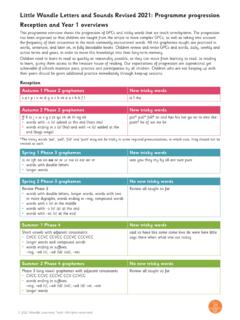
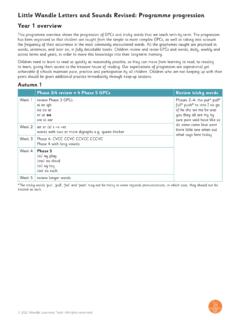
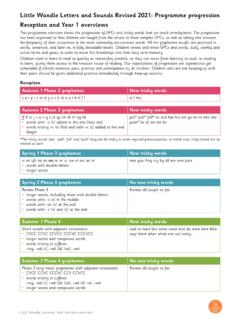
4 All rights , systematic progression in phonics learningIt is essential for progression in phonics learning to cover: all the phonemes of English words correct pronunciation of the phonemes all commonly occurring grapheme-phoneme correspondences (GPCs) the correct formation of all graphemes blending for reading segmenting for writing the sequenced learning of appropriate tricky programme must establish a clear sequence that enables children to begin to read and write simple words , phrases and sentences as early as possible. It must then, systematically and cumulatively, work towards children being able to decode any unknown words in age-appropriate texts by the time they complete the through Little Wandle Letters and Sounds RevisedThe programme provides a full progression through all commonly occurring GPCs, working from simple to more complex, and taking into account the frequency of their occurrence in the most commonly encountered each appropriate stage, the lesson templates guide teachers through the learning of GPCs, the formation of graphemes, blending for reading, segmenting for writing, and reading and writing simple weekly content grids map the introduction.
5 practice and application of each GPC, alongside the controlled learning of tricky words . Providing the content grids are followed carefully, they ensure the secure, systematic progression 2021 Wandle Learning Trust. All rights pace of learning Children need to learn to read as quickly as reasonably possible, so they can move from learning to read to reading to learn, giving them access to the treasure house of reading. Their progress must include reaching national standards by the required times, for example in the phonics screening check. This means they should successfully cover the full phonic progression over the timespan of the school s programme so the pace of learning needs to reflect , this needs to be balanced by our understanding (backed by recent research) that children do not cope well if they have to learn too many new things at the same time.
6 Pace of learning is therefore also about spacing out new learning to avoid overload, and to allow time for repetition and consolidation, so that learning becomes fully embedded in long-term memory. Optimum pacing is a balance between these two through Little Wandle Letters and Sounds RevisedIn Little Wandle Letters and Sounds Revised, the weekly content grids map each element of new learning to each day, week and term for the duration of the programme. The pace allows for full coverage of all aspects of the progression, in a cumulative way, without adding too many elements of new learning at any one time. It also allows for significant periods of practice , consolidation and full effectiveness, it is therefore important that neither teaching nor learning are allowed to drift too far behind the pace set.
7 Equally, it will be unhelpful for the set pace to be exceeded, as this is likely to result in overload for many children. Any temptation to leave out periods of consolidation and revision should also be resisted. 5 2021 Wandle Learning Trust. All rights repeated practiceThe ultimate goal of teaching phonics is that children read fluently, recognising most words instantly and using phonics to decode any unknown means that phonics knowledge needs to be embedded in long-term memory so that its application becomes , spaced practice is by far the most effective way of transferring knowledge from short- to long-term memory. effective phonics teaching offers repeated practice at the point of learning and returns to practise the same elements again at intervals over an extended period.
8 practice makes consistent experience of effective schools using the major programmes is that children do not find repeated practice tedious as long as they are engaged with the learning process. Delivery through Little Wandle Letters and Sounds RevisedThe programme builds repeated practice into all lessons, as modelled in the How to videos. The lessons then return several times to further practise and consolidate learning. It is important that teachers do not shy away from repeated practice or curtail it for fear of becoming tedious. This does not happen if children are fully engaged in the learning. Little Wandle Letters and Sounds Revised promotes children s engagement in learning through: teacher energy and enthusiasm extensive interaction between teachers and children in lessons generous praise and encouragement building on and celebrating 2021 Wandle Learning Trust.
9 All rights of phonics using matched decodable booksAll major phonics programmes use fully decodable reading books for children to practise and apply phonic knowledge. It is an expectation of the Department for Education and Ofsted, and a requirement of the National Curriculum. More importantly though, it gives children the vital opportunity to practise the phonic skills they are learning without the distraction of words they have not yet learned to decode. To be effective , it is essential that decodable books: are exactly matched to the phonics progression of the programme used present only words made up of GPCs learned to that point include tricky words only as they are introduced in the programme are used exclusively when children are practising reading and not mixed in with books that are not fully decodable at the child s course.
10 Teachers should read and share a wide range of non-decodable quality children s books with their through Little Wandle Letters and Sounds RevisedThe programme includes application with decodable books as an essential stage of the teaching Big Cat for Little Wandle Letters and Sounds Revised have devised fully decodable books matched to our programme progression. Detailed guidance on selecting and organising suitable decodable books from your existing stock is also provided in the Reading section of the Reading section of the website also provides lesson templates and How to videos to support reading practice sessions using decodable books. We also have guidance and support about home reading, including the use of both decodable books and other books for sharing.