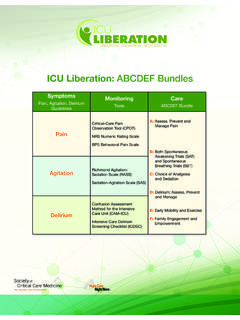
Transcription of KEY REFERENCES: Laying the Foundation for B
1 key references : Laying the Foundation for B (SATs & SBTs) of ABCDEF Bundle Ely E. (SBTs) N Engl J Med. 1996;335:1864-9. Riker R. (SAS) Crit Care Med. 1999; 27:1325-9. Kress J. (SATs) N Engl J Med. 2000;342:1471-7. Sessler C. (RASS) Am J Respir Crit Care , 166:1338-44. Ely E. (RASS) ;289:2983-91. Girard T. (ABC Study) ;371:126-34. Str m T. (No Sedation) ;375:475-80. Shehabi Y. (Deep Sedation) Am J Respir Crit Care Med. 2012;186:724-31. Balas M. (ABCDE) Crit Care Med. 2013;42:1024-36. Bassett R. (IHI ABCDE Collaborative) Jt Comm J Qual Patient Saf. 2015;41:62-74. Klompas M. (CDC ABCDE Collaborative) Am J Respir Crit Care Med. 2015;191 REFERENCES: Hazards of Deep Sedation(Additional Studies Laying the Foundation for B) Treggiari M. (Light Sedation) CritCare Med. 2009;37:2527-34. Pandharipande P. (Lorazepam Predicts Delirium)Anesthesiology. 2006;104:21-6. Seymour C. (Diurnal Sedation and Liberation) ;40:2788-96. Hager D. (Reducing Deep Sedation ALI) CritCare ;41:1435-42.
2 Shehabi Y. (Goal-Directed Sedation) CritCare ;41:1983-91. ShehabiY. (Mortality attributed to Delirium) Intensive Care ;39:910-8. Tanaka L. (Early OversedationOutcomes) ;18:R156. Burry L. (High Versus Low Sedation Outcomes) Can J Anaesth. 2014;61:619-30. Minhas MA. (ProtocolizedSedation) Mayo Clin ;90:613-23. Balzer F. (Early Deep Sedation decrease 2 year survival) ;19 Objectives Review current evidence related to the hazards of deep sedation and the benefits of a coordinated SAT/SBT approach Describe valid and reliable sedation/agitation assessment tools Provide practical guidance for reliable SAT and SBT performance Discuss facilitators and potential barriers to successful SAT and SBT performanceGoals of ICU Sedation Calm Comfortable Cooperative Reduce anxiety and agitation Facilitate mechanical ventilation Decrease traumatic memory of ICU stay and proceduresHow Do We Define Adequate Sedation ? 274 patients Sedatives administered during 85% of 18,050 four-hour intervals 1 in 3 (32%) -unarousable 1 in 5 (22%) -no spontaneous motor activity Only -thought to be over-sedatedWeinert C.
3 Crit Care ;35 Canadian authors of SLEAP n=712 Patient-days = 3,620 We found that nearly all patients were managed with continuous-infusion opioids and sedatives. We also found that actual practice was different from what we expected because the available clinical tools such as protocols and assessment scales were not necessarily applied at the bedside. Burry L. Can J ;61(7) collected Consequences of Prolonged, Deep Sedation/Benefits of Light Sedation Deep sedation Reduced six-month survival Hospital mortality Longer duration of mechanical ventilation Longer ICU length of stay Increased physiologic stress in terms of elevated catecholamine concentrations and/or increased oxygen consumption at lighter sedation levels BUT no clear relationship between elevation and clinical outcomesBrook A. Crit Care ;27 T. ;371 J. N Engl J Med. 2000;342 M. Crit Care ;37 M. ;114 Y. Am J Respir Crit Care Med. 2012;186 Y. Am J RespirCrit Care Med. 2012;186 IntubatedEarly Deep Sedation Longer Mechanical Ventilationand Reduced Six-Month SurvivalMental Health After Light or Deep Sedation 137 adults requiring mechanical ventilation-RCT Sedation with midazolam Light: Ramsay 1-2, intermittent injection Deep: Ramsay 3-4, continuous infusion Results Primary endpoints (4 weeks after ICU discharge) Trend toward more PTSD symptoms with deep sedation (P= ) More trouble remembering the event (P= ) More disturbing memories of the ICU (P= ) No difference in anxiety or depression scores Other endpoints: light sedation patients averaged 1 day shorter on mechanical ventilation (P= ) days shorter length of stay (P= )Treggiari M.
4 Crit Care Med. 2009;37 Sedation of MVICU LOSH ospital LOSM edian Time (days)Protocol n = 162 Routine n = 159P= < A. Crit Care Med. 1999;27 Sedation Protocol Statistically shorter: Duration of MV ICU LOS Hospital LOSS ignificant patient characteristics/metrics/outcomesProtocol ControlPvalueDaily midazolam, mg*44 3192 midazolam, hrs** 11 (6)29 (13) diagnosis 12 (6)34 (15) *Data presented in mean; ** Data presented in median Data presented as n (%)Quenot J. Crit Care Med. 2007;35(9) Enforced Adherence to an ICU Sedation Guideline Statistically shorter: Duration of MV ICU LOS Hospital LOSS ignificant patient characteristics/metrics/outcomesRPhContr olPvalueAlcohol/drug overdose 15 ( )6 ( ) equivalents/vent day, mg* equivalents/vent day, mcg* 328400 *Data presented in mean ; Data presented as n (%)Marshall J. Crit Care Med. 2008;36(2) Daily Sedation Interruption Decreases Duration of Mechanical Ventilation Hold sedation infusion until patient awake, then restart at 50% of prior dose Awake defined as any 3 of the following: Open eyes in response to voice Use eyes to follow investigator on request Squeeze hand on request Stick out tongue on requestKress J.
5 N Engl J ;342 D. Crit Care Med. 2012;40:502-9. Length of MV vs. days (P= ) ICU LOS vs. days (P= ) Fewer diagnostic tests to assess changes in mental status No increase in rate of agitated-related complications or episodes of patient-initiated device removal No increase in PTSD or cardiac ischemiaEly E. N Engl J Med. 1996;335 Analysis of the Duration of Mechanical Ventilation After a Successful Screening TestABC TrialGirard T. ;371 Trial: Main OutcomesOutcome*SBTSAT+SBTP valueVentilator-free , daysSuccessful extubation, discharge, discharge, at 1 year, n (%)97 (58%)74 (44%) of brain *Median, except as notedGirard. ;371 Trial: One-Year MortalityGirard. Lancet. 2008;371 QI projects using B:Wake Up and Breathe(Both SAT/SBT)Bassett R. Jt Comm Qual Patient ;41 M. Am J Respir Crit Care Med. 2015;191 s & CDC s Rethinking Critical Care: Implementing Change Using Bundle Approach Qualitative descriptions of IHI s and CDC s collaboratives between 2011 and 2014.
6 Conclusion:Changing critical care practices requires an multiprofessional approach addressing cultural, psychological, and practical issues. Key Take-Home Points: 1. Test changes on a small scale2. Feed back data regularly and provide ongoing education3. Build will through seeing the work in actionCDC s Wake Up and Breathe Collaborative 20 ICUs: 12 full collaborative 5,164 consecutive MV days Opt-out SATs and SBTs 3x-4x increase in completion 35% less VAE risk/MV episode 65% less IVAC risk/MV episode 8 surveillance-only ICUs had no improvementsKlompas M. Am J Respir Crit Care ;191 Up and Breathe in Indiana N=702 MICU/SICU patients Implemented paired SATs/SBTs Average RASS was 1 level more arousable (P< ) Prevalence of delirium down 11% ( to , P= ) Combined delirium/coma down 6% (P= )Khan B. Crit Care ;42 s ABCDE Bundle Collaborative 51 hospitals in Michigan s Keystone ICU initiative Those implementing SATs and delirium screening were times more likely to exercise ventilated patients Incomplete or nonsequential bundle implementation yielded lower success rates Authors wrote, Another layer of evidence that for the ABCDEs, the whole is greater than sum of the parts.
7 Miller M. Ann Am Thorac ;12 Implementation Success: key findings from a meta-analysis 21 studies, all including process measures and 9 with clinical outcomes dataBundle Implementation Success: key findings from a meta-analysis A variety of programs improved process measures eg, 92% Delirium screening adherence Using moreimplementation strategies (6 or more) andintegrating PAD guidelinesorABCDE bundle: Statistically lower mortality and shorter ICU LOS Delirium incidence static; delirium duration may be better metric Strategies targeting organizational changes in addition to provider behavior also associated with reduced mortalityTrogrli Z. Critical Care 2015;19:157 Sedation, Dehumanization andMaslow s Hierarchy in Critical s talk about this point: What often happens is that sedation is stopped in the morning for a brief period and then resumed later that day or during the night when the patient begins to wake up and is delirious. The physician on call or the nurses on duty either will not, cannot, or simply do not spend time dealing with an awake patient or perhaps operate under the belief that people should not be awake while receiving mechanical ventilation.
8 Jackson J. J Crit ;29 C. Crit Care ;40:2788-96 (diurnal sedation).Valid and ReliableAgitation/SedationAssessment ToolsPAD Agitation/Sedation Assessment RecommendationsBarr J. Crit Care Med. 2013;41:263 306. Depth and quality of sedation should be routinely assessed in all ICU patients (1B) The RASS &SASS are the most valid and reliable scales for assessing quality and depth of sedation in ICU patients (B) Suggest using objective measures of brain function to adjunctively monitor sedation in patients receiving neuromuscular blocking agents (2B) Use EEG monitoring either to monitor nonconvulsive seizure activity in ICU patients at risk for seizures, or to titrate electrosuppressive medication to achieve burst suppression in ICU patients with elevated intracranial pressure (1A)Sedation-Agitation Scale (SAS) Riker R. Crit Care Med. 1999;27 K. ;21 StateBehaviors7 Dangerous agitationPulls at ET tube, climbs over bedrail, strikes at staff, thrashes side to side6 Very agitatedDoes not calm despite frequent verbal reminding, requires physical restraints5 AgitatedAnxious or mildly agitated, attempts to sit up, calms down to verbal instructions4 Calm and cooperativeCalm, awakens easily, follows commands3 SedatedDifficult to arouse,awakens to verbal stimuli or gentle shaking but drifts off2 Very sedatedArouses to physical stimuli but does not communicate or follow commands1 UnarousableMinimal or no response to noxious stimuli, does not communicate or follow commandsSesslerC.
9 Am J Respir Crit Care Med. 2002;166 Agitation Sedation Scale (RASS) Facilitating Reliable Performanceof SATs and SBTsB Related Terminology Spontaneous Awakening Trial (SAT) Daily Awakening Trial Daily Sedation Interruption (DSI) Daily Sedation Cessation Sedation Vacation Protocolized Sedation Spontaneous Breathing Trial (SBT) T-Piece Trial Weaning TrialPAD Depth of Sedation Statements Maintaining light levels of sedation in adult ICU patients is associated with improved clinical outcomes, , shorter duration of mechanical ventilation and shorter ICU lengths of stay (LOS) (B). Maintaining light levels of sedation increases the physiologic stress response, but is not associated with an increased incidence of myocardial ischemia (B). The association between depth of sedation and psychological stress in these patients remains unclear (C). Barr. Crit Care Med. 2013;41:263 Depth of Sedation Recommendations We recommend that sedative medications be titrated to maintain a light rather than a deep levelof sedation in adult ICU patients, unless clinically contraindicated (+1B).
10 We recommend that eitherdaily sedation interruption or a light target level of sedationbe routinely used in mechanically ventilated adult ICU patients (+1B).Barr J. Crit Care Med. 2013;41:263 Level of ConsciousnessChoose Target RASS Assess Actual RASS Modify treatment so Actual = TargetWake Up and Breathe January January T. ;371 Study Restarting Criteria FrequencyDrug Restarting Guidelines Restart drug(s) at halfof the previous dose Titrate to goal Consider bolus dose if rapid anxiolysis needed Watch for signs of bradycardia and hypotensionSBT . Accessed January 2013 SATR epeat SAT each dayThings to Consider: Barriers Concern by staff Workload and productivity concerns Fear of patient discomfort and asynchrony Fear of inadvertent extubation Fear of self-extubation during decreased sedation Excuses: Let s just give it one more day. It s late in the day, and we don t have coverage tonight. Ostermann M. ;283 J. Intensive Crit Care ;26 M. J Crit ;24 to Consider:Facilitating Success Extubation takes a team Timing Dedicated RRT in rounds speaking up Ventilator LOS posted Extubation rates posted Incentives aligned around common goalsSAT/SBT Outcomes Summary Decreased days of mechanical ventilation Reduced weaning time Reduced reintubation rates Fewer days with delirium Decreased length of ICU stay Decreased length of hospital stay Ely E.