Transcription of LAB: WEGENER’S PUZZLING CONTINENTS
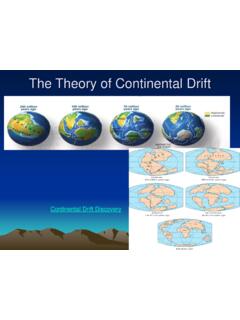
1 Name: Class: Date: LAB: wegener S PUZZLING CONTINENTS Overview: Although Alfred wegener was not the first to suggest that CONTINENTS have moved about the Earth, his presentation of carefully compiled evidence for continental drift inspired decades of scientific debate. wegener 's evidence, in concert with compelling evidence provided by post World War II technology, eventually led to universal acceptance of the theory of Plate Tectonics in the scientific community Objectives: Students will observe and analyze scientific evidence used by wegener . Students will read and interpret maps and map symbols. Students will use the evidence to try to reconstruct the CONTINENTS . Students will interpret the evidence to formulate a hypothesis.
2 Students will defend their position on continental drift. To start this activity the teacher will present background information on wegener . Students will then be placed into groups of 2 to 3 and work to piece together continent cut-outs using this evidence. As students fit the CONTINENTS together they find that isolated pieces of geologic information are no longer isolated. Groups describe what they have found, and must defend their conclusion by explaining how the evidence supports or refutes continental drift. For each student group: Student Map of the World Today Key to wegener 's Evidence sheet Student Puzzle Pieces Crayons or markers Scissors Glue or tape Teacher instructions for activity: Briefly present background on wegener . Stress that although others had recognized the fit of Africa and South America, it was wegener who gathered other scientific data to support his theory.
3 Divide students into groups of two or three. These small groups allow students to discuss the significance of different lines of evidence as they piece together the continental puzzle. Each group is given a cut-out sheet containing fossil evidence (Student Puzzle Pieces), the Key to wegener 's Evidence sheet, the Student Map of the World Today reference sheet, crayons or markers, and a pair of scissors. Groups label the CONTINENTS or land mass on each piece. The students then color each fossil type and the Key to wegener 's Evidence sheet. Then cut out the land masses from the evidence sheets. Have the students arrange the puzzle pieces using the Key to wegener 's Evidence to support their arrangement. The final puzzle configuration should be attached to paper with glue or tape. When finished, each group will present and defend their reconstruction You may compare the students' reconstructions with wegener 's Key to Continental Positions about 250 million years ago (Teacher Copy) Hints for solving the puzzle: Have the students look for all the pieces with the fossil remains of Cynognathus and then put them together (South America and Africa).
4 Then look for fossils that extend beyond the plate boundary such as the fern Glossopteris and the land-dwelling reptile Lystrosaurus. Put all of the CONTINENTS with Glossopteris and Lystrosaurus near each other. Notice how two of the CONTINENTS (Africa and Antartica) have the end regions of Lystrosaurus. Lystrosaurus is the key to solving the puzzle. What happens to the other continent (India) if you put Antartica next to Africa? The students must place India next to Africa to complete the puzzle. You can also use the Puzzle Outline Hint as a base for the puzzles. Assessment suggestions: Students evaluate wegener s hypothesis based on the evidence they observe. Student groups each write a position paper on whether the evidence they researched is compelling and conclusive enough for scientific acceptance of the Theory of Continental Drift.
5 Each group then presents their conclusion as they would at a professional scientific meeting, explaining their research and how they came to this conclusion. Other students are encouraged to ask probing (but polite!) questions. For self-assessment, the teacher may hand out the wegener 's Key to Continental Positions. Name: Class: Date: LAB: wegener S PUZZLING CONTINENTS Directions: 1. Label the land masses on each sheet. Color the fossil areas to match the legend below. 2. Cut out each of the CONTINENTS along the edge of the continental shelf (the outermost dark line). Alfred wegener 's fossil evidence for continental drift is shown on the cut-outs. 3. Try to logically piece the CONTINENTS together so that they form a giant supercontinent.
6 Use wegener s fossil evidence to place them in the correct positions. 4. When you are satisfied with the 'fit' of the CONTINENTS , glue the land masses down on a piece of paper and answer the analysis questions that follow. Key to wegener s PUZZLING Evidence Fossils: The CONTINENTS are surrounded by the continental shelf (stippled pattern), which extends beyond the continent until there is a large change in slope. By about 300 million years ago, a unique community of plants had evolved known as the European flora. Fossils of these plants are found in Europe and other areas. Color the areas with these fossils yellow. Fossils of the fern Glossopteris have been found in these locations. Glossopteris had very heavy seeds that could not move by wind. Color the areas with these fossils green. Fossil remains of the half meter-long fresh water reptile called Mesosaurus.
7 Mesosaurs had limbs for swimming, but could also walk on land. Other evidence suggests that although they lived in water at times, they were not strong swimmers. Color the areas with these fossils blue. Fossil remains of Cynognathus, a land reptile approximately 3 meters long that lived during the Early Mesozoic Era, about 230 million years ago. It was a weak swimmer. Color the areas with these fossils orange. Fossil evidence of the Early Mesozoic, land-dwelling reptile Lystrosaurus. They reproduced by laying eggs on land. In addition, their anatomy suggests that these animals were probably very poor swimmers. Color the areas with these brown. Name: Class: Date: LAB: wegener S PUZZLING CONTINENTS Name: Class: Date: LAB: wegener S PUZZLING CONTINENTS Analysis Questions: 1.
8 Imagine you are Alfred wegener . Write a one- paragraph statement to summarize your work. Your summary must included descriptions on: a. What your map shows about the Earth 225 million years ago (What does the map show?) b. How the fossil evidence helped you to put the landmasses together (What was your process?) c. Why the fossil evidence is good (Why do you think your map is a good one?) 2. Imagine you are a skeptic of Alfred wegener . Write a one-paragraph statement to criticize his work. Your criticism must included challenges about: a. Why the CONTINENTS could NOT possibly move the way wegener is describing b. How the fossils could naturally be located in the places wegener found them, without the CONTINENTS moving c. Why wegener is not qualified to be proposing theories in the fields of geology and Earth history Name: Class: Date: LAB: wegener S PUZZLING CONTINENTS Analysis Questions: 1.
9 Imagine you are Alfred wegener . Write a one- paragraph statement to summarize your work. Your summary must included descriptions on: a. What your map shows about the Earth 225 million years ago (What does the map show?) b. How the fossil evidence helped you to put the landmasses together (What was your process?) c. Why the fossil evidence is good (Why do you think your map is a good one?) 2. Imagine you are a skeptic of Alfred wegener . Write a one-paragraph statement to criticize his work. Your criticism must included challenges about: a. Why the CONTINENTS could NOT possibly move the way wegener is describing b. How the fossils could naturally be located in the places wegener found them, without the CONTINENTS moving c. Why wegener is not qualified to be proposing theories in the fields of geology and Earth history Name: Class: Date: LAB: wegener S PUZZLING CONTINENTS (KEY) Name: Class: Date: LAB: wegener S PUZZLING CONTINENTS (KEY) Analysis Questions: 1.
10 Imagine you are Alfred wegener . Write a one- paragraph statement to summarize your work. Your summary must included descriptions on: a. What your map shows about the Earth 225 million years ago (What does the map show?) b. How the fossil evidence helped you to put the landmasses together (What was your process?) c. Why the fossil evidence is good (Why do you think your map is a good one?) 2. Imagine you are a skeptic of Alfred wegener . Write a one-paragraph statement to criticize his work. Your criticism must included challenges about: a. Why the CONTINENTS could NOT possibly move the way wegener is describing b. How the fossils could naturally be located in the places wegener found them, without the CONTINENTS moving c. Why wegener is not qualified to be proposing theories in the fields of geology and Earth history Name: Class: Date: TEACHER NOTES: Alfred wegener s Story Perhaps Alfred wegener 's greatest contribution to the scientific world was his ability to weave seemingly dissimilar, unrelated facts into a theory, which was remarkably visionary for the time.