Transcription of Lambda-cyhalothrin
1 Lambda-cyhalothrin (General Fact Sheet) Please refer to the Technical Fact Sheet for more technical information. What is Lambda-cyhalothrin ? $ Lambda-cyhalothrin is an insecticide registered by the Environmental Protection Agency (EPA) in 1988 (1). $ Lambda-cyhalothrin belongs to a group of chemicals called pyrethroids. Pyrethroids are manmade chemicals that are similar to the natural insecticides pyrethrins. Scientists developed pyrethroid insecticides to have properties better than those of the pyrethrins (2). $ Lambda-cyhalothrin is similar to the pyrethroid cyhalothrin (2, 3). Due to their similarity, researchers sometimes use toxicity tests conducted with cyhalothrin to evaluate the toxicity of Lambda-cyhalothrin (3). $ Lambda-cyhalothrin is a colorless to beige solid that has a mild odor. It has a low water solubility and is nonvolatile (2, 4). $ Signal words for products containing Lambda-cyhalothrin range from Caution to Danger (5). The signal word reflects the combined toxicity of Lambda-cyhalothrin and other ingredients in each product.
2 See the Pesticide Label box above. $ Lambda-cyhalothrin products come in various forms including powders, pellets, liquids, small capsules, and ear tags containing the chemical (5). How does Lambda-cyhalothrin work? $ Pyrethroids, including Lambda-cyhalothrin , disrupt the normal functioning of the nervous system in an organism (2). By disrupting the nervous system of insects, Lambda-cyhalothrin may cause paralysis or death (4). Temperature influences insect paralysis and the toxicity of Lambda-cyhalothrin (6). $ Lambda-cyhalothrin affects a variety of indoor and outdoor insects when they eat or touch the chemical (4). $ Lambda-cyhalothrin has properties that may repel insects (4). NPTN General Fact Sheets are designed to answer questions that are commonly asked by the general public about pesticides that are regulated by the Environmental Protection Agency ( EPA). This document is intended to be helpful to professionals and to the general public for making decisions about pesticide use.
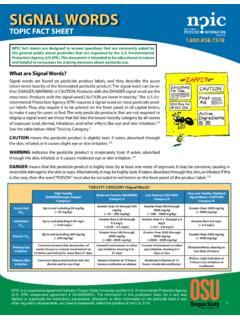
3 The Pesticide Label: Labels provide directions for the proper use of a pesticide product. Be sure to read the entire label before using any product. A signal word on each product label indicates the product s potential hazard. CAUTION - low toxicity WARNING - moderate toxicity DANGER - high toxicity Exposure: Effects of Lambda-cyhalothrin on human health and the environment depend on how much Lambda-cyhalothrin is present and the length and frequency of exposure. Effects also depend on the health of a person and/or certain environmental factors. This fact sheet was created in 2001; some of the information may be out-of-date. NPIC is not planning to update this fact sheet. More pesticide fact sheets are available here. Please call NPIC with any questions you have about pesticides at 800-858-7378, Monday through Friday, 8:00 am to 12:00 pm PST. What types of products contain Lambda-cyhalothrin ? $ Agricultural insecticides for food and non-food crops $ Insecticides used indoors and outdoors for homes, hospitals, and other buildings $ Greenhouse, ornamental plant, and lawn insecticides $ Insecticide products for use on cattle $ Termite treatments $ Insecticide products for use on rights-of-way $ Aerially-applied insecticides $ What are some products that contain Lambda-cyhalothrin ?
4 $ Demand $ Karate $ Warrior How toxic is Lambda-cyhalothrin ? Animals $ When eaten, Lambda-cyhalothrin is highly toxic to mice and moderately toxic to rats (2). See boxes on Laboratory Testing, LD50/LC50, and Toxicity Category. $ A Lambda-cyhalothrin product is moderately toxic when inhaled (1). $ Lambda-cyhalothrin is moderately toxic when applied to the skin of rats (2). $ In skin irritation studies, Lambda-cyhalothrin caused no skin irritation in rabbits (2). The EPA classifies Lambda-cyhalothrin as very low in toxicity for skin effects (3). $ Lambda-cyhalothrin causes mild eye irritation in rabbits (2). The EPA categorizes Lambda-cyhalothrin as moderately toxic for eye effects (3). $ Guinea-pigs exposed to Lambda-cyhalothrin show no signs of skin sensitivity (2). $ Investigators fed rats Lambda-cyhalothrin for 90 days and at the highest dose detected lower body weight gains in both male and female rats. Investigators did not detect adverse effects at lower doses (2, 3).
5 $ Researchers fed dogs Lambda-cyhalothrin for 1 year and observed symptoms of toxicity at the highest dose (2). Laboratory Testing: Before pesticides are registered by the EPA, they must undergo laboratory testing for short-term (acute) and long-term (chronic) health effects. Laboratory animals are purposely fed high enough doses to cause toxic effects. These tests help scientists judge how these chemicals might affect humans, domestic animals, and wildlife in cases of overexposure. When pesticide products are used according to the label directions, toxic effects are not likely to occur because the amount of pesticide that people and pets may be exposed to is low compared to the doses fed to laboratory animals. LD50/LC50: A common measure of acute toxicity is the lethal dose (LD50) or lethal concentration (LC50) that causes death (resulting from a single or limited exposure) in 50 percent of the treated animals.
6 LD50 is generally expressed as the dose in milligrams (mg) of chemical per kilogram (kg) of body weight. LC50 is often expressed as mg of chemical per volume ( , liter (L)) of medium ( , air or water) the organism is exposed to. Chemicals are considered highly toxic when the LD50/LC50 is small and practically non-toxic when the value is large. However, the LD50/LC50 does not reflect any effects from long-term exposure ( , cancer, birth defects, or reproductive toxicity) that may occur at levels below those that cause death. Toxicity Category Toxicity Category (Signal Word) (7) High Toxicity (Danger) Moderate Toxicity (Warning) Low Toxicity (Caution) Very Low Toxicity (Caution) Oral LD50 Less than 50 mg/kg 50 - 500 mg/kg 500 - 5000 mg/kg Greater than 5000 mg/kg Dermal LD50 Less than 200 mg/kg 200 - 2000 mg/kg 2000 - 5000 mg/kg Greater than 5000 mg/kg Inhalation LC50 Less than mg/l - mg/l - 2 mg/l Greater than 2 mg/l Eye Effects Corrosive Irritation persisting for 7 days Irritation reversible within 7 days Minimal effects, gone within 24 hrs Skin Effects Corrosive Severe irritation at 72 hours Moderate irritation at 72 hours Mild or slight irritation $ Rats inhaling Lambda-cyhalothrin for 21 days at the highest dose displayed lower body weight gains for males and decreased food consumption for both male and female rats.
7 Researchers observed the following symptoms of toxicity: paw flicking, erect tails, altered walking, eye tearing, and salivation (3). $ Scientists exposed the skin of rats for 21 days to Lambda-cyhalothrin . Two male rats died after 3 applications at the highest dose. No cause of death was determined, but scientists proposed a link to Lambda-cyhalothrin exposure. The highest dose was reduced, and at the reduced dose, scientists detected symptoms of toxicity in the rats and decreased body weight gain and food consumption in male rats. They did not detect effects at lower doses (3). Humans $ Individuals working with Lambda-cyhalothrin in laboratories reported symptoms of facial tingling and burning sensations. Symptoms began within 30 minutes of exposure and lasted for 6 hours to 2 days. All incidents involved people handling relatively pure or concentrated Lambda-cyhalothrin (2). $ Four field workers out of 38 reported adverse health effects from exposure to Lambda-cyhalothrin .
8 Three of the workers reported skin irritation or burning sensations that developed 45-60 minutes after exposure and lasted for 5, 18, and 72 hours. The other worker experienced a skin rash that developed 24 hours after exposure and lasted several days. All workers handled concentrated Lambda-cyhalothrin , and three of the four applied diluted solutions (2). $ Lambda-cyhalothrin may cause irritation to the skin, throat, nose, and other body parts if exposed. Skin tingling, burning, and prickling feelings, particularly around the face, are unique temporary symptoms of exposure. Other symptoms may include dizziness, headache, nausea, lack of appetite, and fatigue. In severe poisonings, seizures and coma may occur (8). Does Lambda-cyhalothrin break down and leave the body? Animals $ Rats exposed to cyhalothrin absorbed approximately half of the dose. Researchers detected the chemical in both urine and feces (2). $ Scientist observed that cyhalothrin is extensively broken down in many different types of mammals (2).
9 Humans $ Human data are not available regarding the break down and excretion of Lambda-cyhalothrin . Does Lambda-cyhalothrin cause reproductive or birth defects? Animals $ Researchers fed rats cyhalothrin for three generations and did not detect any effects on fertility. At the highest dose, they noted decreased body weights and body weight gains in adult and offspring rats but no signs of nervous system effects. Researchers detected no effects at lower doses (2, 3). $ Researchers exposed pregnant rats to cyhalothrin and observed no effects on fetal development. At the highest dose, they detected decreased body weight gain and food consumption for mother rats. Mother rats exhibited no effects at lower doses (2, 3). $ In a developmental study, scientists exposed pregnant rabbits to cyhalothrin and observed no effects to fetal development. At the highest dose, they found decreased body weight gain and food consumption in mother rats.
10 Scientists did not detect effects to mother rats at lower doses (2, 3). Humans $ Data are not available from accidental poisonings, work-related exposures, or other human studies regarding the reproductive and developmental toxicity of Lambda-cyhalothrin . Does Lambda-cyhalothrin cause cancer? Animals $ Laboratory workers fed rats cyhalothrin for 2 years and noted no evidence of carcinogenicity in the study. Workers did observe decreased body weight gain and altered blood chemistry at the highest dose. They did not find effects at lower doses (2, 3). $ Researchers fed mice cyhalothrin for 2 years and at the two highest doses detected an increased frequency in mammary tumors in female mice. The frequency of tumors was not related to the cyhalothrin dose, and the tumor frequency was comparable to that normally observed in the type of mouse studied. Due to the unclear results, cancer could not be linked to cyhalothrin (2, 3). $ Researchers often test chemicals for their ability to change the genetic material of an organism as an indication of the chemical s potential to cause cancer.