Transcription of Learn Present Perfect and Present Perfect Continuous ...
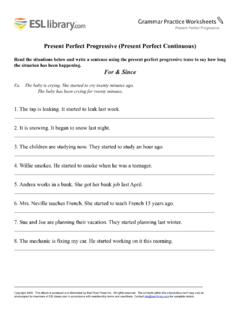
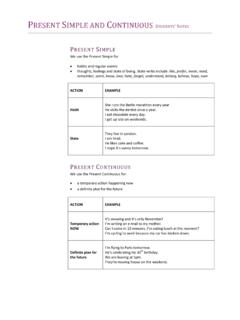
1 Present PerfectPresent Perfect Continuous Have you ever seen a woolly mammoth? You ve never seen a real mammoth. I have learned a lot about animals. She has written two books about wildlife. We have never gone to that wildlife sanctuary. They have read books about elephants. People have been exploiting elephants for many years. I have been learning about elephants this week in school. He has been writing a new book about elephants. We have been going to the wildlife sanctuary every Saturday. They have been reading about elephants for their wildlife Present Perfect and Present Perfect ContinuousTipyou have = you vethey have = they veI have = I veshe has = she she has = he swe have = we veSimple PresentThe lion eats the ContinuousThe lion is eating the pastThe lion ate the perfectThe lion has eaten the Review of TensesTiphas not = hasn thave not = haven tOxford Discover Online Practice Oxford University Press 2014 PastPresentFuture Last Tuesday, my gums were fine, and I could eat everything.
2 My teeth hurt and I couldn t eat anything. Today, my gums feel better, so now I can chew. I can t chew hard foods today because my gums hurt. Tomorrow, my gums will be fine, and I will be able to eat almost everything. I won t be able to eat nuts until my mouth feels Modals of Ability Your gums are swollen. That must hurt. (You know something is true.) You might have a cavity. Your teeth have been hurting all day. It can t feel good to have a toothache! (You know something is not possible.) Learn Modals of Certainty Must, Has to, Can t and MightOxford Discover Online Practice Oxford University Press 2014 WillGoing toFuture Plan The train will leave at 2:59 Plan They are going to increase the number of bikes to 175,000 by about things you believe City officials think the number of bikes will increase by 50%.
3 Prediction about things you can see I m late. I m going to miss the Future with Will and Going toWill (future facts and predictions about things you believe) It will be dark soon. Will the sun set at 6:00? Yes, it to (future plans and predictions about things you can see) I m going to write about a bicycle carrier. Are you going to draw a picture? No, I m not. I m going to paint. Present Continuous (future arrangements) You re riding home on the cart. Are you coming with me? Yes, I Future with Present ContinuousOxford Discover Online Practice Oxford University Press 2014 Direct SpeechReported Speech We can t help, cried brother said that we couldn t help. I need to go to the store, she said that she needed to go to the Reported Speech with Said ThatDirect SpeechReported Speech Bees are communicating by dancing, he said that bees were communicating by asked, How do bees know where to find the flowers?
4 People asked how bees knew where to find the flowers. Bees are doing a dance, the scientist told them. The scientist told them that bees were doing a Reported Speech: Told and AskedOxford Discover Online Practice Oxford University Press 2014 QuestionAnswerWho as subjectWho performs the dance? The dancers perform the dance. Who as objectWho do the dancers perform for?The dancers perform for the audience. Other question wordsWhatWhat is the Dance of the Flyers?It s a cultural is it performed?It s performed in Mexico and was the first dance performed?It was performed in ancient Asking QuestionsAre you ready?Yes, I am. No, I m you know what s next?Yes, I do. No, I don it ready yet?Yes, it , it isn Short AnswersOxford Discover Online Practice Oxford University Press 2014 ActivePassivePeople cut down trees.
5 Subject objectScientists measure the groups educate are cut down. subjectThe mountain is measured. People are PassivePresent ActivePeople call the mountain Mount PassiveThe mountain is called Mount ActivePeople called the mountain Mount PassiveThe mountain was called Mount Past Passive Oxford Discover Online Practice Oxford University Press 2014 Learn Adjectives and AdverbsThe delicate design was so beautiful. adjective nounHe thought the crowd was a bit terrifying! noun adjectiveA man rudely pushed in front of him. adverb verbThe man started speaking aggressively to the vendor. verb adverbThey had often visited Madrid, but they had never been to the coin market.
6 Adverb of frequency verb adverb of frequency verbLearn Unreal ConditionalI would buy a boat if I had a lot of I had a lot of money, I wouldn t spend it all at one time. If you were far away, the salt would be worth more. The salt bars would be worth less if you were close to a salt not = wouldn tshe would = she dhe would = he d If I had a lot of money, (with comma) I would buy a house. past tense verb phrase base verb I would buy a house (without comma) if I had a lot of money. base verb past tense verb phraseOxford Discover Online Practice Oxford University Press 2014 Learn Sense Verb + AdjectiveSense verbs look, sound, feel, taste , smell. The sculptures look delicate, but they are actually very strong.
7 Sense verb adjectiveWhen you hear the Strandbeests, they sound gentle. sense verb adjective I feel sickly. I feel sick. She looked beautifully. She looked Infinitive as SubjectIt is (It s) + difficult + to create the sets. It was adjective infinitive as subjectCreating the sets + is + difficult. wasWorking on the sets is is challenging to build isn t easy to write a a novel is hard Discover Online Practice Oxford University Press 2014 First the architect needs to make a design. Then the design needs to be approved. first time second timeAn approval is important. third timeHow is a green building made? one of manyIt s good for the environment. something knownNo ArticleI love to play basketball.
8 SportsIt s time for lunch. mealI am very good at math. school subjectThere are many temples in Thailand. most countriesLearn A, An, The, and No ArticleCountries with article thethe United Statesthe United Kingdomthe United Arab Emiratesthe Netherlands the PhilippinesOxford Discover Online Practice Oxford University Press 2014 Past Arianwen looked out the car window. You were telling me your plan when my phone rang. Castles were built long I like lighthouses and windmills. We are planning to build a We are going to have animals here. Our castle will be an animal Review of Tenses and Future FormsOxford Discover Online Practice Oxford University Press 2014