Transcription of Learning Spatio-Temporal Transformer for Visual Tracking
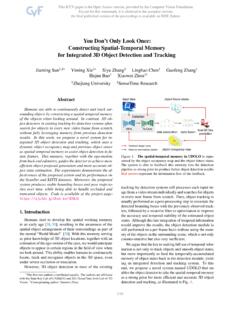
1 Learning Spatio-Temporal Transformer for Visual TrackingBin Yan1, , Houwen Peng2, , Jianlong Fu2, Dong Wang1, , Huchuan Lu11 Dalian University of Technology2 Microsoft Research AsiaAbstractIn this paper, we present a new Tracking architecturewith an encoder-decoder Transformer as the key compo-nent. The encoder models the global Spatio-Temporal fea-ture dependencies between target objects and search re-gions, while the decoder learns a query embedding to pre-dict the spatial positions of the target objects. Our methodcasts object Tracking as a direct bounding box predictionproblem, without using any proposals or predefined an-chors. With the encoder-decoder Transformer , the predic-tion of objects just uses a simple fully-convolutional net-work, which estimates the corners of objects directly.
2 Thewhole method is end-to-end, does not need any postprocess-ing steps such as cosine window and bounding box smooth-ing, thus largely simplifying existing Tracking pipelines. Theproposed tracker achieves state-of-the-art performance onmultiple challenging short-term and long-term benchmarks,while running at real-time speed, being6 faster thanSiam R-CNN [54]. Code and models are open-sourced IntroductionVisual object Tracking is a fundamental yet challeng-ing research topic in computer vision. Over the past fewyears, based on convolutional neural networks, object track-ing has achieved remarkable progress [28, 11, 54]. How-ever, convolution kernels are not good at modeling long-range dependencies of image contents and features, becausethey only process a local neighborhood, either in space ortime.
3 Current prevailing trackers, including both the offlineSiamese trackers and the online Learning models, are almostall built upon convolutional operations [2, 44, 3, 54]. As aconsequence, these methods only perform well on model-ing local relationships of image content, but being limitedto capturing long-range global interactions. Such deficiencymay degrade the model capacities for dealing with the sce-narios where the global contextual information is important Work performed when Bin Yan was an intern of MSRA. Corresponding authors: Houwen Peng Wang Figure 1: Comparison with state-of-the-arts on LaSOT [15].
4 Wevisualize the Success performance with respect to the Frames-Per-Seconds (fps) Tracking speed. The circle size indicates a weightedsum of the tracker s speed (x-axis) and success score (y-axis). Thelarger, the better. Ours-ST101 and Ours-ST50 indicate the pro-posed trackers with ResNet-101 and ResNet-50 as backbones, re-spectively. Better viewed in localization, such as the objects undergoing large-scalevariations or getting in and out of views problem of long-range interactions has been tackledin sequence modeling through the use of Transformer [53]. Transformer has enjoyed rich success in tasks such asnatural language modeling [13, 46] and speech recogni-tion [40]. Recently, Transformer has been employed in dis-criminative computer vision models and drawn great atten-tion [14, 5, 41].
5 Inspired by the recent DEtection TRans-former (DETR) [5], we propose a new end-to-end trackingarchitecture with encoder-decoder Transformer to boost theperformance of conventional convolution spatial and temporal information are important forobject Tracking . The former one contains object appearanceinformation for target localization, while the latter one in-cludes the state changes of objects across frames. PreviousSiamese trackers [28, 59, 16, 7] only exploit the spatial in-formation for Tracking , while online methods [63, 66, 11, 3]use historical predictions for model updates. Although be-ing successful, these methods do not explicitly model therelationship between space and time. In this work, consider-ing the superior capacity on modeling global dependencies,we resort to Transformer to integrate spatial and temporal10448information for Tracking , generating discriminative Spatio-Temporal features for object specifically, we propose a new Spatio-Temporal ar-chitecture based on the encoder-decoder Transformer forvisual Tracking .
6 The new architecture contains three keycomponents: an encoder, a decoder and a prediction encoder accepts inputs of an initial target object, thecurrent image, and a dynamically updated template. Theself-attention modules in the encoder learn the relation-ship between the inputs through their feature the template images are updated throughout video se-quences, the encoder can capture both spatial and tempo-ral information of the target. The decoder learns a queryembedding to predict the spatial positions of the target ob- ject . A corner-based prediction head is used to estimatethe bounding box of the target object in the current , a score head is learned to control the updates ofthe dynamic template experiments demonstrate that our method es-tablishes new state-of-the-art performance on both short-term [20, 43] and long-term Tracking benchmarks [15, 25].
7 For instance, our Spatio-Temporal Transformer tracker sur-passes Siam R-CNN [54] by (AO score) and (Success) on GOT-10K [20] and LaSOT [15], is also worth noting that compared with previous long-term trackers [9, 54, 62], the framework of our method ismuch simpler. Specifically, previous methods usually con-sist of multiple components, such as base trackers [11, 57],target verification modules [23], and global detectors [47,21]. In contrast, our method only has a single networklearned in an end-to-end fashion. Moreover, our tracker canrun at real-time speed, being6 faster than Siam R-CNN(30 5fps) on a Tesla V100 GPU, as shown in Fig. 1 Considering recent trends of over-fitting on small-scale benchmarks, we collect a new large-scale trackingbenchmark calledNOTU, integrating all sequences fromNFS [24], OTB100 [58], TC128 [33], and UAV123 [42].
8 In summary, this work has four contributions. We propose a new Transformer architecture dedicatedto Visual Tracking . It is capable of capturing global fea-ture dependencies of both spatial and temporal infor-mation in video sequences. The whole method is end-to-end, does not needany postprocessing steps such as cosine window andbounding box smoothing, thus largely simplifying ex-isting Tracking pipelines. The proposed trackers achieve state-of-the-art perfor-mance on five challenging short-term and long-termbenchmarks, while running at real-time speed. We construct a new large-scale Tracking benchmark toalleviate the over-fitting problem on previous small-scale Related WorkTransformer in Language and originally proposed by Vaswaniet al.
9 [53] for machinetranslation task, and has become a prevailing architecture inlanguage modeling. Transformer takes a sequence as the in-put, scans through each element in the sequence and learnstheir dependencies. This feature makes Transformer be in-trinsically good at capturing global information in sequen-tial data. Recently, Transformer has shown their great po-tential in vision tasks like image classification [14], objectdetection [5], semantic segmentation [56], multiple objecttracking [51, 41], etc. Our work is inspired by the recentwork DETR [5], but has following fundamental differences.(1) The studied tasks are different. DETR is designed forobject detection, while this work is for object Tracking . (2)The network inputs are different. DETR takes the wholeimage as the input, while our input is a triplet consisting ofone search region and two templates.
10 Their features fromthe backbone are first flattened and concatenated then sentto the encoder. (3) The query design and training strate-gies are different. DETR uses 100 object queries and usesthe Hungarian algorithm to match predictions with ground-truths during training. In contrast, our method only uses onequery and always matches it with the ground-truth withoutusing the Hungarian algorithm. (4) The bounding box headsare different. DETR uses a three-layer perceptron to pre-dict boxes. Our network adopts a corner-based box head forhigher-quality , TransTrack [51] and TrackFormer [41] aretwo most recent representative works on Transformer track-ing. TransTrack [51] has the following features. (1) Theencoder takes the image features of both the current andthe previous frame as the inputs.