Transcription of Learning Styles Inventory - Middlesex Community College
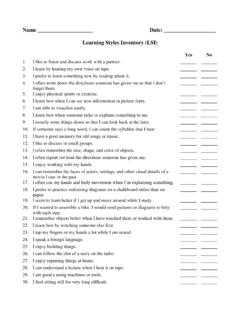
1 Name _____ Date: _____ Learning Styles Inventory (LSI) Yes No 1. I like to listen and discuss work with a partner. _____ _____ 2. I learn by hearing my own voice on tape. _____ _____ 3. I prefer to learn something new by reading about it. _____ _____ 4. I often write down the directions someone has given me so that I don t forget them. _____ _____ 5. I enjoy physical sports or exercise. _____ _____ 6. I learn best when I can see new information in picture form. _____ _____ 7. I am able to visualize easily. _____ _____ 8. I learn best when someone talks or explains something to me.
2 _____ _____ 9. I usually write things down so that I can look back at the later. _____ _____ 10. If someone says a long word, I can count the syllables that I hear. _____ _____ 11. I have a good memory for old songs or music. _____ _____ 12. I like to discuss in small groups. _____ _____ 13. I often remember the size, shape, and color of objects. _____ _____ 14. I often repeat out loud the directions someone has given me. _____ _____ 15. I enjoy working with my hands. _____ _____ 16. I can remember the faces of actors, settings, and other visual details of a movie I saw in the past.
3 _____ _____ 17. I often use my hands and body movement when I m explaining something. _____ _____ 18. I prefer to practice redrawing diagrams on a chalkboard rather than on paper. _____ _____ 19. I seem to learn better if I get up and move around while I study. _____ _____ 20. If I wanted to assemble a bike, I would need pictures or diagrams to help with each step. _____ _____ 21. I remember objects better when I have touched them or worked with them. _____ _____ 22. I learn best by watching someone else first. _____ _____ 23. I tap my fingers or my hands a lot while I am seated. _____ _____ 24.
4 I speak a foreign language. _____ _____ 25. I enjoy building things. _____ _____ 26. I can follow the plot of a story on the radio. _____ _____ 27. I enjoy repairing things at home. _____ _____ 28. I can understand a lecture when I hear it on tape. _____ _____ 29. I am good a using machines or tools. _____ _____ 30. I find sitting still for very long difficult. _____ _____ Yes No 31. I enjoy acting or doing pantomimes. _____ _____ 32. I can easily see pattern in designs. _____ _____ 33. I need frequent breaks to move around. _____ _____ 34. I like to recite or write poetry. _____ _____ 35.
5 I can usually understand people with different accents. _____ _____ 36. I can hear many different pitches or melodies in music. _____ _____ 37. I like to dance and create new movements or steps. _____ _____ 38. I enjoy activities that require physical coordination. _____ _____ 39. I follow written directions better than oral ones. _____ _____ 40. I can easily recognize differences between similar sounds. _____ _____ 41. I like to create or use jingles/rhymes to learn things. _____ _____ 42. I wish more classes had hands-on experiences. _____ _____ 43. I can quickly tell if two geometric shapes are identical.
6 _____ _____ 44. The things I remember best are the things I have seen in print or pictures. _____ _____ 45. I follow oral directions better than written ones. _____ _____ 46. I could learn the names of fifteen medical instruments much easier if I could touch and examine them. _____ _____ 47. I need to say things aloud to myself to remember them. _____ _____ 48. I can look at a shape and copy it correctly on paper. _____ _____ 49. I can usually read a map without difficulty. _____ _____ 50. I can hear a person s exact words and tone of voice days after he or she has spoken to me. _____ _____ 51.
7 I remember directions best when someone gives me landmarks, such as specific buildings and trees. _____ _____ 52. I have a good eye for colors and color combinations. _____ _____ 53. I like to paint, draw, or make sculptures. _____ _____ 54. When I think back to something I once did, I can clearly picture the experience. _____ _____ Jo/02 Scoring Your Profile 1. Ignore the NO answers. Work only with the questions that have a YES answer. 2. For every YES answer, look at the number of the question. Find the number in the following chart and circle that number. 3. When you finish, not all the numbers in the following boxes will be circles.
8 Your answers will very likely not match anyone else s in class. 4. Count the number of circles for the Visual box and write the total on the line. Do the same for the Auditory box and the Kinesthetic box. Visual Auditory Kinesthetic 3, 4, 6, 7, 9, 1, 2, 8, 10, 11, 5, 15, 17, 18, 19, 13, 16, 20, 22, 32 12, 14, 24, 26, 28, 21, 23, 25, 27, 29, 39, 43, 44, 48, 49, 34, 35, 36, 40, 41, 30, 31, 33, 37, 38, 51, 52, 54 45, 47, 50 42, 46, 53 Total: _____ Total: _____ Total: _____ Analyzing Your Scores 1. The highest score indicates your preference. The lowest score indicates your weakest modality.
9 2. If your two highest scores are the same or very close, both of these modalities may be your preference. 3. If all three of your scores are identical, you have truly integrated all three modalities and can work equally well in any of the modalities. 4. Scores that are 10 or higher indicated you use the modality frequently. 5. Scores lower than 10 indicate the modality is not highly used. Most often, it is because you have had limited experience Learning how to use the modality effectively as you learn. In this case, Learning new strategies can strengthen your use of the modality.
10 Common Characteristics of Visual, Auditory, and Kinesthetic Learners The following chart shows common characteristics of each of the three types of learners or Learning Styles . A person does not necessarily possess abilities or strengths in all of the characteristics but may instead specialize in some of the characteristics. Some of this may be due to a person s educational background or background of experiences. For example, an auditory learner may be strong in the area of language skills but may not have had the experience to develop skills with a foreign language or music.