Transcription of Lecture 10 - Redox Titrations
1 Redox Titrations -the oxidation/reduction reaction between analyte and titrant -titrants are commonly oxidizing agents, although reducing titrants can be used -the equivalence point is based upon: Aox + Bred ! Ared + Box Rx n goes to completion after each addition of titrant Potentiometric Titration: Titration reaction: Ce4+ + Fe2+ ! Ce3+ + Fe3+ (1) Reference half-reaction: 2Hg(l) + 2Cl- ! Hg2Cl2(s) + 2e- At the Pt indicator electrode (Indicator half-reaction) Fe3 + e- !Fe2+ E0 = V (2) Ce4+ + e- !
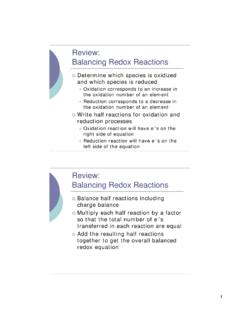
2 Ce3+ E0 = (3) Cell reactions (in 1 M HClO4): 2Fe3+ + 2Hg(l) + 2Cl- !2Fe2+ + Hg2Cl2(s) (4) 2Ce4+ + 2Hg(l) + 2Cl- ! 2Ce3+ + Hg2Cl2(s) (5) Relationships - Cell reactions are not the same as the titration reaction - May describe the cell voltage with either (4) or (5) or both Balancing Redox Reactions Balance: -atoms -# of electrons transferred Example: Cr(s) + Ag+ ! Cr3+ + Ag(s) 1. Write the half reactions: 2. Balance the electrons: 3. Recombine Equilibrium constants for oxidation-reduction reactions Cu(s) + 2Ag ! Cu2+ + 2 Ag(s) Keq = 22]Ag[][Cu++ Galvanic cell: Ecell = Ecathode Eanode = EAg+ - ECu2+ Under equilibrium conditions, the potential of the cell becomes zero, thus can write: Ecell = O = Ecathode Eanode = EAg+ - ECu2+ or Ecathode = Eanode = EAg+ = ECu2+ -Also when in equilibrium, electrode potentials of all systems are identical: EOx1 = EOx2 = EOx3 = EOx4 Where electrode potentials for the four half-reactions Calculating Equilibrium Constants Cu(s) + 2Ag !
3 Cu2+ + 2 Ag(s) E0Ag+ - =+2]Ag[1 E0Cu2+- ]Cu2[1+ E0Ag+ - E0Cu2+ = ]Cu[ ][ +!+Ag = eq22Cu200K log][Ag][ )2(=+=!+++EEAg Ex: Calculate the equilibrium constant: )-2( ]Ag[][CulogKlog22eq=+=+ = Keq = antilog = x 1015 = 4 x 10¹⁵ Redox Titration Curves Fe2 + + Ce4 + ! Fe3+ + Ce3 + ECe4 + = EFe3 + = Esystem EIn = ECe4 + = EFe3 + = Esystem Equivalence Point Potentials Fe3 + e- !Fe2+ Ce4+ + e- !Ce3+ 1. ]4[Ce]3[ ++!+=EE 2. ]3[Fe]2[ ++!+=EE 2]Fe][[Ce]][Fe[Ce0Fe0Ce eq342334++++++!+=EEE (1) Definition of requires that: [Fe3+] = [Ce3+] [Fe2+] = [Ce4+] 2]3Ce][4[Ce]4][Ce3[ eq++++!
4 +++=EEE= 0Fe0Ce34+++EE eqE=2EE03Fe0Ce4++ (2) The Derivation of Titration Curves Titration of mL of M Fe2 + with M Ce4 + in a solution that is M in H2SO4 at all times. Ce4 + + e- !Ce3 + Ef = Fe3 + + e- !Fe2 + Ef = 1. Initial potential Ce and Fe3 + only present in very small amounts. 2. Potential after addition of mL of Ce4 + [Fe3 +]= ]Ce4[ x !+"+ [Fe2 +] = ]Ce[ x - x !++ Substitution into Nernst equation: systemE= + potential +==+++ 3. Potential after addition of mL of Ce4+ [Fe2 +] = amt of Ce4+ left unreacted, therefore added to CCe4 + calculated from the volumes of the two solutions and subtracted from CCe3 + Conc of two cerium ion species: [Ce3 +]= ] x [!
5 +" ][Ce][ ++!+=E=+ = + V Effect of system variables on Redox titration curves Concentration independent of analyte and reagent concentrations. Exception: Electrode potentials dependent upon dilution I!3+2e-!3 I- ]-I[]-[ !=EE num-mol/L3, denom-mol/L Completeness of reaction the change in Esystem in the region becomes larger as the reaction becomes more concentrated. Redox indicators a. specific indicators react with one of the participants in the titration to produce a color, thiocyanate b. Oxidation-reduction indicators- respond to the potential of the system rather than to the appearance or disappearance of some species during the course of the titration, methylene blue Color changes will occur over the range.
6 VoltsnEE) (0 = where n= # of electrons in the indicator half-reaction -larger diff in std potential between titrant and analyte, the sharper the break in the titration curve at the V, best detected potentiometrically Gran plot - more accurate way to use potentiometric data - uses data well before (Ve) to locate Ve For the oxidation of Fe2+ to Fe3 +, the potential prior to Ve is: ref)]Fe[[Felog( '[3]20 EEE!!=++ where, '0E= formal potential for Fe3+ Fe2+ and Eref is the potential of the reference electrode. If vol of analyte = V0 and the vol of titrant = V, and if reaction goes to completion with each addition of titrant.]
7 [Fe2+] / [Fe3+] = (Ve-V) V 10- = Ve10-n(Eref E0 ) - V 10-n(Eref E0 ) y b x m Adjustment of Analyte Oxidation State -before titration, Mn2+ preoxidized to MnO4- -excess preadjustement reagent must be destroyed so that it will not interfere in subsequent titration Preoxidation -powerful oxidants can be removed after preoxidation, peroxydisulfate (S2O82-) requires Ag+ as a catalyst. ++++!+2-4-24 -282 AgSOSOAgOS Excess reagent destroyed: +++!!!!"!+4H2O4 SOO2H 2O2S-24 -282boiling Prereduction -Stannous chloride (SnCl2) will reduce Fe3 + to Fe2 + in hot HCl Excess reductant is then destroyed: Sn2 + + 2 HgCl2 !
8 Sn4 + + HgCl2 + 2 Cl- Oxidation with Potassium Permanganate -strong oxidant, violet color In strongly acidic solutions, reduced to colorless Mn2+: MnO4- + 8H+ + 5e- !Mn2 + + 4 H20 In neutral or alkaline solution, the product is the brown solid, MnO2: MnO4- + 4H+ + 3e- !MnO2(s) + 2H2O In strongly alkaline solution (2 M NaOH), green manganate is produced: MnO4- + e- ! MnO42- Tales below Note: permanganate solutions are unstable, therefore not a primary standard. 4 MnO4- + 2H2O > 4 MnO2 + 4OH- + 3O2 (MnO2 catalyses this reaction) Permanganate must be standardized for example with oxalate; H2C2O4 > 2H+ + CO2 + 2e- Overall.
9 2 MnO4- + 5H2C2O4 + 16H+ > 2Mn2 + + 10CO2 + 8H2O Initially the reaction is slow but is catalyzed by Mn2 + so becomes more rapid. Can also standardize with arsenic (III) oxide As(III) > As(V) + 2e- The reaction of As (III) with permanganate ion takes place without complications in acidic medium if a trace of an iodine compound (for example potassium iodate) is added as a catalyst. The reaction generally carried out in HCl rather than H2SO4 .. in the latter a brown green coloration occurs due to formation of a manganese arsenate compound KMnO4 can serve as own indicator, since product Mn2+ is colorless.
10 Cerium(IV) Strong oxidant > Ce(III) Ce4 + [Yellow ]+ e- > Ce3 + [Colorless] Note however that the color change not good enough for it to act as self indicator. Ce(IV) not found in acid solution as simple aqua ion .. forms complexes. Dichromate reactions Dichromate ion is an oxidizing agent Cr2O72- + 14H+ + 6e- > 2Cr3 + + 7H2O E = + Dichromate has replace permanganate in many analyses .. notably iron (II).. it can be prepared as a standard solution and so avoids the need to standardize as is the case with permanganate. Iodine Methods I2 + 2e- > 2I- E = + Value for E is intermediate can therefore be reduced or can be reduced to iodide by for example As(III), Sn(II) whilst iodide can be oxidized to iodine by for example permanganate.