Example: quiz answers
Lecture 14: Reinforcement Learning
Lecture 14 - May 23, 2017 Case Study: Playing Atari Games 42 Objective: Complete the game with the highest score State: Raw pixel inputs of the game state Action: Game controls e.g. Left, Right, Up, Down Reward: Score increase/decrease at each time step [Mnih et al. NIPS Workshop 2013; Nature 2015]
Tags:
Information
Domain:
Source:
Link to this page:
Documents from same domain

Lecture 9: CNN Architectures
cs231n.stanford.eduLecture 9 - 22 May 2, 2017 ImageNet Large Scale Visual Recognition Challenge (ILSVRC) winners First CNN-based winner. Fei-Fei Li & Justin Johnson & Serena Yeung Lecture 9 - 23 May 2, 2017 ImageNet Large Scale Visual Recognition Challenge (ILSVRC) winners ZFNet: Improved hyperparameters over AlexNet. Fei-Fei Li & Justin Johnson & Serena Yeung ...

Lecture 10: Recurrent Neural Networks
cs231n.stanford.eduimage -> sequence of words. Fei-Fei Li & Justin Johnson & Serena Yeung Lecture 10 - 13 May 4, 2017 Recurrent Neural Networks: Process Sequences e.g. Sentiment Classification sequence of words -> sentiment. Fei-Fei Li & Justin Johnson & Serena Yeung Lecture 10 - 14 May 4, 2017
Fei-Fei Li & Justin Johnson & Serena Yeung Lecture 2 ...
cs231n.stanford.eduFei-Fei Li & Justin Johnson & Serena Yeung Lecture 2 - April 6, 2017 Administrative: Piazza For questions about midterm, poster session, projects,

Convolutional Neural Networks for Visual Recognition
cs231n.stanford.eduProgressive GAN, Karras 2018. Models from Single RGB Images”, ECCV 2018 Beyond recognition: Segmentation, 2D/3D Generation. Fei-Fei Li, Ranjay Krishna, Danfei Xu Lecture 1 - 15 March 30, 2021 Scene Graphs Krishna et al., Visual Genome: Connecting Vision and Language using Crowdsourced Image Annotations, IJCV 2017
Lecture 11: Detection and Segmentation
cs231n.stanford.eduFei-Fei Li & Justin Johnson & Serena Yeung Lecture 11 - 1 May 10, 2017 Lecture 11: Detection and Segmentation

Lecture 13: Generative Models
cs231n.stanford.eduFei-Fei Li & Justin Johnson & Serena Yeung Lecture 13 - May 18, 2017 Generative Models 17 Training data ~ p data (x) Generated samples ~ p model (x) Want to learn p
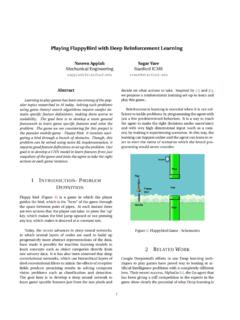
NaveenAppiah SagarVare - Stanford University
cs231n.stanford.eduNaveenAppiah Mechanical Engineering nappiahb@stanford.edu SagarVare Stanford ICME svare@stanford.edu ... the popular mobile game - Flappy Bird. It involves navi-gating a bird through a bunch of obstacles. Though, this ... the game emulator and learns to make good decisions over time. It is this simple learning framework and their

Attention and Transformers Lecture 11
cs231n.stanford.edugraph with shared weights h 0 f W h 1 f W h 2 f W h 3 x 3 y T ... Extract spatial features from a pretrained CNN Image Captioning using spatial features 11 CNN Features: H x W x D h 0 [START] Xu et al, “Show, Attend and Tell: Neural Image Caption Generation with Visual Attention”, ICML 2015 z 0,0 z 0,1 z 0,2 z 1,0 z 1,1 z 1,2 z 2,0 z 2,1 z ...

CNNs for Face Detection and Recognition
cs231n.stanford.edudevelopment of object classification, localization and detec-tion techniques. 2.1. Sliding Window In the early development of face detection, researchers tended to treat it as a repetitive task of object classifica-tion, by imposing sliding windows and performing object classification with the neural networks on the window re-gion.
Vector, Matrix, and Tensor Derivatives
cs231n.stanford.eduErik Learned-Miller The purpose of this document is to help you learn to take derivatives of vectors, matrices, and higher order tensors (arrays with three dimensions or more), and to help you take ... At this point, we have reduced the original matrix equation (Equation 1) …
Related documents
Lecture 13: Generative Models
cs231n.stanford.eduLecture 13 - 33 May 18, 2017 PixelRNN and PixelCNN Improving PixelCNN performance - Gated convolutional layers - Short-cut connections - Discretized logistic loss - Multi-scale - Training tricks - Etc… See - Van der Oord et al. NIPS 2016 - Salimans et al. 2017 (PixelCNN++) Pros: - Can explicitly compute likelihood p(x) - Explicit likelihood ...

Attention is All you Need - NIPS
papers.nips.cc31st Conference on Neural Information Processing Systems (NIPS 2017), Long Beach, CA, USA. Recurrent models typically factor computation along the symbol positions of the input and output sequences. Aligning the positions to steps in computation time, they generate a …

A Unified Approach to Interpreting Model Predictions - NIPS
papers.nips.cc31st Conference on Neural Information Processing Systems (NIPS 2017), Long Beach, CA, USA. 2. We then show that game theory results guaranteeing a unique solution apply to the entire class of additive feature attribution methods (Section 3) and propose SHAP values as …
Neural Discrete Representation Learning
arxiv.org31st Conference on Neural Information Processing Systems (NIPS 2017), Long Beach, CA, USA. arXiv:1711.00937v2 [cs.LG] 30 May 2018 “posterior collapse” issue which has been problematic with many VAE models that have a powerful decoder, often caused by latents being ignored. Additionally, it is the first discrete latent VAE model

2017 NIPS Poster for web
media.nips.ccLONG BEACH CA | DEC 4 - 9 | NIPS.CC NIPS 2017 TUTORIALS - DEC 4TH Statistical Relational Artificial Intelligence: Logic, Probability and Computation Luc De Raedt, David Poole, Kristian Kersting, Sriraam Natarajan Reinforcement Learning with People Emma Brunskill A Primer on Optimal Transport Marco Cuturi, Justin Solomon

Sentence-BERT: Sentence Embeddings using Siamese BERT …
arxiv.org2017). RoBERTa (Liu et al.,2019) showed, that the performance of BERT can further improved by small adaptations to the pre-training process. We also tested XLNet (Yang et al.,2019), but it led in general to worse results than BERT. A large disadvantage of the BERT network structure is that no independent sentence embed-
CatBoost: gradient boosting with categorical features support
learningsys.orgCatBoost: gradient boosting with categorical features support Anna Veronika Dorogush, Vasily Ershov, Andrey Gulin Yandex Abstract In this paper we present CatBoost, a new open-sourced gradient boosting library